
Behavioral Health Staff Turnover: What It Costs—and What It Is Actually Telling You
Recruitment is your first retention strategy. The resignation letter is usually the last data point in a much longer story.
When an employee leaves, organizations tend to move quickly through a familiar sequence:
Express surprise.
Redistribute the work to the people who remain.
Post the same job description that helped create the last problem.
Hire someone as quickly as possible.
Describe the situation as resolved.
Then the replacement leaves six months later and leadership begins an important investigation into why “people do not want to work anymore.”
Efficient.
Behavioral-health staff turnover is expensive, disruptive, and sometimes unavoidable. But when it becomes a pattern, turnover is not merely an HR problem. It is operational data.
It may be telling you that the role was designed poorly. The workload is unrealistic. The manager is inconsistent. The compensation does not match the responsibility. The organization’s promises do not reliably become actions. Employees receive expectations without authority, feedback without support, or consequences without prior clarity.
It may also be telling you that the recruitment process keeps selecting people based on chemistry, urgency, and hope instead of the actual requirements of the work.
The employee’s resignation may be the visible event.
The operating system usually started the conversation much earlier.
Staff turnover is not one number
Before leaders can understand turnover, they need to define it.
At minimum, separate:
Voluntary turnover: Employees who choose to leave.
Involuntary turnover: Employees the organization terminates.
Regrettable turnover: Capable employees the organization wanted to retain.
Non-regrettable turnover: Departures that may improve performance, safety, or team functioning.
Early turnover: Employees who leave during onboarding or the first months of employment.
Role-specific turnover: Departures concentrated within a position, program, location, shift, or supervisor.
The basic turnover formula is:
Turnover rate = employee separations during the period ÷ average employee headcount during the period × 100
That percentage provides a starting point. It does not explain the pattern.
An organization with ten employees and two departures has a 20% turnover rate. But leadership needs to know:
Did the employees resign or get terminated?
Were both departures in the same department?
Did both report to the same manager?
Did they leave within the first 90 days?
Were they difficult to replace?
Did their departures reduce clinical capacity?
Were concerns raised before they left?
Did the organization respond?
A turnover rate tells you how often people leave.
A turnover analysis tells you what the organization should do about it.
Why behavioral-health staff turnover is especially costly
Every organization incurs costs when an employee leaves. Behavioral-health organizations carry additional consequences because staffing is tied directly to access, continuity, licensure, capacity, documentation, safety, and revenue.
The loss is not limited to a job advertisement and several awkward interviews.
Direct replacement costs
These are the expenses leaders are most likely to recognize:
Job-board and advertising fees.
Recruiter or agency fees.
Background checks and screenings.
Credential verification.
Internal HR and leadership time.
Candidate travel or relocation.
Sign-on incentives.
Orientation and training.
Technology, equipment, and account setup.
These costs are visible, which makes them easy to count.
Unfortunately, turnover contains several other costs that are less courteous about identifying themselves on the general ledger.
Lost clinical capacity
When a therapist, prescriber, nurse, technician, admissions professional, or clinical leader leaves, available capacity may decrease immediately.
The organization may experience:
Fewer available appointments.
Longer wait times.
Closed admissions or reduced program census.
Delayed assessments.
Cancelled groups or services.
Payer limitations while a replacement is credentialed.
Reduced ability to accept specific populations or levels of care.
The position may remain “open” on the staffing report while unavailable appointments quietly become a growth problem.
Coverage and workload costs
The work does not leave when the employee does.
It moves.
Remaining employees absorb caseloads, groups, calls, documentation reviews, supervision, admissions, projects, and administrative responsibilities. Leaders may authorize overtime, contractors, temporary coverage, or schedule changes. More often, the team simply performs additional work without a corresponding change in time, support, or compensation.
One departure creates overload. Overload creates another departure. Leadership posts another opening and refers to the pattern as “unexpected.”
Turnover can become self-replicating remarkably quickly.
Ramp-up costs
A new hire does not begin at full productivity on the first day.
They must learn:
The population and programs.
Clinical and operational workflows.
Documentation standards.
The EMR.
Payer requirements.
Scheduling systems.
Team roles.
Safety procedures.
Communication expectations.
The collection of informal workarounds no one remembered to include in orientation.
During the ramp period, the new employee produces less while supervisors and peers spend time training, reviewing, correcting, and answering questions.
That time is necessary. It is also a real operational cost.
Client-continuity costs
Behavioral-health care depends heavily on trust and continuity.
When a clinician leaves, clients may need to repeat difficult information, rebuild a therapeutic relationship, change schedules, or transition to a provider they did not choose. Some disengage. Some discharge early. Some experience a delay in care while the organization finds an appropriate replacement.
Even when transitions are managed thoughtfully, they require communication, clinical judgment, and coordination.
“Your therapist no longer works here, but good news—we found someone with an opening Thursday” is not continuity planning.
Quality, documentation, and compliance costs
Staffing transitions increase the risk of:
Late or incomplete documentation.
Missed handoffs.
Unclear case ownership.
Interrupted treatment planning.
Inconsistent supervision.
Authorization gaps.
Training errors.
Policy deviations.
Reduced audit readiness.
Turnover does not automatically create a quality problem. Poorly managed turnover does.
Leadership and opportunity costs
Managers spend time covering work, screening candidates, interviewing, negotiating, onboarding, rebuilding schedules, responding to staff concerns, and explaining the transition to clients and partners.
That time comes from somewhere.
Program development slows. Quality projects pause. Performance conversations get delayed. Strategic work becomes the thing leadership plans to resume immediately after the next emergency.
The organization pays for the vacancy twice: once through the missing employee and again through the work leaders cannot complete while replacing them.
Cultural and recruiting costs
Employees watch how departures happen.
Was the person treated fairly? Did leadership communicate honestly? Was the team given meaningful support, or simply told to “pull together”? Did anyone acknowledge the increased workload? Were the problems that contributed to the departure addressed—or reassigned to the replacement?
Candidates also notice instability. Repeated openings, inconsistent explanations, rushed interviews, negative reviews, and unclear job expectations make recruiting harder. The organization may need more time or money to attract a qualified candidate.
Turnover is not only an internal event. Eventually, it becomes part of the employer brand.
Calculate the real cost instead of borrowing a dramatic statistic
Turnover articles frequently claim that replacing an employee costs a precise percentage of salary. Those estimates vary widely because jobs, markets, programs, and cost definitions vary widely.
Do not borrow a national percentage and present it as your organization’s truth.
Calculate your own.
A practical turnover-cost model
For each vacancy, estimate:
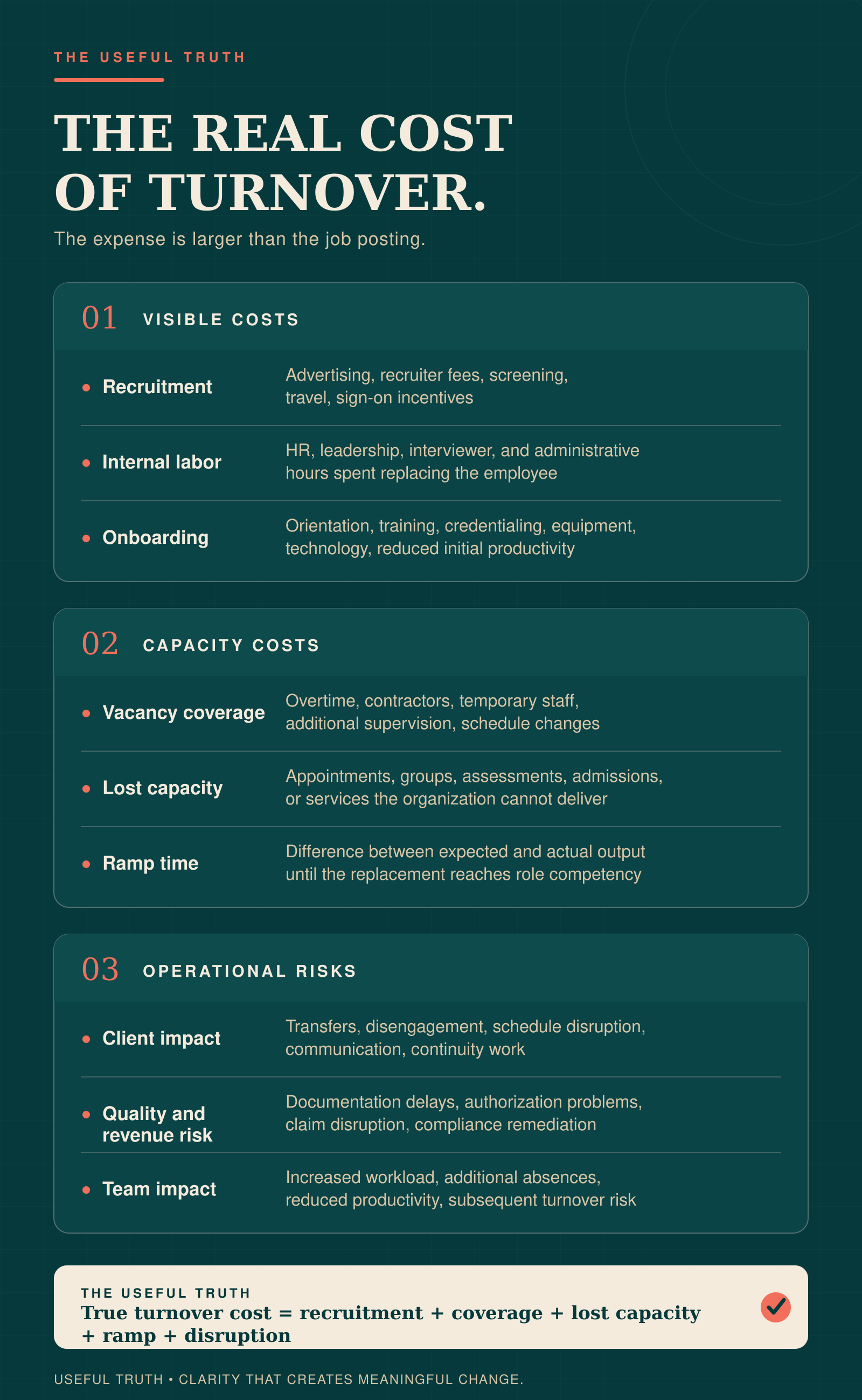
Some consequences cannot be converted credibly into dollars. Record them anyway.
An early client discharge, a delayed safety review, the loss of a trusted referral relationship, or another employee reaching burnout may not arrive with a convenient invoice. They still belong in the decision.
The purpose is not to produce a terrifying number for a leadership retreat.
The purpose is to compare the cost of preventable turnover with the cost of fixing what is causing it.
The workforce is already constrained
Behavioral-health organizations are recruiting inside a limited labor market. A 2025 federal workforce brief reported that approximately 40% of the U.S. population lived in a designated Mental Health Professional Shortage Area as of December 2, 2025, and projected substantial future shortages across several behavioral-health professions. Read HRSA’s State of the Behavioral Health Workforce, 2025.
That means repeated preventable turnover is not merely expensive. It weakens access in a market where qualified capacity is already difficult to replace.
The organization cannot control the national workforce supply.
It can control whether its own recruitment and operating practices make qualified people want to join, succeed, and remain.
Recruitment is your first retention strategy
Retention does not begin at the employee’s annual review.
It begins before the job is posted.
The recruitment process establishes the first expectations about how the organization communicates, makes decisions, respects time, defines work, and follows through. Candidates experience the employer before they become employees.
If the process is confusing, delayed, inconsistent, or misleading, the organization is already demonstrating part of its culture.
Define the job before looking for a person
Many organizations recruit for a title rather than a role.
They post a generic description containing every task the department has ever needed, request a candidate who is “flexible,” and postpone the question of what the person will actually own until after hire.
Before recruiting, define:
The outcomes the role exists to produce.
Core responsibilities.
Decision authority.
Reporting relationship.
Schedule and location expectations.
Clinical or operational capacity.
Required credentials and competencies.
Performance and quality measures.
Work that explicitly does not belong to the role.
Compensation range and advancement path.
Conditions required for success.
If three leaders describe the same opening differently, do not interview candidates yet.
The vacancy is not ready.
Give candidates a realistic view of the work
Recruitment is not the time to market the organization past the point of accuracy.
Candidates should understand:
The population and acuity.
Expected caseload or clinical availability.
Group, on-call, or crisis responsibilities.
Documentation standards.
Schedule requirements.
Supervision structure.
Productivity and quality expectations.
Current operational challenges.
Available tools and support.
What success should look like during the first 90 days.
Do not describe a chaotic role as “fast-paced” and hope the employee appreciates the branding.
An honest preview may cause some candidates to decline. That is not a recruitment failure. It is a mismatch prevented before payroll, clients, and coworkers had to experience it.
Use a structured interview
Hiring decisions often rely too heavily on conversational chemistry.
The candidate is warm. The conversation flows. Everyone has worked at a similarly named company. The panel leaves the interview feeling excellent and later realizes no one assessed whether the candidate can perform the job.
A structured interview gives each candidate a consistent opportunity to demonstrate relevant competencies. The U.S. Office of Personnel Management’s structured-interview guidance recommends beginning with a job analysis, identifying the competencies required, asking candidates the same job-related questions, and using a common rating scale. Its guidance notes that structure improves consistency and reduces the subjectivity associated with unstructured interviews. Review OPM’s Structured Interviews: A Practical Guide.
For a behavioral-health role, assess competencies such as:
Clinical or technical judgment.
Boundaries.
Documentation discipline.
Communication.
Response to feedback.
Conflict management.
Prioritization.
Client safety.
Reliability.
Cross-functional collaboration.
Ask for specific examples of what the candidate did, why, and what happened next.
“Tell us about yourself” is a pleasant opening. It is not a selection system.
Use a relevant work sample when appropriate
For roles involving writing, analysis, scheduling, leadership, clinical reasoning, or workflow ownership, a short realistic exercise can provide useful evidence.
Examples include:
Drafting a response to a client or referral scenario.
Prioritizing several operational problems.
Reviewing a de-identified schedule for capacity issues.
Explaining how the candidate would handle a documentation concern.
Creating a brief 30-day plan.
Facilitating a sample training or case discussion.
The task should be limited, relevant, respectful of the candidate’s time, and never disguised free labor.
The goal is not to see whether the candidate can produce a complete consulting engagement before receiving dental insurance.
It is to observe how they think and work.
Score evidence before discussing preference
Create a scorecard before the interviews begin. Rate candidates against the same competencies and role requirements.
Have interviewers record evidence before the group discussion. Otherwise, the most senior or enthusiastic person in the room may determine the interpretation for everyone else.
Compare:
Evidence of required competencies.
Relevant experience.
Work-sample quality.
Role and schedule alignment.
Support or training needs.
Compensation alignment.
Risks that require clarification.
“I just have a good feeling” is not useless information.
It is simply not enough information to build a staffing decision around.
Respect candidates during the process
Behavioral-health organizations cannot claim to value people while treating applicants as disposable.
Provide:
A clear timeline.
Honest compensation information.
Interview preparation details.
Prompt communication.
Reasonable scheduling.
Accurate descriptions of next steps.
Closure when the organization decides not to proceed.
A candidate who receives three enthusiastic interviews followed by six weeks of silence has learned something about the organization.
It may not be the employer-brand lesson leadership intended to deliver.
Onboarding is where recruitment promises become testable
The hiring process describes the job.
Onboarding reveals whether the description was true.
New employees need more than forms, passwords, policy acknowledgments, and a cheerful tour of the break room.
A defensible onboarding plan should include:
A written first-week schedule.
Required systems and access before the employee needs them.
Role-specific workflows.
Documentation and quality expectations.
Safety and escalation procedures.
Named trainers and supervisors.
Shadowing and observation.
A graduated caseload or workload.
Weekly check-ins during the initial period.
30-, 60-, and 90-day outcomes.
Clear opportunities to ask questions and identify barriers.
Do not give someone a full caseload, two incomplete login credentials, and a calendar invitation titled CHECK IN SOMETIME NEXT MONTH.
That is not independence.
It is organizational hide-and-seek.
What repeated turnover is actually telling you
Turnover is a lagging indicator. By the time a resignation arrives, the conditions that produced it may have existed for months.
The pattern may be pointing to one or more of the following.
1. The role was never designed clearly
Employees cannot consistently succeed in a job whose priorities change depending on which leader is asking.
Warning signs include:
Conflicting instructions.
Expanding responsibilities without revised scope.
Unclear decision authority.
Performance measures unrelated to the actual work.
Accountability without tools or access.
Chronic “other duties as assigned” becoming the primary job.
When several people fail in the same position, review the position before concluding the organization has an extraordinary ability to attract uniquely disappointing humans.
2. The workload is mathematically impossible
Caseload, documentation, meetings, supervision, crisis response, care coordination, and administrative work all consume time.
If expectations require more hours than the role contains, employees will compensate through unpaid labor, shortcuts, delayed work, or eventual departure.
The U.S. Surgeon General identifies excessive workloads, administrative burdens, limited influence over scheduling, and insufficient organizational support as workplace contributors to health-worker burnout. The advisory treats burnout as an organizational and systems issue, not merely a personal resilience problem. Read the Surgeon General’s guidance on health-worker burnout.
People do not stop burning out because the organization adds a meditation link to the employee newsletter.
Workload is an operating model. Measure it.
3. Managers are not creating clarity or safety
Employees need to know:
What is expected.
How performance is evaluated.
Where to escalate concerns.
Whether feedback will be addressed fairly.
Whether leadership commitments can be trusted.
Managers who avoid difficult conversations allow resentment and confusion to grow. Managers who deliver only criticism create fear. Managers who punish disagreement teach employees to withhold information until the exit interview—where leadership finally asks for honesty approximately six months too late.
The first honest conversation should not occur after the employee has accepted another job.
4. Compensation is misaligned—or commitments are unreliable
Compensation is not the only reason employees leave.
It is still a reason.
Review market alignment, internal equity, workload, credentials, leadership responsibility, schedule burden, benefits, and advancement. Then examine whether the organization follows through on what it promises.
An employee may tolerate a temporary constraint when leadership communicates honestly and keeps its commitments. Repeated assurances without action create a different message:
Your work is valuable enough to praise, but not valuable enough to honor.
Praise remains surprisingly difficult to use for a mortgage payment.
5. Employees do not see a future
Capable employees want to know whether strong work leads anywhere.
That does not always mean a management title. Growth can include:
Increased compensation.
Specialty training.
Advanced clinical responsibility.
Program ownership.
Mentorship.
Schedule flexibility.
Leadership development.
Greater autonomy.
Recognition connected to meaningful contribution.
If the organization asks employees to grow while keeping their role, authority, and compensation permanently unchanged, the employee may eventually pursue development somewhere else.
6. The organization’s stated values are not operational
Employees notice the difference between what the organization says and what it does.
The website may emphasize compassion, integrity, safety, and transparency. Employees experience whether concerns are investigated, decisions are explained, workloads are addressed, commitments are honored, and people are treated fairly when situations become difficult.
Culture is not the values page.
Culture is what happens after someone raises a problem leadership does not want to hear.
7. The organization keeps hiring for the wrong thing
Repeated early turnover may indicate that recruitment is screening for availability instead of fit.
The organization may be selecting candidates who interview well but lack a critical competency, or rejecting strong candidates because they communicate differently from current leaders. It may be overselling the role, rushing references, skipping work samples, or changing expectations after the employee begins.
If the role repeatedly surprises the people hired to perform it, the surprise belongs to the recruitment process—not the employee.
Not all turnover is bad
Retention should not become an excuse to avoid performance management.
Some turnover protects clients, staff, quality, and culture. Organizations should act when employees repeatedly violate standards, fail to perform essential responsibilities, resist support, or create safety concerns.
The difference is whether the process is fair and evidence-based.
Before an involuntary separation, when circumstances reasonably allow, the employee should understand:
The expected standard.
The observed gap.
Why the gap matters.
What must change.
What support is available.
When progress will be reviewed.
The consequence if improvement does not occur.
Unexpected terminations sometimes happen for legitimate reasons. “We never gave feedback because the employee should have known” is rarely one of the stronger ones.
Healthy organizations do not retain everyone.
They make employment decisions clearly, consistently, and humanely.
The workforce dashboard leadership should review
Turnover should sit beside access, capacity, quality, and financial performance—not inside an HR report no one opens until several people resign.
Track:
Headcount and full-time equivalents.
Open positions.
Vacancy days by role.
Time to fill.
Qualified applicants by source.
Interview-to-offer rate.
Offer-acceptance rate.
Days from acceptance to productive start.
30-, 60-, and 90-day retention.
Time to role competency or expected productivity.
Voluntary and involuntary turnover.
Regrettable turnover.
Turnover by role, program, location, tenure, and manager.
Internal promotions and transfers.
Employee-reported workload barriers.
Exit and stay-interview themes.
Capacity, overtime, or contractor use created by vacancies.
Every metric should have a definition, owner, threshold, and response.
Do not track turnover by manager if leadership is unwilling to discuss what the pattern might mean. That is not analysis. It is decorative courage.
Conduct stay interviews before exit interviews
Exit interviews can provide information, but they arrive after the organization has lost the opportunity to retain the person.
Stay interviews ask current employees:
What makes you want to remain here?
What part of your work is becoming unsustainable?
Where are expectations unclear?
What barriers interfere with doing good work?
Which responsibilities are not reflected in your role?
What would make you consider leaving?
What support or development would matter most?
What has leadership promised that has not happened?
The questions are only useful if the organization can tolerate the answers.
Do not ask employees for honest feedback, defend every decision in real time, and later report that the team “did not identify any actionable concerns.”
That outcome may say more about the conversation than the workplace.
A practical recruitment and retention reset
If turnover has become a pattern, do not begin by posting more jobs.
1. Map the departures
Review the previous 12 to 24 months by role, manager, tenure, program, reason, and business impact.
2. Calculate the cost
Estimate direct replacement expenses, vacancy coverage, lost capacity, onboarding, ramp time, and measurable disruption.
3. Diagnose the role
Compare the written job, the promised job, and the job employees actually perform.
4. Review workload and authority
Determine whether expected work fits within available time and whether employees have the tools and decision rights needed to deliver it.
5. Examine management patterns
Review feedback cadence, escalation, follow-through, workload support, fairness, and turnover concentration by supervisor.
6. Rebuild recruitment
Create a role scorecard, realistic job preview, structured questions, common rating scale, relevant work sample, and clear decision process.
7. Build a real onboarding plan
Define first-week access, training ownership, graduated workload, role outcomes, and 30-, 60-, and 90-day reviews.
8. Assign retention actions
Identify what leadership will change, who owns it, when it will occur, and which metric should improve.
Because “we need to improve culture” is not a plan.
It is a sentence organizations say immediately before scheduling another pizza lunch.
Frequently asked questions about behavioral-health staff turnover
Why is staff turnover costly in behavioral health?
Turnover creates recruiting, onboarding, coverage, and ramp-up costs. It can also reduce clinical capacity, disrupt client relationships, increase remaining staff workload, delay documentation, weaken program continuity, and affect revenue. The true cost depends on the role, vacancy duration, service model, and how effectively the transition is managed.
How do you calculate employee turnover rate?
Divide the number of employee separations during a period by the average employee headcount during that period, then multiply by 100. Separate voluntary, involuntary, regrettable, and early turnover to understand the pattern.
What does high employee turnover indicate?
High or concentrated turnover may indicate problems with role design, workload, supervision, compensation, onboarding, advancement, organizational follow-through, psychological safety, or hiring accuracy. Turnover is a signal requiring investigation, not proof of one universal cause.
How does recruitment affect employee retention?
Recruitment establishes expectations about the role, workload, compensation, culture, and leadership. Clear job design, realistic previews, structured interviews, consistent evaluation, and honest communication reduce mismatches that can lead to early turnover.
What should a behavioral-health organization track during recruitment?
Track qualified applicants by source, time to fill, interview-to-offer rate, offer acceptance, vacancy days, candidate withdrawal reasons, time to productive start, first-90-day retention, and performance or retention by recruiting source.
What is a stay interview?
A stay interview is a structured conversation with a current employee about what supports their retention, what is becoming unsustainable, and what changes may reduce departure risk. It gives leadership an opportunity to act before concerns become resignation reasons.
Is all staff turnover bad?
No. Some departures are necessary to protect safety, quality, performance, and team functioning. The goal is not zero turnover. The goal is to reduce preventable regrettable turnover and make all employment decisions fairly and clearly.
Your turnover rate is telling you something
A strong workforce strategy does not begin with convincing people to stay in a system that is wearing them down.
It begins with building roles people can succeed in, recruiting honestly, selecting against real evidence, onboarding deliberately, measuring workload, giving useful feedback, and following through on leadership commitments.
At Useful Truth, we help behavioral-health organizations understand what workforce instability is actually revealing. We connect recruitment, role design, capacity, compensation, accountability, leadership, and operational performance—then translate the findings into job scorecards, interview structures, onboarding plans, workload models, dashboards, and implementation tools.
Because replacing the employee without repairing the system is not a staffing strategy.
It is recurring revenue for job boards.
Useful Truth: clarity that creates meaningful change.
Ready to find out what your turnover is actually telling you?
