
The People Closest to the Crisis Are Often Paid the Least
How to build fair compensation for behavioral-health technicians, clinicians, and leaders—without pretending every role is the same
A behavioral-health technician is on the floor at 11:30 p.m.
They are monitoring client safety, managing a tense interaction, documenting behavior, supporting a new admission, answering a family’s question, and trying to remember whether they ever actually took their break. They may be helping a client regulate through one of the hardest nights of that person’s life.
They may be earning $16 to $20 an hour.
Elsewhere in the organization, a leadership role pays more than $100,000. A clinician who is still completing the requirements for independent licensure may be requesting $80,000 or $90,000. Both may have legitimate reasons for earning more: advanced education, scarce credentials, supervisory responsibility, revenue accountability, compliance exposure, decision authority, or years of experience.
But the technician can still see the difference.
So can everyone else.
The problem is not automatically that different roles receive different pay. Fair compensation does not mean identical compensation. It means the organization can explain every meaningful difference in pay using consistent, job-related factors—and can show that the people doing essential frontline work are not being priced as disposable.
That distinction matters.
This is not an argument that leaders should earn less simply because technicians earn too little. It is not an argument that a pre-licensed clinician should accept whatever an organization happens to offer. It is not a competition over whose job is hardest, whose degree cost the most, or who has suffered most nobly for the mission.
It is an argument for a compensation system.
Because “we pay what we can” is not a compensation philosophy. Neither is “that is what the last person made,” “the candidate negotiated well,” or “we will revisit it after the next budget cycle.” Compensation by improvisation is still improvisation, even when payroll is involved.
And in behavioral health, improvised compensation has consequences: vacancies, overtime, burnout, inconsistent care, wage compression, avoidable turnover, resentment, and leaders who are genuinely shocked when another experienced employee leaves for two dollars more an hour and a schedule that does not change every Thursday.
The organization says every role matters.
Payroll has entered the chat.
The pay gap is real. The explanation is often missing.
The latest national occupational data provide a useful starting point—not a universal price list, but a reality check.
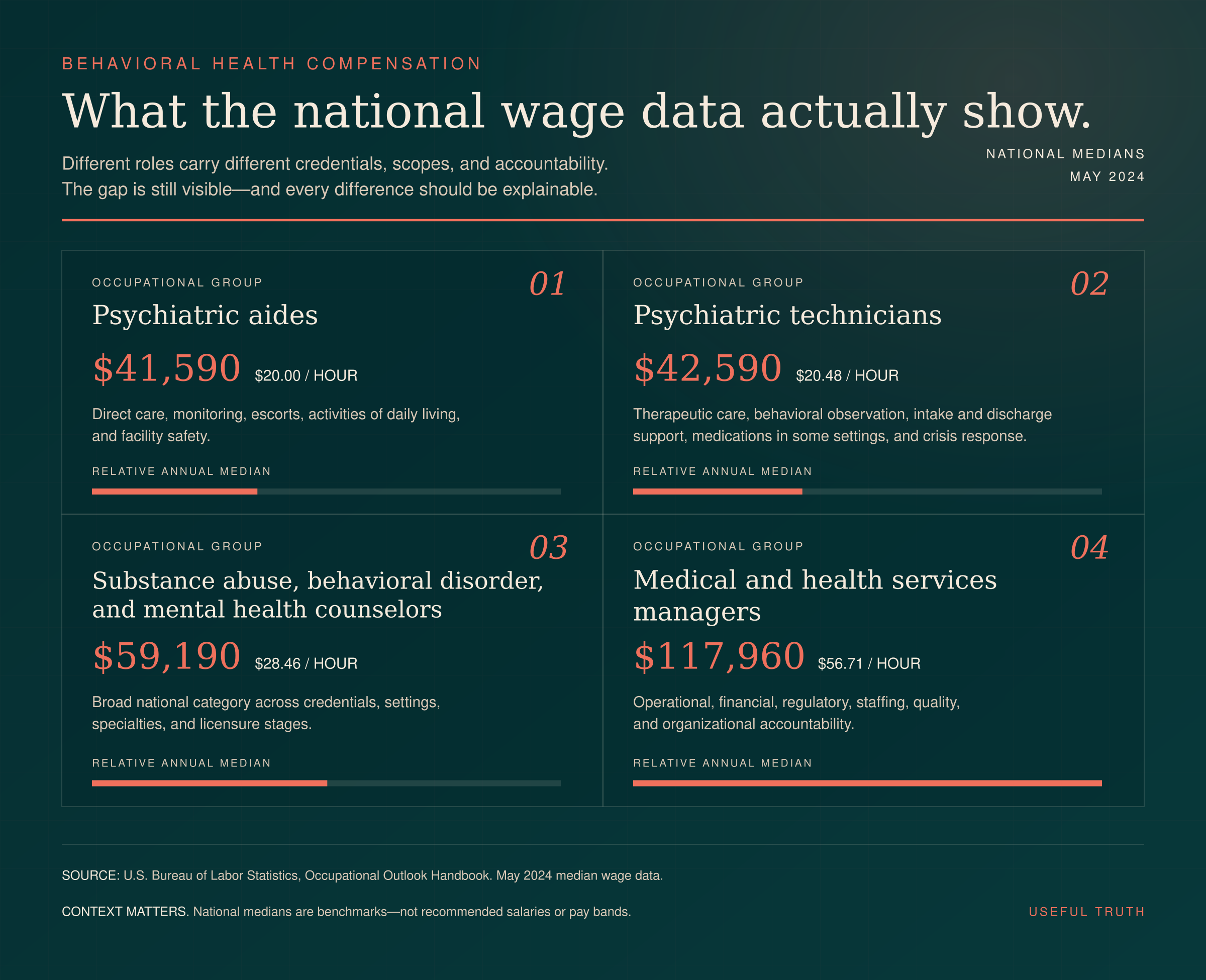
Those medians do not tell an employer exactly what to pay in a specific city, program, or labor market. They do show that the gap people experience inside behavioral-health organizations is not imaginary.
The math makes it even more visible:
$16 an hour is approximately $33,280 per year at 40 hours a week.
$18 an hour is approximately $37,440 per year.
$20 an hour is approximately $41,600 per year.
$80,000 per year is approximately $38.46 per hour.
$90,000 per year is approximately $43.27 per hour.
$100,000 per year is approximately $48.08 per hour.
These are simple annualized conversions. They do not account for overtime, bonuses, unpaid time, benefits, differentials, or actual hours worked. Still, they reveal the scale of the difference.
A technician earning $18 an hour may be paid less than half the base salary of a clinician earning $80,000—and less than one-third of a healthcare manager at the national median.
That does not prove the difference is unfair.
It does mean the organization should be able to prove that it is fair.
Frontline work is not “entry-level” just because the credential threshold is lower
Behavioral-health technician, psychiatric aide, residential support, milieu staff, behavioral-health associate—organizations use different titles, but the pattern is familiar. These employees are often the people with the most continuous exposure to clients.
They notice the first change in behavior. They de-escalate conflict. They support meals, medication lines, transportation, groups, observation, room checks, admissions, discharge transitions, daily routines, and documentation. They work nights, weekends, and holidays because a 24-hour program remains inconveniently committed to operating 24 hours a day.
BLS describes psychiatric technician and aide work as physically demanding and reports that these occupations have some of the highest rates of injuries and illnesses across all occupations. The work may include caring for clients who are disoriented, uncooperative, or violent, and schedules may include nights, weekends, and holidays.
In other words: exposure to clinical crisis is real labor even when it does not generate a CPT code.
Yet many organizations still compensate direct-care work as if its lower formal credential requirement makes the work itself low-value. That is a category error.
Education and licensure are valid compensation factors. They are not the only factors.
A fair compensation model also accounts for:
sustained client contact;
physical and psychological demands;
workplace safety exposure;
overnight, weekend, and holiday coverage;
responsibility for recognizing and escalating risk;
documentation and communication requirements;
program continuity;
the operational cost of vacancy and turnover; and
the skill required to remain regulated while another human being is not.
You cannot call someone essential in the morning and price the role as disposable by lunch.
Why clinicians may earn more—including before independent licensure
Pre-licensed clinicians create a particularly tense compensation conversation.
Organizations may look at a candidate requesting $80,000 or $90,000 and think: They are not independently licensed yet. The candidate may look at the organization’s offer and think: I completed graduate school, carry student debt, provide treatment, manage clinical risk, document constantly, and still need to survive while accumulating supervised hours.
Both perspectives contain relevant information.
The national BLS category for substance abuse, behavioral disorder, and mental health counselors reported a median annual wage of $59,190 in May 2024. But that category combines different credentials, settings, specialties, locations, and stages of professional development. It does not establish a single “correct” salary for a pre-licensed therapist—and it does not validate or invalidate an $80,000 to $90,000 request in a particular market.
An organization should evaluate pre-licensed clinician pay using concrete factors:
degree and specialty training;
prior behavioral-health experience;
permitted scope of practice under state law;
payer credentialing and reimbursement rules;
whether services can be billed and collected under supervision;
expected caseload and scheduled clinical hours;
acuity and complexity of the population;
documentation and care-coordination demands;
supervision the organization must provide;
geographic labor market; and
the scarcity of qualified candidates.
The key is to create a visible progression rather than negotiate every offer as if compensation were an auction.
For example:
Pre-Licensed Clinician I: completing supervised hours; standard caseload; weekly supervision; defined documentation expectations.
Pre-Licensed Clinician II: demonstrated competence; more complex caseload; consistent productivity and quality; nearing independent licensure.
Independently Licensed Clinician: expanded scope, payer participation, autonomy, and accountability.
Senior or Lead Clinician: advanced specialty, mentorship, clinical leadership, program development, or supervision.
Each step should have a published pay band and a defined progression rule. Independent licensure should trigger a predetermined review or increase—not a vague promise that everyone forgets until the employee produces screenshots.
The organization can also strengthen the total package with paid supervision, licensure fees, exam support, continuing education, protected documentation time, specialty training, and a sustainable caseload. Those benefits have real value, especially during the long path to independent practice.
Why leadership may earn more—and when the difference becomes indefensible
Leadership compensation above $100,000 is not inherently excessive. In many cases, it is consistent with the market and the scope of the role.
BLS reports a May 2024 median annual wage of $117,960 for medical and health services managers. These roles may hold responsibility for budgets, regulatory compliance, hiring, staffing, scheduling, performance, quality, technology, reporting, and organizational goals. Some work more than 40 hours, cover evenings or weekends, and remain on call for emergencies.
A capable behavioral-health leader may be accountable for:
client and employee safety;
clinical and operational quality;
licensure and accreditation readiness;
financial performance and cash protection;
staffing capacity and labor cost;
payer requirements and revenue-cycle performance;
serious incidents and corrective action;
strategic decisions with consequences across the organization; and
the performance, development, and conduct of other leaders.
That is real responsibility. It should be compensated.
The problem is not that a leader earns six figures. The problem is when the organization cannot connect that compensation to actual scope, authority, accountability, and results.
Leadership pay becomes harder to defend when:
senior roles retain high compensation while chronically understaffing direct-care shifts;
executives receive incentives disconnected from quality, safety, retention, or access;
a director title exists without defined decision authority or measurable outcomes;
leadership repeatedly asks frontline employees to absorb vacancies without differential pay or support;
managers are rewarded for reducing labor cost while overtime, agency use, turnover, and risk increase elsewhere;
pay decisions depend on personal relationships rather than job architecture; or
the organization celebrates its mission while employees working closest to clients cannot afford basic stability.
A mission statement is not a shift differential. Praise remains stubbornly unable to cover rent.
Fair does not mean equal. It means defensible.
The cleanest compensation principle is this:
Every meaningful difference in pay should be visible, job-related, consistently applied, and explainable without embarrassment.
Compensation differences may reasonably reflect:
1. Scope and complexity
What decisions can the employee make? How complex is the work? What level of judgment is required? What is the consequence of error?
2. Credentials and education
Does the role require a degree, license, certification, specialty credential, or supervised practice? How expensive and time-consuming is that preparation?
3. Accountability and authority
Is the employee responsible only for their own work, or for a team, program, budget, license, outcome, or enterprise-level decision? Do they have the authority needed to meet that accountability?
4. Labor-market scarcity
How difficult is the role to recruit in the relevant geography and setting? What are credible employers paying for comparable work—not merely similar titles?
5. Revenue and economic contribution
Does the role directly generate billable services, protect collections, increase capacity, reduce denials, prevent avoidable cost, or make other roles productive? Revenue contribution should include direct and enabling work.
6. Working conditions
Does the role involve nights, weekends, on-call responsibilities, workplace violence exposure, physical demands, travel, crisis response, or unusually high acuity?
7. Supervision received or provided
Does the employee require clinical supervision, provide supervision, carry supervisory liability, or develop other employees?
8. Sustained performance and capability
Has the employee demonstrated reliable quality, productivity, judgment, leadership, or specialty expertise over time?
These factors create legitimate differences. Personal favoritism, desperation, secrecy, and whoever negotiated hardest do not.
Compensation by negotiation alone tends to reward people who know their leverage, have access to salary information, or feel comfortable making aggressive requests. It may also reproduce disparities across gender, race, age, disability, and other protected characteristics. The U.S. Equal Employment Opportunity Commission emphasizes that job content—not titles—determines whether work is substantially equal, and that compensation includes far more than base salary.
This article is not legal advice. It is, however, a strong suggestion that “we have always done it this way” is a poor defense in both an employee meeting and a pay-equity review.
A practical method for building behavioral-health pay bands
Fair compensation is not found by selecting one salary survey and adding a hopeful percentage. It is built through a series of explicit decisions.
Step 1: Write the compensation philosophy
Before setting a single range, decide what the organization intends to do.
Answer these questions in writing:
Which labor market are we competing in: local, regional, or national?
Which roles are genuinely remote, and which require local coverage?
Do we target the 50th percentile of the market, a higher percentile for scarce roles, or a different position by job family?
How do we balance internal equity with external competitiveness?
What portion of compensation is fixed, variable, or benefit-based?
How will we recognize shifts, on-call work, bilingual capability, specialty expertise, or safety exposure?
How often will bands be reviewed?
Who can approve exceptions, and what evidence is required?
If these decisions are not explicit, managers will create their own. Then the organization will have twelve compensation philosophies, each confidently described as “what HR told me.”
Step 2: Build job architecture before salary ranges
A simplified behavioral-health structure might include:
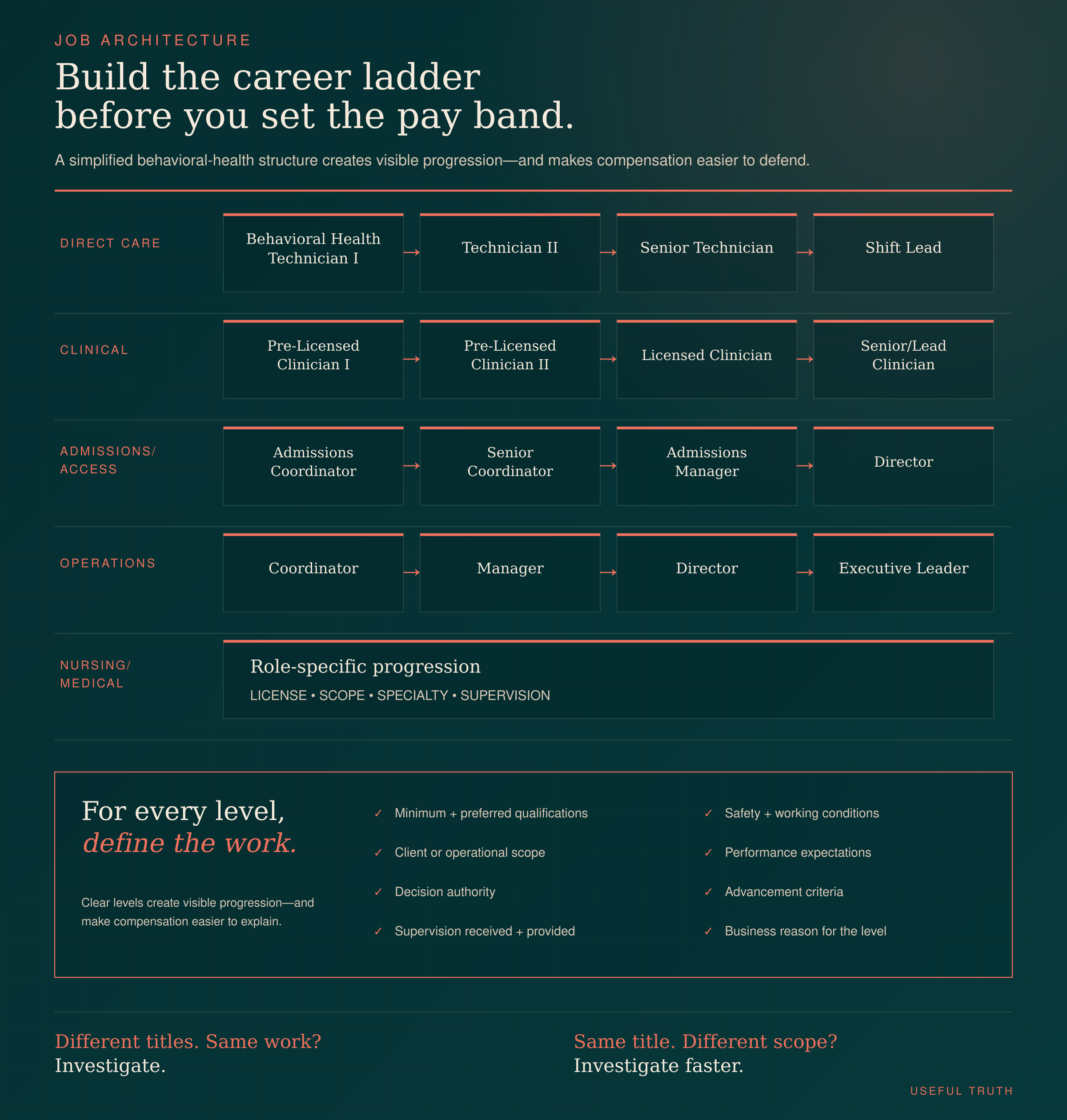
Group roles into coherent job families and levels. Titles should reflect actual work rather than historical prestige.
Step 3: Use credible market data—then interpret it
Start with sources such as BLS Occupational Employment and Wage Statistics, state labor-market data, and reputable compensation surveys relevant to the organization’s setting and geography. Compare job content, not just titles.
Then segment the data:
residential, inpatient, outpatient, community, or private practice;
local on-site versus national remote labor market;
urban, suburban, or rural location;
credential and licensure stage;
organization size and role scope;
individual contributor versus people leader; and
base pay versus total cash and total rewards.
A national median is a benchmark, not an answer. Rural recruiting may require a premium because the workforce is scarce. A high-cost metro may require a geographic adjustment. A residential role with overnight crisis exposure should not be priced from an outpatient schedule with no comparable conditions.
HRSA’s State of the Behavioral Health Workforce, 2025 reports that 40% of the U.S. population lived in a Mental Health Professional Shortage Area as of December 2, 2025, and projects substantial shortages across multiple behavioral-health professions. Scarcity is not an abstract concern; it affects recruiting, access, workload, and the cost of leaving roles vacant. See the HRSA workforce report.
Step 4: Create minimum, midpoint, and maximum values
Every role or level should have a pay range:
Minimum: appropriate for someone who meets the role requirements and is developing toward full proficiency.
Midpoint: the market-aligned value for a fully competent employee consistently performing the role.
Maximum: appropriate for sustained expertise, exceptional depth, or long-term contribution without requiring a promotion into work the employee may not want.
The range should be wide enough to support progression but not so wide that it stops meaning anything. The appropriate range width varies by job family and level. Organizations should choose and document the method rather than copying a generic percentage.
Use a compa-ratio to see where an employee sits relative to the midpoint:
Compa-ratio = employee base pay ÷ pay-range midpoint
An employee earning $50,000 in a range with a $52,000 midpoint has a compa-ratio of 0.96.
Compa-ratio is not a performance score. It is one lens for identifying employees who sit unusually low or high in a range and determining whether tenure, experience, performance, market adjustments, or inequity explain the difference.
Step 5: Establish starting-pay rules
Managers need rules for where a new hire enters the band.
Consider:
years of directly relevant experience;
demonstrated specialty expertise;
current license or credential;
additional responsibilities;
internal comparison with employees performing similar work; and
scarcity supported by current recruiting data.
Do not solve a difficult recruitment by giving the new employee more than experienced employees without reviewing compression. The new hire may be worth the offer. Your current employees may also be underpaid.
That is not a reason to withdraw the offer. It is a reason to fix the system.
Step 6: Add differentials and milestone increases
Base pay alone cannot capture every condition. Create consistent additions for work that is meaningfully different.
Examples include:
evening, night, weekend, and holiday differentials;
on-call or call-back pay;
lead-shift responsibility;
bilingual or specialty capability when used in the role;
high-acuity or hard-to-staff program premiums;
temporary assignment pay;
independent licensure milestones;
approved certification increases; and
retention incentives for defined critical roles.
The rule should state who qualifies, how much is paid, when it starts, and when it ends. Otherwise a “temporary” premium will become permanent for one employee and mysteriously unavailable to everyone else.
Step 7: Review equity, compression, and affordability together
Before implementation, test the bands against the current workforce.
Look for:
employees below the new minimum;
employees above the maximum;
new hires earning close to or more than experienced staff;
supervisors earning little more than direct reports;
differences not explained by role-related factors;
protected-group disparities;
programs where the labor model cannot support safe staffing; and
positions whose pay depends on chronically excessive overtime.
Then price the corrections. A compensation structure that is “fair” only when no one calculates its cost is a document, not a plan.
Benefits are compensation—and they should not be a scavenger hunt
Base salary is only part of total rewards.
The Bureau of Labor Statistics defines employer compensation as wages and salaries plus benefits such as paid leave, supplemental pay, insurance, retirement, and legally required benefits. In December 2025, BLS estimated that benefits represented 34.2% of employer compensation costs in private-industry hospitals and 27.3% in nursing and residential care facilities. The mix varies substantially by role, employer, participation, and plan design. See the BLS Employer Costs for Employee Compensation release.
This matters because two offers with the same salary may not be remotely equivalent.
A behavioral-health total-rewards package may include:
medical, dental, and vision coverage;
employer retirement contributions;
paid time off, sick leave, and holidays;
short- and long-term disability coverage;
life insurance;
paid clinical supervision;
licensure, examination, and renewal support;
continuing education and specialty training;
professional liability coverage;
tuition or student-loan assistance;
paid parental or caregiver leave;
employee assistance and behavioral-health benefits;
flexible or predictable scheduling;
remote documentation time where appropriate;
performance or retention incentives; and
real career pathways for non-clinical employees.
For frontline staff, predictable schedules, affordable health coverage, paid time off, differentials, and a genuine advancement path may be more meaningful than a small annual bonus with seven eligibility conditions and a spiritual commitment to staying through payout day.
For pre-licensed clinicians, paid supervision and a guaranteed licensure adjustment may materially improve the offer.
For licensed clinicians, workload design, documentation time, continuing education, and schedule flexibility may determine whether an apparently competitive salary is sustainable.
For leaders, variable compensation should reflect a balanced set of outcomes—not just margin.
Benefits should be summarized in plain language with their employer-paid value wherever possible. Candidates should not need to conduct an archaeological dig through four PDFs to understand the offer.
Build compensation from both market data and operating reality
An organization cannot ignore economics. Behavioral-health reimbursement is often constrained, labor intensive, administratively complex, and slow to collect. HRSA identifies reimbursement challenges as a barrier to workforce access and sustainability.
But limited reimbursement cannot become a permanent excuse for paying frontline staff whatever remains after every other decision has been made.
Organizations need two connected models.
The total-rewards cost model
Total rewards cost = base pay + payroll taxes + benefits + differentials + incentives + supervision and training + expected coverage cost
This shows the true cost of employing the role.
The service-line economic model
Sustainable contribution = net collected revenue − direct labor − required supervision − program overhead − administrative and occupancy cost − risk reserve
This shows whether reimbursement, capacity, scheduling, collections, and program design can support the workforce required to deliver safe care.
If the model fails, leaders should examine more than wages:
Are authorized services actually scheduled and delivered?
Are claims clean and collected?
Is documentation delaying billing?
Are clinician schedules designed around realistic availability?
Is overtime masking chronic vacancy?
Are managers performing work that belongs in a different role?
Is low utilization caused by client access barriers, no-shows, or internal workflow?
Does the program have the right staffing model for its acuity?
Is the payer mix sustainable?
Are administrative layers adding value?
The answer may involve rates, contracts, scheduling, workflow, staffing ratios, program redesign, or service mix. The answer cannot always be “the technician will absorb it.”
Incentives should reward what the organization actually wants
Poorly designed incentives create impressively predictable problems.
If clinicians are rewarded only for volume, quality, documentation, care coordination, and team contribution may suffer. If leaders are rewarded only for margin, vacancies and workload may be treated as savings. If technicians have no meaningful progression except leaving or becoming clinicians, the organization has not built a technician career ladder. It has built an exit sign.
A balanced incentive model may include:
productivity or capacity within safe expectations;
documentation timeliness and accuracy;
quality and client-safety indicators;
retention and vacancy improvement;
training, mentorship, or supervision;
program development;
client access and continuity;
financial performance based on collected—not merely billed—revenue; and
implementation of measurable organizational priorities.
No single metric should carry enough weight to encourage employees to game the system or sacrifice care.
The same principle applies to leadership bonuses. A leader should not receive a full incentive for meeting a margin target while turnover, overtime, complaints, incident risk, and employee vacancy all deteriorate. The financial result matters. So does what it cost the workforce to produce it.
The compensation dashboard every behavioral-health organization should review
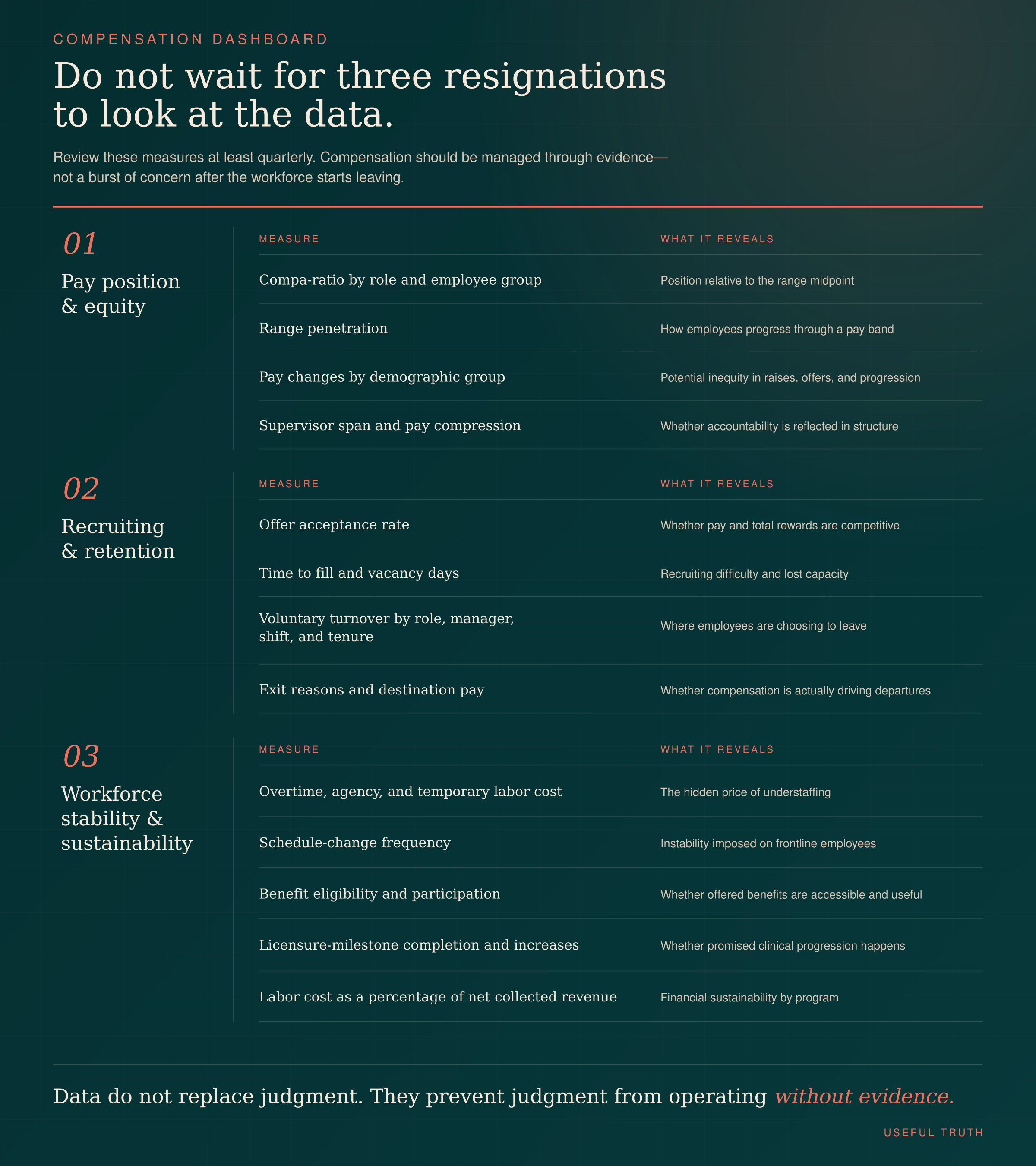
A 90-day plan to fix compensation without creating chaos
Days 1–30: See the truth
Inventory every role, salary, hourly rate, differential, incentive, and benefit.
Confirm actual job content, credentials, schedule, supervision, and authority.
Calculate compa-ratios using current or provisional market ranges.
Analyze turnover, vacancies, overtime, schedule changes, and recruiting outcomes.
Identify employees below credible minimums and obvious compression.
Listen to frontline employees, clinicians, managers, and recruiters.
Do not begin with “what can we afford?” Begin with “what is happening?” Affordability matters, but it should not edit the facts before the facts have been collected.
Days 31–60: Name what matters
Approve a compensation philosophy.
Build job families and levels.
Select market sources and comparison rules.
Draft pay bands and starting-pay guidance.
Define differentials, licensure milestones, and exception approval.
Model total-rewards cost and service-line economics.
Complete an equity and compression review with qualified HR and legal support.
Prioritize the greatest risks: employees below minimum, unsafe vacancy patterns, inequitable differences, hard-to-fill roles, and broken promises.
Days 61–90: Build what works
Correct the most urgent gaps.
Publish ranges or, at minimum, transparent placement and progression rules.
Train managers to explain pay decisions.
Provide each employee with a total-rewards summary.
Implement the compensation dashboard.
Establish a recurring annual market review and quarterly equity monitoring.
Communicate what changed, what did not, and why.
Transparency does not require publishing every employee’s salary. It does require telling people how the system works.
The hard truth about “fair” pay
An organization may complete this analysis and discover that it cannot immediately fund every correction.
That is possible.
The honest response is not to hide the gap. It is to name it, prioritize it, create a timeline, and stop making compensation promises that depend on unspecified future success.
Employees can often tolerate constraints better than contradiction. They struggle when leaders say their work is invaluable while treating every request for stability as a lack of commitment.
Fair pay does not require pretending roles are interchangeable.
A technician, a pre-licensed clinician, a licensed provider, and an executive carry different scopes, responsibilities, credentials, and economic impacts. Those differences belong in the compensation model.
So do risk exposure, nights and weekends, client contact, organizational dependency, supervision, scarcity, and retention.
The question is not whether leadership should earn $100,000 or whether a pre-licensed clinician is “allowed” to ask for $90,000. Candidates can ask. Organizations can evaluate. Markets can change.
The real questions are:
What work is the role actually responsible for?
What does the market pay for comparable work?
What does the organization require from this person?
What risk, complexity, scarcity, and accountability does the role carry?
How does the employee progress?
Is the total package sustainable?
Can the organization explain the difference to the people living with it?
If the answer to the last question is no, the organization does not have a communication problem.
It has a compensation problem.
Frequently asked questions about behavioral-health compensation
What is fair pay in behavioral health?
Fair pay is compensation based on consistently applied, job-related factors such as role scope, credentials, decision authority, experience, market scarcity, working conditions, supervision, and sustained performance. It also accounts for internal equity, legal requirements, and total rewards—not base salary alone.
How should an organization determine behavioral-health technician pay?
Compare credible local and setting-specific market data, then account for client acuity, physical and psychological demands, schedule, safety exposure, documentation, certifications, and vacancy risk. Establish a pay band and add consistent premiums for nights, weekends, lead work, specialty assignments, or hard-to-staff programs.
Should a pre-licensed therapist earn $80,000 to $90,000?
There is no universal answer. Evaluate geography, degree, prior experience, permitted scope, payer rules, caseload, acuity, supervision cost, recruiting difficulty, and internal equity. The national BLS counselor median was $59,190 in May 2024, but the category does not separate licensure stages or local markets. A high offer may be appropriate in a scarce, high-cost, or high-demand market; it should still fit a defined band and progression model.
How much should behavioral-health leaders earn?
Leadership pay should reflect the size and complexity of the operation, financial and regulatory accountability, staffing responsibility, decision authority, experience, market data, and measurable results. The national BLS median for medical and health services managers was $117,960 in May 2024. A six-figure salary can be reasonable. It should be connected to actual scope and balanced outcomes.
What is pay compression?
Pay compression occurs when differences between employees’ pay become too small relative to differences in experience, tenure, responsibility, or level. It commonly appears when market rates rise and new hires receive higher offers while existing employee pay remains unchanged.
Which benefits matter most in behavioral health?
The answer varies by workforce segment. Common priorities include affordable health coverage, predictable schedules, paid time off, retirement contributions, shift differentials, paid supervision, licensure and continuing-education support, protected documentation time, disability coverage, and clear career progression. Ask employees and examine participation data rather than assuming.
Should organizations publish salary ranges?
Publishing ranges can improve transparency and recruiting, and some jurisdictions require it. Whether or not every range is public, employees should understand how starting pay, increases, promotions, licensure milestones, and exceptions are determined. Consult qualified legal counsel regarding applicable federal, state, and local requirements.
Build compensation people can understand—and the business can sustain
Useful Truth helps behavioral-health organizations turn compensation concerns into an operating system.
We can help you:
diagnose pay compression, turnover, vacancy, and workload patterns;
build job families, levels, and role-specific accountability;
create defensible pay bands and placement rules;
design licensure milestones, differentials, and career pathways;
connect total rewards to program economics and collected revenue;
create a compensation and workforce dashboard; and
give leaders the tools to communicate decisions clearly and consistently.
Not a prettier spreadsheet. A compensation structure your leaders can explain, your employees can navigate, and your organization can actually operate.
What has your compensation system learned to live with?
