
Should Your Behavioral-Health Practice Go In-Network—Or Keep Its Sanity?
The actual benefits, costs, and operational consequences of accepting insurance
Insurance participation can expand access and create demand. It can also turn highly trained clinicians into unpaid part-time investigators trying to determine why a payer portal has suddenly decided their suite number is fraudulent. Let us discuss both.
There is a very specific moment in the life of a behavioral-health practice when someone says:
We should probably take insurance.
The room nods.
Accepting insurance sounds accessible, mission aligned, and financially responsible. More people can afford care. The payer directory may generate referrals. The practice can serve clients who would otherwise be priced out.
Then someone opens the first credentialing application.
Three hours later, that same person is trying to remember every address where a clinician has practiced since graduate school, locate a malpractice face sheet that apparently exists only in a former employer’s inbox, explain a six-week gap from eleven years ago, and convince a web portal that the clinician is both a real person and somehow authorized to use her own email address.
And that is before contracting, enrollment, fee schedules, authorizations, claims, denials, recredentialing, directory maintenance, and the deeply spiritual experience of being told a claim cannot be processed because the payer entered the provider’s taxonomy incorrectly.
I have worked inside these systems. I have watched good organizations choose insurance participation for the right reasons and then dramatically underestimate the machinery required to make that choice operationally viable. I have also watched practices remain private pay for understandable reasons while clients with perfectly good insurance discover that “coverage” and “access” are distant relatives who exchange holiday cards but rarely visit.
The argument is often framed as if one model is ethical and the other is greedy:
In-network providers care about access.
Out-of-network providers care about money.
That is lazy analysis.
The truth is more complicated.
A provider can join networks, accept rates that do not cover the real cost of care, drown in administrative work, burn out, and eventually close. That does not improve access.
A provider can remain out-of-network, preserve enough clinical and financial stability to deliver excellent care, offer sliding-scale options, and stay in practice for decades. That is not automatically exploitation.
The real question is not whether insurance is good or bad.
It is this:
Does the reimbursement, demand, administrative burden, cash-flow risk, and clinical restriction associated with a particular payer make sense for this provider, service, and patient population?
That answer may be yes for one payer, no for another, and “absolutely not until someone shows us the fee schedule” for a third.
FIRST, LET US STOP USING FIVE DIFFERENT WORDS AS IF THEY MEAN THE SAME THING
Providers often say they are “getting paneled” as though paneling is one moderately unpleasant form.
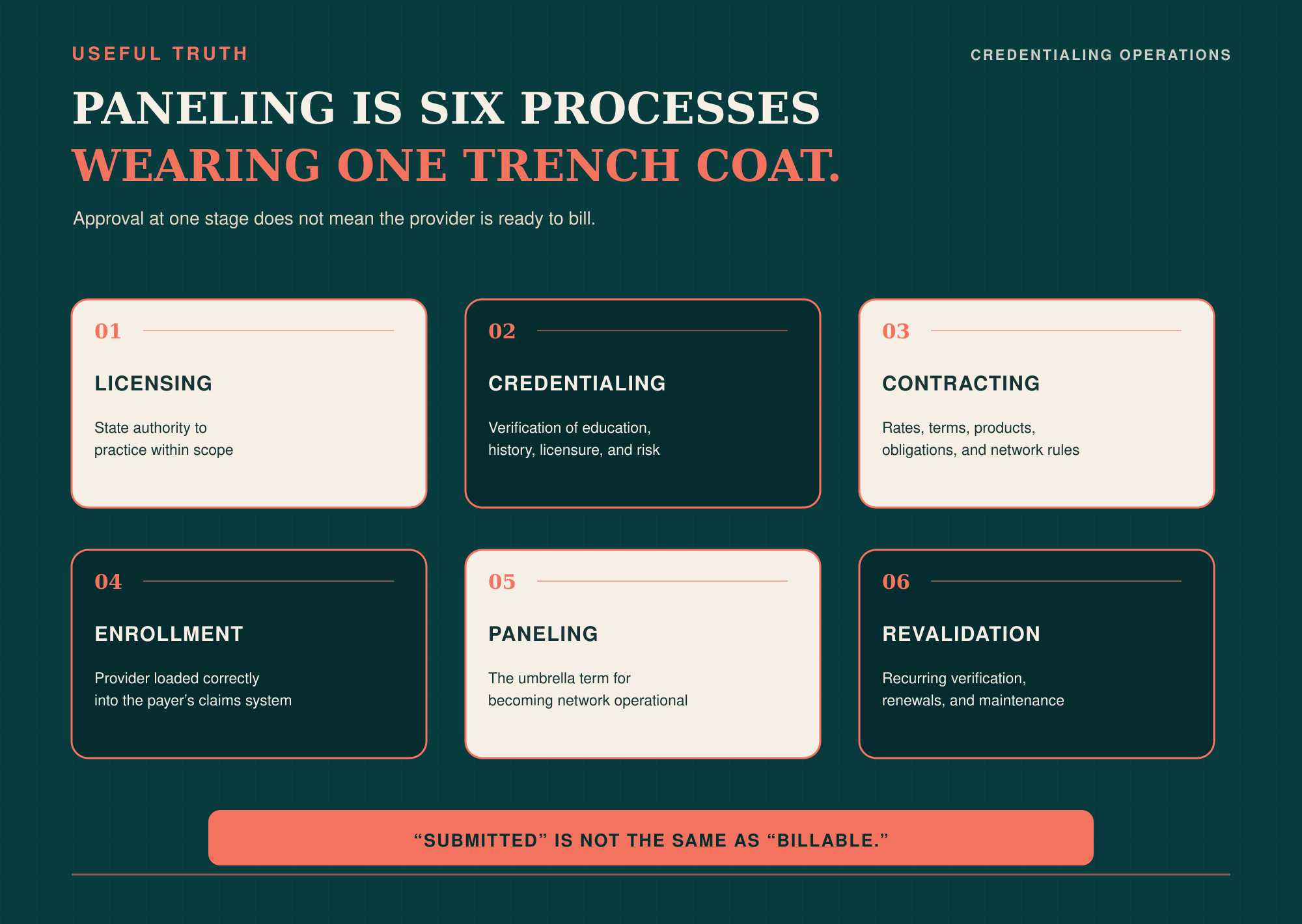
These steps can overlap, occur in a different order, or be handled differently by Medicare, Medicaid, commercial payers, managed-care organizations, employee-assistance programs, and delegated credentialing entities.
They can also fail independently.
A provider may be credentialed but not contracted. Contracted but not loaded correctly. Loaded under the group but not at the correct location. Active for one product but not another. Listed in the directory but unable to generate a payable claim.
In other words, “approved” is not the same thing as “ready to bill.”
Please place that sentence somewhere visible before scheduling 40 insured clients with a newly hired provider.
WHY PROVIDERS CHOOSE TO GO IN-NETWORK
There are real and meaningful benefits to insurance participation.
1. It can materially expand access
The most obvious benefit is also the most important. Many clients cannot afford recurring behavioral-health treatment at full private-pay rates. A negotiated copay or coinsurance amount may make therapy, psychiatry, medication management, or structured treatment possible when self-pay would not be.
For behavioral-health organizations that claim access is part of their mission, insurance participation is one of the clearest ways to reduce the immediate financial barrier for clients.
That does not mean every client will find insured care affordable. High deductibles, coinsurance, exclusions, authorization limits, and denied claims can still produce substantial costs. But participation can open the door for people who would otherwise never reach it.
2. It can create a reliable referral channel
Clients frequently begin their search inside a payer directory because insurance is how they expect to pay. An accurate in-network listing can create a steady source of inquiries without requiring the practice to personally fund every click, referral lunch, sponsored post, and mysteriously ineffective marketing campaign.
Payer relationships may also support referrals from health systems, primary-care practices, case managers, employee-assistance programs, and other organizations that prioritize or require in-network options.
3. It can improve conversion
A prospective client may strongly prefer a particular provider and still decline when the expected cost is several hundred dollars per visit. In-network status can reduce the distance between inquiry and admission because the client has a familiar benefit structure and may face a lower immediate expense.
Again, benefit verification is not a guarantee of payment. Insurance apparently enjoys keeping some mystery alive. But a defined in-network benefit can still make the decision easier for families.
4. It can diversify revenue
Depending on rates and payer mix, insurance contracts can reduce reliance on a small private-pay market. A practice with several viable payer relationships may be less vulnerable to shifts in consumer spending, local competition, or referral concentration.
5. It can support continuity across levels of care
For organizations operating multiple services—such as psychiatry, outpatient therapy, intensive outpatient programming, partial hospitalization, medication-assisted treatment, or other structured care—network participation may help clients move between appropriate levels without having to restart their search or pay the full cost at every transition.
The word may is doing important work there. Coverage, authorization, medical-necessity criteria, benefits, and provider eligibility still vary by plan and service.
WHY PROVIDERS CHOOSE NOT TO GO IN-NETWORK
Many behavioral-health providers do not avoid insurance because they are lazy, elitist, or insufficiently committed to access.
They avoid it because the work can be a real pain in the ass.
That is not merely anecdotal frustration. A 2024 consensus report from the National Academies of Sciences, Engineering, and Medicine concluded that participating in Medicare, Medicaid, and Marketplace plans commonly involves lower reimbursement than self-pay markets, greater revenue-cycle complexity and uncertainty, restrictive administrative requirements, and recurring enrollment and credentialing processes that may disproportionately burden smaller behavioral-health practices without administrative staff.
The report also identified reimbursement, prior authorization, claims denials, payment delays, and credentialing complexity as barriers to provider participation. Its recommendations included streamlining credentialing and enrollment, reducing low-value prior authorization, improving rates, and strengthening prompt-payment and claims practices.
That is an impressively formal way of saying: providers are not imagining this.
1. The reimbursement may not support the service
An allowed amount is not automatically a sustainable rate.
A provider must cover far more than the minutes spent face-to-face with a client:
documentation;
care coordination;
supervision;
scheduling and intake;
billing and collections;
credentialing and compliance;
technology and facility costs;
malpractice and other insurance;
cancellations and no-shows;
authorization work;
denials and appeals;
training and quality review; and
uncompensated clinical judgment that does not fit neatly inside a billing code.
A payer may offer a rate that looks respectable until the practice calculates the labor required to earn and collect it.
The 2024 RTI International analysis of commercial claims for more than 22 million people found substantial disparities between behavioral-health and medical/surgical networks. In-network office-visit reimbursement for medical/surgical clinicians was, on average, 22% higher than reimbursement for behavioral-health clinicians. The exact financial impact varies by code, geography, payer, provider type, and contract, but the broader finding matters: network participation decisions are shaped by whether the economics recognize the actual cost of delivering care.
2. Credentialing takes time before the first dollar can be billed
Credentialing and enrollment require detailed, accurate, and repeatedly verified information. A missing document, expired attestation, mismatched address, incorrect taxonomy, incomplete ownership disclosure, or unprocessed roster can delay approval or create billing failures after services begin.
The National Academies report specifically noted that lengthy and repetitive credentialing discourages participation and that delays postpone the ability to bill and receive payment.
For a small practice, waiting several months to bill under a new clinician is not an administrative inconvenience. It is payroll risk.
3. The administrative work does not end after approval
Joining a network is not a one-time project followed by a commemorative ribbon cutting.
The work continues:
CAQH and payer attestations;
license and malpractice renewals;
directory updates;
location and roster changes;
recredentialing;
EFT and ERA maintenance;
benefit verification;
authorizations and reauthorizations;
clean-claim submission;
corrected claims;
medical-record requests;
denials and appeals;
takebacks and recoupments;
contract amendments; and
explaining to a client why the payer said the provider was in-network last Tuesday but has apparently reconsidered.
The 2024 CAQH Index estimated that the health-care industry could unlock approximately $20 billion in annual savings by moving remaining administrative transactions to fully electronic workflows. That estimate spans health-care administrative transactions broadly; it is not a credentialing-only figure. It does, however, show the scale of time and money still consumed by fragmented manual processes.
4. Prior authorization can move clinical decisions into administrative limbo
Prior authorization is intended to confirm coverage and manage utilization. In practice, it can also delay care, interrupt continuity, and consume significant staff time.
The American Medical Association’s 2025 national survey of 1,000 practicing physicians found that practices completed an average of 40 prior authorizations per physician per week and spent about 13 hours of physician and staff time on them. Ninety-five percent of respondents reported care delays, and 94% said prior authorization somewhat or significantly increased physician burnout.
This was a broad physician survey, not a behavioral-health-only sample, so those figures should not be applied as an exact benchmark for every therapy or treatment program. They are still useful evidence of the wider administrative environment in which network providers operate.
And behavioral-health care has its own special authorization joys: continuing-stay reviews, level-of-care criteria, concurrent review, documentation deadlines, changing benefits, carve-outs, and the occasional denial that appears to have been written for an entirely different patient, service, or dimension of reality.
5. Cash flow becomes more complicated
Private-pay services may be collected at or before the appointment. Insurance revenue arrives after eligibility verification, documentation, coding, claim submission, payer adjudication, patient billing, follow-up, and—when the universe is feeling whimsical—an appeal.
Even a profitable contract can create cash-flow pressure if claims are delayed, denials are high, or the organization lacks reserves. Revenue booked is not cash collected. A $200 charge is not a $200 payment. An allowed amount is not collected revenue. I will continue repeating this until someone stops building forecasts from gross charges.
6. The payer controls important parts of the relationship
Contract terms may govern reimbursement, documentation, medical necessity, authorization, appeals, audits, recoupments, timely filing, client cost-sharing, telehealth, modifiers, locations, products, and termination.
Providers remain clinically responsible for care, but they may have less freedom over how services are packaged, scheduled, documented, and paid.
THE BENEFITS OF REMAINING OUT-OF-NETWORK
Out-of-network is not synonymous with cash pay, although the two often overlap. A provider may collect directly from the client and provide a superbill, submit out-of-network claims, accept single-case agreements, or use another reimbursement arrangement.
The potential benefits are substantial.
1. More control over rates
The practice can set fees based on the actual cost and value of the service rather than a payer’s fee schedule. That can support longer appointments, specialized expertise, additional coordination, better staffing, and financial stability.
Freedom to set a price does not mean the market will pay it. But it allows the organization to build the service first and determine whether its economics are viable without beginning from someone else’s allowed amount.
2. Greater flexibility in service design
Out-of-network providers may have more freedom to structure appointment length, treatment packages, consultation, coordination, groups, and non-covered services around clinical and operational needs.
They are still subject to professional standards, licensure requirements, privacy law, documentation expectations, and applicable billing rules. Out-of-network is not a regulatory witness-protection program.
3. Less payer administration
A true self-pay model can dramatically reduce eligibility work, authorizations, claims follow-up, denials, appeals, recoupments, and payer-specific documentation rules.
It does not eliminate administration. The practice still needs scheduling, consent, payment, compliance, records, financial policies, and transparent estimates. But it may stop requiring a full-time staff member to call three departments in order to learn that the fourth department has the answer.
4. Faster launch and provider onboarding
Once licensing, employment, clinical readiness, and organizational requirements are satisfied, a self-pay provider may begin seeing clients without waiting for each payer to complete credentialing and enrollment.
That can be especially valuable when adding a new clinician, entering a new market, or launching a specialized service.
5. More predictable collections
When fees and payment expectations are transparent and collected at the time of service, the organization may have a shorter and more predictable revenue cycle.
Predictable does not mean easy. Affordability, payment plans, bad debt, chargebacks, refunds, and cancellations still exist. But the practice is not waiting for a payer to decide whether the claim met an invisible requirement that was last updated in a manual nobody can locate.
THE COSTS OF REMAINING OUT-OF-NETWORK
Out-of-network freedom has a price, and clients often pay a significant portion of it.
1. Fewer people can afford care
The most serious disadvantage is access. Many clients cannot sustain weekly therapy, psychiatry, testing, or intensive treatment at private-pay rates. Even clients with out-of-network benefits may face separate deductibles, higher coinsurance, reimbursement based on a plan-defined allowable amount, and the need to pay first and wait for reimbursement.
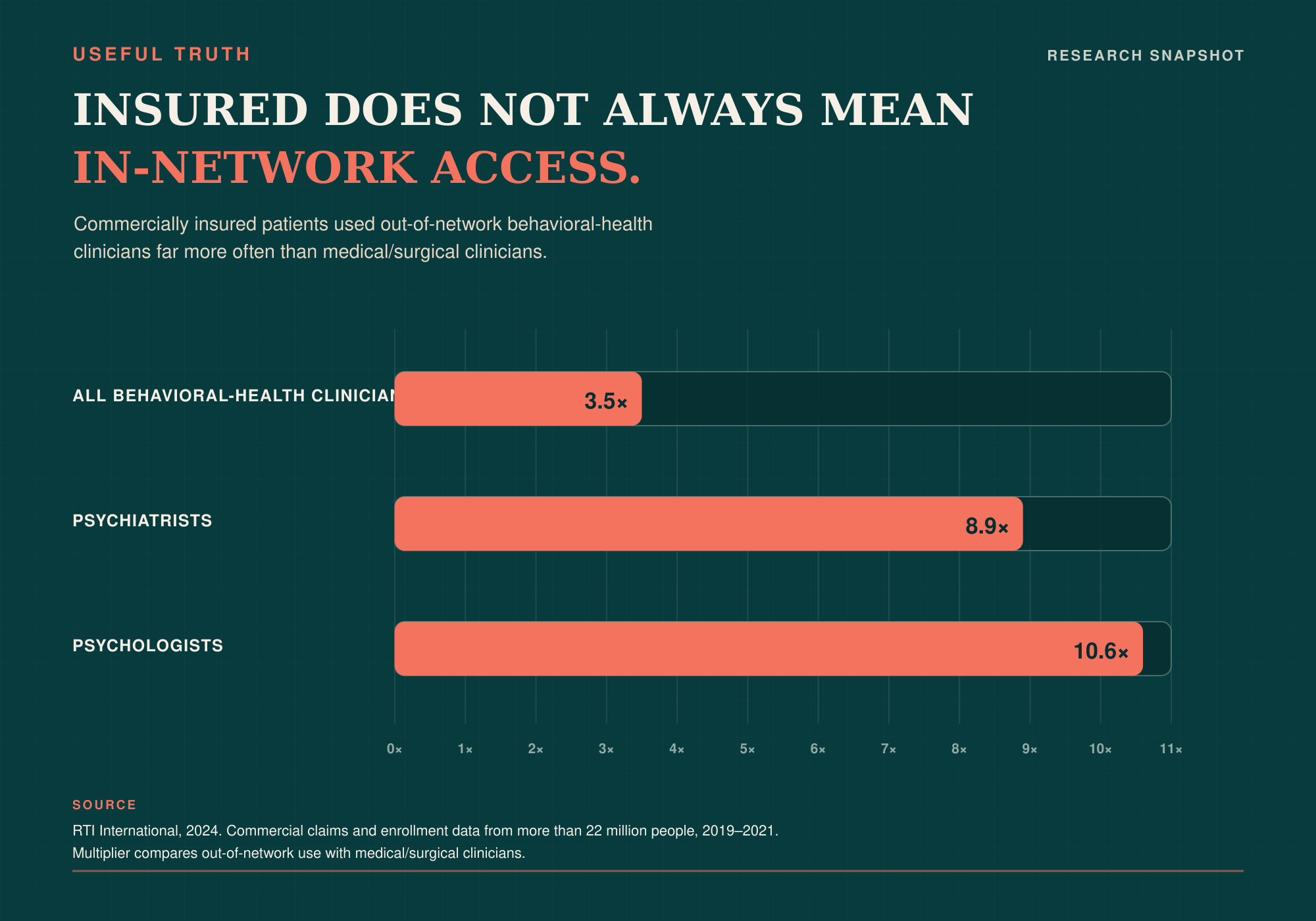
The RTI study found that commercially insured patients used out-of-network behavioral-health clinicians 3.5 times more often than medical/surgical clinicians. Out-of-network use was 8.9 times higher for psychiatrists and 10.6 times higher for psychologists. Those figures do not mean providers should automatically accept every network contract. They show that insured clients are already being pushed outside networks for behavioral-health care—and bearing the financial consequences.
2. The practice must generate its own demand
Without payer-directory visibility, the organization may depend more heavily on reputation, referral development, search visibility, physician relationships, community partnerships, outcomes, and paid marketing.
That can produce stronger-fit referrals. It can also be expensive and slow.
3. Clients inherit administrative work
Some out-of-network models require the client to submit superbills, track deductibles, appeal reimbursement, or negotiate single-case agreements while also attempting to manage the condition that led them to seek treatment.
Nothing says “we support your mental health” quite like assigning a client a 14-step claims project.
If a practice remains out-of-network, it should make the process as transparent and manageable as possible. Explain fees, expected payment timing, superbills, diagnosis and coding implications, benefit limitations, reimbursement uncertainty, and available financial options before treatment begins.
4. Out-of-network benefits are not guaranteed payment
A client may have out-of-network coverage and still receive little or no reimbursement because of a deductible, excluded service, non-covered provider type, authorization rule, plan-specific allowed amount, or claim requirement.
Verification is useful. It is not a promise from the payer, no matter how confident the representative sounded at 10:42 a.m. on a recorded line.
5. Consumer-protection rules still apply
Out-of-network does not mean an organization can charge whatever it wants without disclosure. Federal and state requirements vary by circumstance. Under the federal No Surprises Act, providers generally must give a good-faith estimate to uninsured or self-pay individuals when care is scheduled or requested, subject to the law’s requirements and exceptions. Separate protections apply to certain emergency and facility-based out-of-network services.
Organizations need compliant financial policies, estimates, notices, consent processes, and billing practices. This article is operational education, not legal advice; obtain qualified guidance for the services and states in which you operate.
THIS IS NOT A BINARY DECISION
Many organizations do not need to choose between “all insurance” and “cash-pay monastery.”
A selective or hybrid strategy may be more sustainable:
Contract with payers representing meaningful demand and viable rates.
Decline plans whose reimbursement or administrative burden makes the service unsustainable.
Use a different payer strategy for psychiatry, therapy, testing, medication-assisted treatment, or higher levels of care.
Keep some specialized or non-covered offerings self-pay.
Explore single-case agreements when a clinically appropriate service is unavailable in-network.
Offer sliding-scale or limited reduced-fee capacity with defined eligibility and financial controls.
Reassess contracts using actual collections, denials, authorizations, staff time, and client access—not gross charges or hope.
The right network strategy may differ by provider type, code, service line, location, and payer product.
That is not inconsistency. That is analysis.
CALCULATE THE RATE YOU ACTUALLY KEEP
Do not compare a private-pay fee directly with a payer’s allowed amount and declare the decision finished.
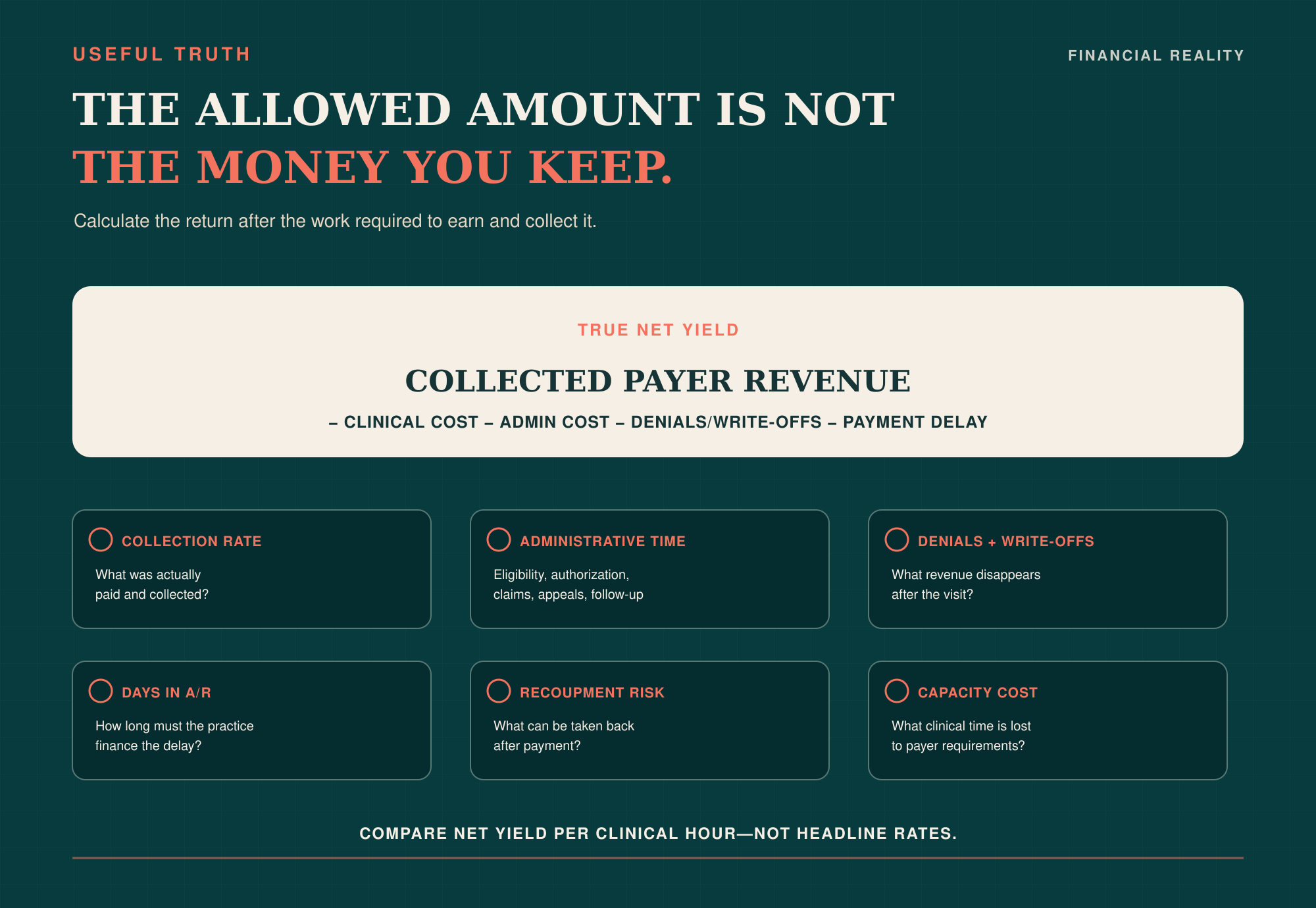
Calculate the true net yield.
True net yield = collected payer revenue − variable clinical cost − administrative cost − denial/write-off cost − financing cost of delayed payment
Then calculate the amount per unit of scarce capacity:
Net yield per clinical hour = true net yield ÷ total clinical and administrative time required
Include:
contracted allowed amount by code;
realistic collection rate;
client cost-sharing actually collected;
clean-claim rate;
denial and write-off rate;
authorization and concurrent-review time;
billing and follow-up labor;
credentialing and recredentialing costs;
average days in accounts receivable;
recoupment exposure;
cancellation rules;
documentation and supervision requirements; and
capacity that cannot be used because of payer restrictions or administrative delays.
A $150 allowed amount with low denials and minimal administration may outperform a $190 allowed amount that requires repeated authorizations, takes 90 days to collect, and generates constant appeals.
The fee schedule is the beginning of the analysis, not the answer.
BEFORE YOU SIGN A PAYER CONTRACT, ASK THESE QUESTIONS

A PRACTICAL NETWORK-PARTICIPATION SCORECARD
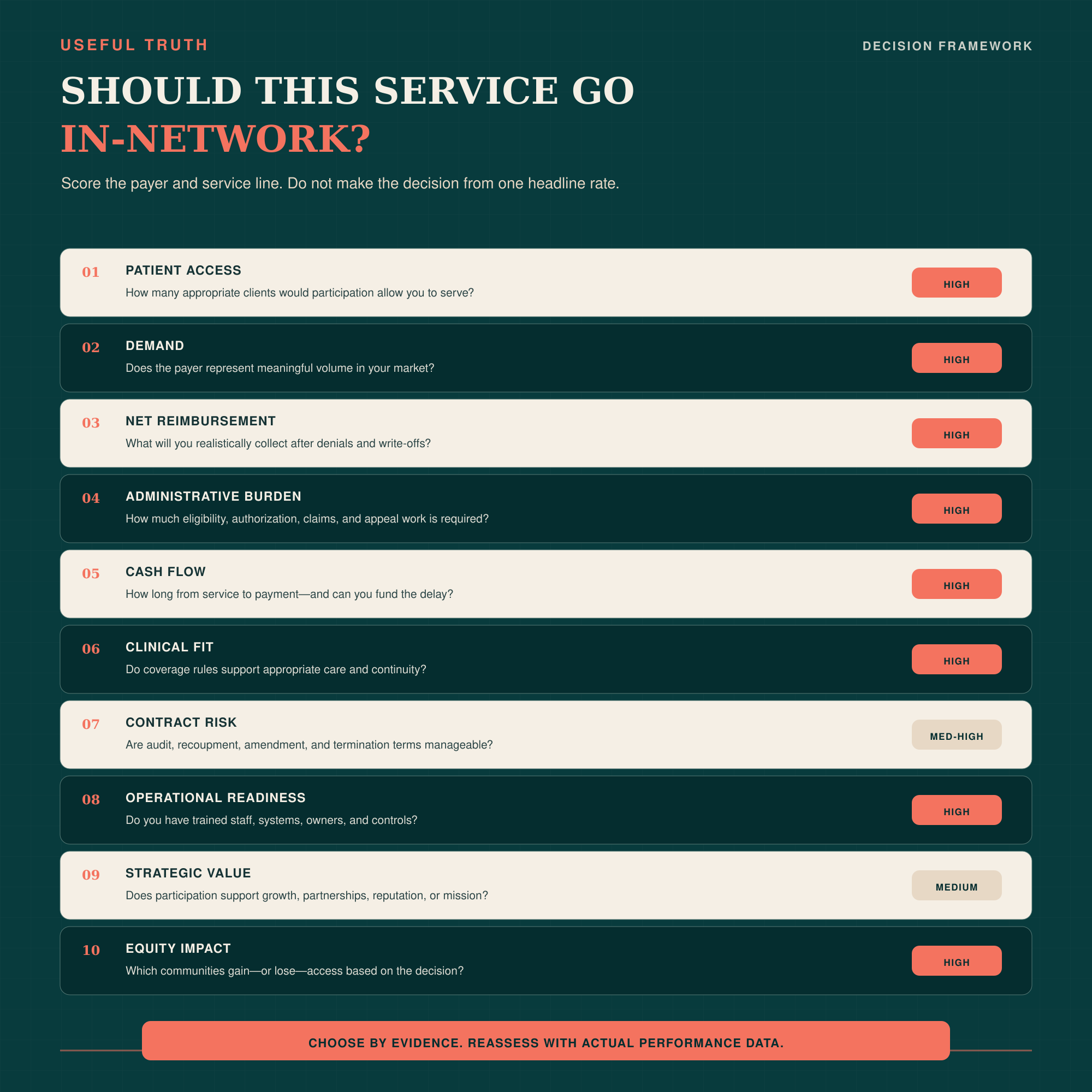
Do not let a contract score well because someone wrote “major regional payer” in the strategic-value box and then stopped thinking.
Use evidence. Assign owners. Revisit the decision after actual performance data is available.
WHY CREDENTIALING PROJECTS GO SIDEWAYS
Credentialing usually fails in the spaces between teams.
The clinician assumes HR submitted everything. HR assumes billing owns the payer application. Billing assumes the payer relations representative added the location. The payer says it never received the roster. Someone forwards an email from four months ago containing the phrase “should be all set.” Claims begin denying.
The most common operational failures are painfully ordinary:
no single owner;
no master provider-data file;
inconsistent names, addresses, taxonomies, and effective dates;
incomplete or expired CAQH information;
missing licenses, attestations, malpractice documents, or work-history explanations;
application status tracked in email rather than a shared system;
no follow-up cadence;
no escalation path;
the contract, credentialing, and claims teams using different effective dates;
providers scheduled before enrollment is confirmed;
no test claim;
no payer-directory validation; and
no recredentialing calendar.
Credentialing is not difficult because each individual task is intellectually extraordinary.
It is difficult because there are many tasks, multiple organizations, inconsistent systems, long wait periods, hidden dependencies, and very little tolerance for one wrong field.
It is the perfect project to postpone when everyone already has ten thousand other things on their plate.
It is also the perfect project to assign to Useful Truth.
WE WILL DO THE TASKS YOU DO NOT WANT TO DO
Providers did not complete years of education, supervision, examinations, and clinical training because they dreamed of spending Thursday afternoon uploading the same malpractice certificate to six payer portals.
Leaders should understand the process. They should not have to personally chase every application.
Useful Truth can build and manage the operational work required to move from “we should probably accept insurance” to “this provider is correctly enrolled, billable, tracked, and maintained.”
Depending on scope, that may include:
state licensing and renewal tracking;
multi-state licensure project coordination;
NPI and taxonomy review;
CAQH profile creation, cleanup, documentation, and attestation;
payer and product prioritization;
provider and group credentialing applications;
Medicare, Medicaid, and commercial enrollment support;
contracting workflow and fee-schedule analysis;
provider rosters and location additions;
EFT and ERA enrollment coordination;
malpractice, W-9, ownership, and disclosure-file organization;
application follow-up and escalation;
payer-status dashboards with owners, dates, blockers, and next actions;
directory validation;
recredentialing and revalidation calendars;
pre-billing readiness checks;
test-claim coordination;
denial-pattern review when enrollment errors surface; and
standard operating procedures so the process remains functional after the project ends.
We do not replace legal counsel, clinical leadership, certified coding expertise, or the payer’s own approval process. We do make sure the correct work is organized, assigned, completed, followed up, verified, and visible.
Because “the application was submitted” is not a deliverable.
An operationally ready provider is.
THE DECISION SHOULD SUPPORT CARE—NOT CONSUME IT
Going in-network can be one of the most meaningful access decisions a behavioral-health organization makes. It can also be financially damaging if the rates, service rules, payer mix, or administrative structure do not work. Remaining out-of-network can protect autonomy, quality, time, and sustainability.
It can also exclude clients who cannot afford to pay first and argue with their insurance company later.
There is no morally pure answer and no universal business model.
There is only the responsibility to understand the tradeoffs, use real data, communicate honestly with clients, and build the infrastructure required by the decision you make.
Do not join a network solely because it sounds accessible.
Do not stay out solely because credentialing is annoying.
Determine which payers and services create sustainable access. Calculate what you actually collect. Account for the work required. Read the contract. Track every application. Verify every effective date. Protect cash flow. Measure denials. Revisit the strategy.
And if the licensing, credentialing, enrollment, and follow-up work keeps falling to the bottom of your list, give it to people who genuinely enjoy turning a giant administrative mess into a controlled operating process.
You take care of the clients.
We will deal with the portal that has rejected your password for the fourth time despite the fact that you just reset it.
That feels like a fair division of labor.
