Your Behavioral-Health Program Passed The Audit. So Why Is Everything Still On Fire?
Compliance can confirm that a system exists. It cannot prove that the system works.
There is a very specific kind of relief that moves through a behavioral-health organization after a successful audit.
The surveyor leaves. Leadership exhales. Someone sends a celebratory email with an irresponsible number of exclamation points. A certificate eventually appears in the lobby, where it begins its distinguished career of quietly implying that everything inside the building is under control.
And, to be clear, passing an audit matters.
Licensure, accreditation, payer requirements, credentialing standards, safety rules, and documentation expectations exist for a reason. They establish necessary protections for people receiving care. They create external accountability. They can force organizations to examine systems that might otherwise remain neglected until something goes wrong.
But passing an audit does not prove that your organization works well every day.
It proves that, at a particular point in time, the organization demonstrated sufficient evidence of compliance with the standards being reviewed.
That is important evidence.
It is not the same thing as operational proof.
Because the auditor may confirm that a policy exists. The auditor cannot spend the next six months watching whether the policy is followed on a Friday night when census is high, two staff members called out, a family is furious, the on-call chain is unclear, and the only person who understands the workflow is on a plane to Cabo.
The binder can be immaculate while the workflow is on fire.
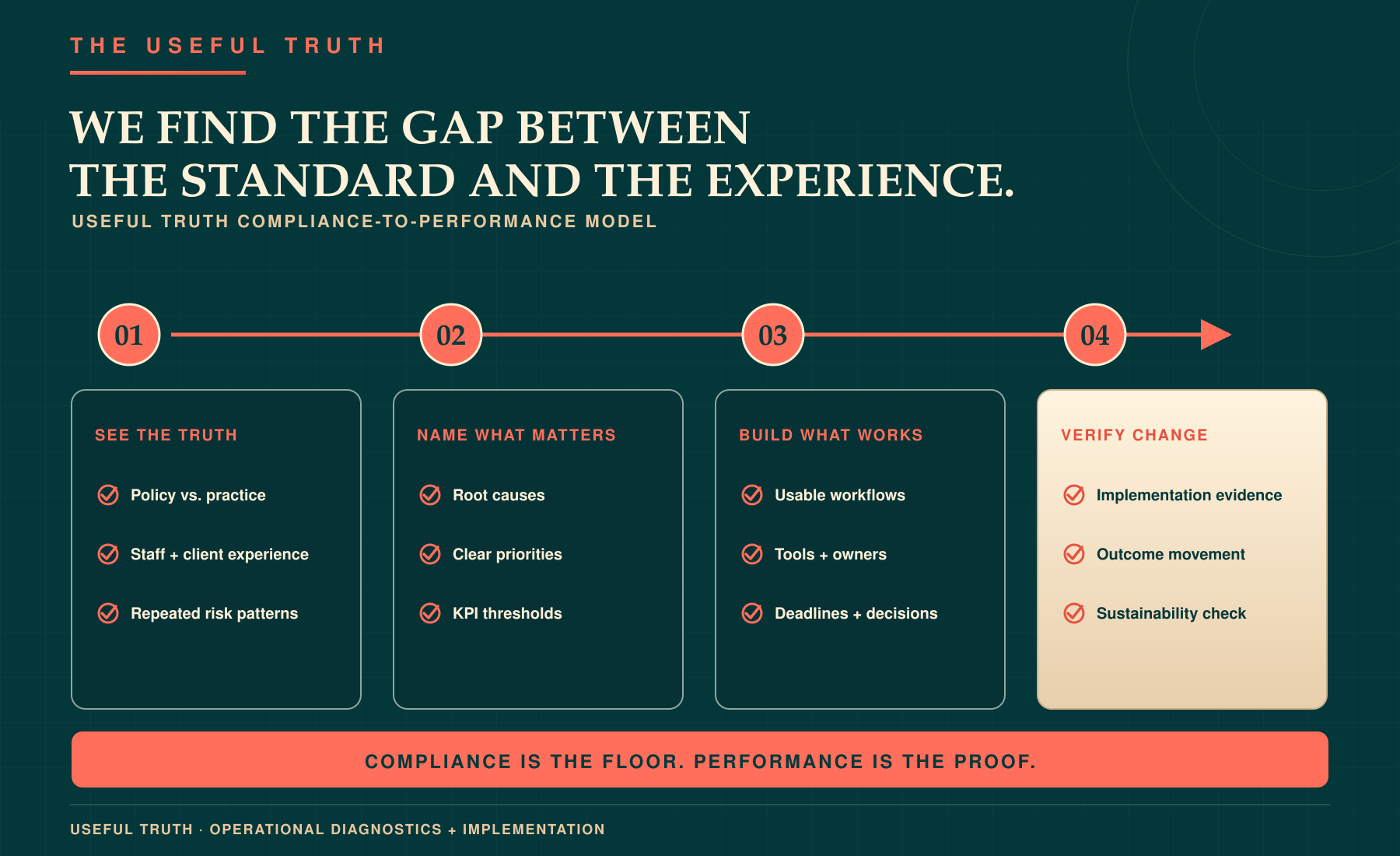
That is the gap this article is about.
Not the gap between compliance and noncompliance. The more dangerous gap is between documented compliance and operational reality—between what an organization can show and what its clients, families, and employees actually experience.
And closing that gap requires more than another policy.
It requires enough humility to admit that passing the test does not mean there is nothing left to learn.
Accreditation Is Valuable. It Is Also Not Magic.
The point is not that accreditation is meaningless. The evidence does not support that conclusion.
A 2026 systematic review examining 13 studies found that healthcare accreditation was associated with improvements in patient safety, organizational performance, and quality of care. But the magnitude of those improvements varied substantially across settings. The review found that sustainability depended on factors such as governance, leadership commitment, workforce capacity, resources, staff participation, and the organization’s ability to integrate standards into routine practice—not merely prepare for a survey. The authors also described administrative burden, staff stress, and “compliance fatigue” as persistent challenges. (Bhoomadevi et al., 2026)
That distinction matters.
Accreditation can create the structure for improvement. It does not operate the structure for you.
It can require an incident-review process. It cannot make leaders respond honestly to what the incidents reveal.
It can require staff training. It cannot guarantee that staff are competent, supported, or able to apply the training under pressure.
It can require measurement. It cannot force an executive team to look at a bad number without explaining it away, changing the denominator, blaming the employee who found it, or scheduling a meeting to discuss scheduling another meeting.
Standards create expectations. Organizations create behavior.
The best programs use accreditation as scaffolding for a stronger operating system. The weaker ones use it as theater: intense preparation before the visit, beautiful documentation during the visit, and a slow return to business as usual afterward.
Nobody puts “business as usual” in the mission statement. It still seems to be one of the industry’s most consistently delivered services.
The Survey-Ready Illusion
An organization can look highly functional when its evidence has been carefully assembled.
Policies have signatures. Personnel files have checklists. Meeting minutes contain words such as reviewed, discussed, and ongoing. Corrective-action plans say the team was retrained, which is apparently the healthcare equivalent of turning a computer off and back on again.
The problem is not that these things are inherently useless. The problem is that organizations often mistake the presence of an artifact for proof of an effective process.
There is a difference between:
having a policy and having a reliable workflow;
documenting training and validating competency;
discussing a problem and assigning accountability;
collecting data and using it to make a decision;
closing a corrective action and verifying that the problem stopped;
completing an audit and improving care.
When the evidence is disconnected from the work, compliance becomes a parallel universe. One version of the organization exists in the policy manual. Another exists in the hallway.
The people working in the hallway know the difference.
They know which policies are outdated. They know which workarounds keep the day moving. They know which manager will respond, which escalation will disappear, which numbers leadership does not want to see, and which “temporary” process has quietly celebrated three birthdays.
The question is whether leadership is willing to know it too.
What an Audit Can Confirm—and What Operations Must Prove
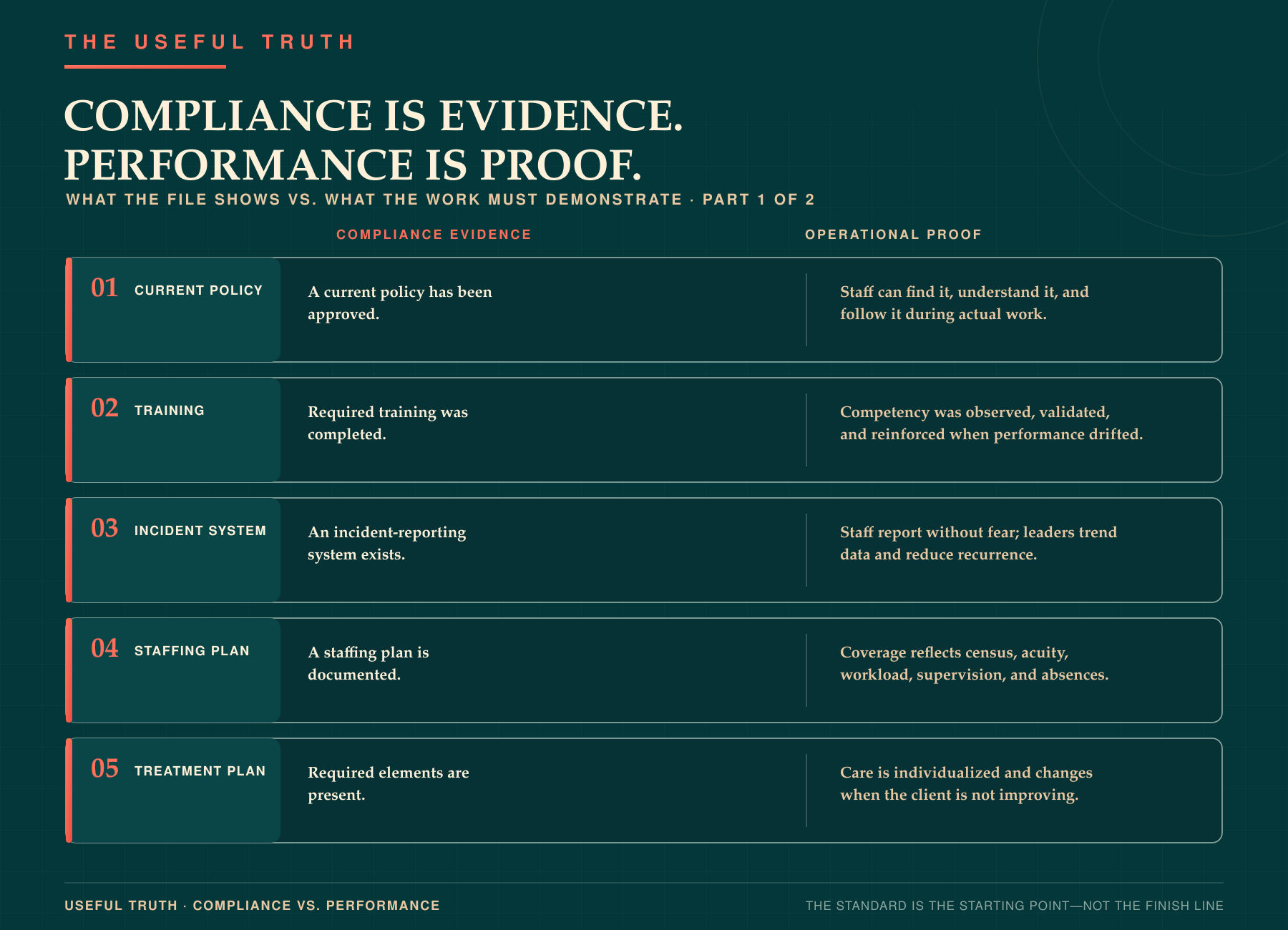
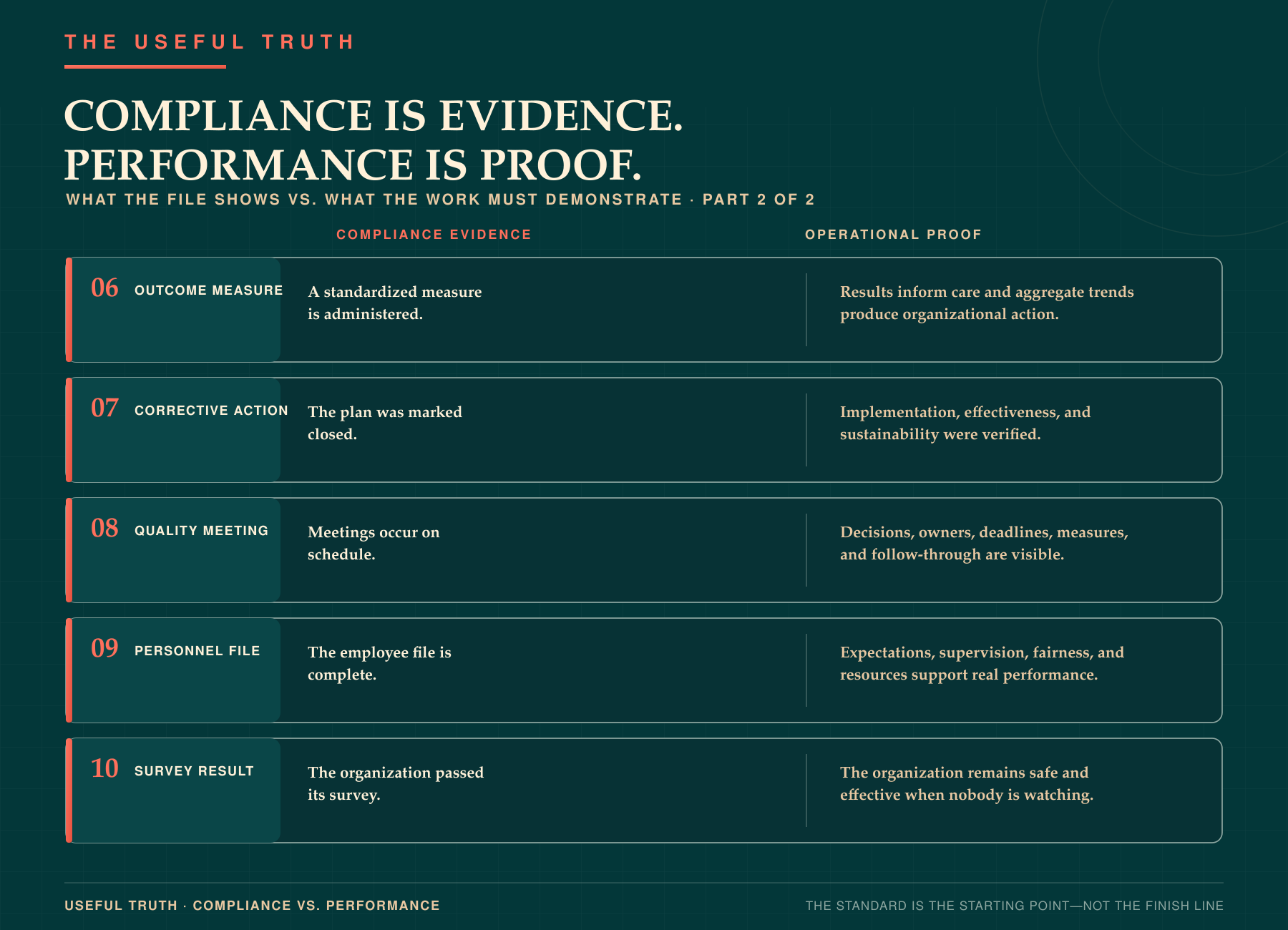
That final row is the entire point.
Compliance asks: Can you demonstrate that the requirement is addressed?
Quality improvement asks: Is the system producing the result it was designed to produce?
Those are related questions. They are not interchangeable.
Measurement That Does Not Change Anything Is Just Administrative Decor
Behavioral-health organizations collect extraordinary amounts of information.
Assessments. Progress notes. Incident reports. Satisfaction surveys. Attendance records. Authorization dates. Discharge summaries. PHQ-9 scores. GAD-7 scores. Staffing grids. Productivity reports. Denial reports. Training logs. Complaints. Grievances. Chart audits. Census data.
The industry does not have an information shortage.
It has a conversion problem.
Too often, data enters the organization and never completes the journey from information to decision to action to verified improvement.
The Joint Commission’s current guidance on measurement-based care makes that expectation explicit. Behavioral-health organizations are expected to administer standardized measures at multiple points, use the feedback to inform individual care, and aggregate the data for organizational performance improvement. The stated goal is not merely to collect a score; it is to use the information to identify opportunities for higher-quality care and determine where programs or practitioners may need additional support. (Joint Commission, updated May 7, 2026)
That is the difference between measurement and management.
If the PHQ-9 is completed because a field is required, but nobody reviews the trend, the organization has collected data.
If leadership receives a monthly no-show report, but no one distinguishes access barriers from engagement problems, the organization has distributed data.
If incidents are counted, but no one evaluates pattern, severity, location, shift, contributing conditions, recurrence, or completion of corrective actions, the organization has archived data.
None of those activities necessarily improves anything.
The useful question is not, “Do we track it?”
The useful questions are:
What decision is this measure intended to inform?
Who owns reviewing it?
What result requires action?
What action occurs when that threshold is reached?
How will we know whether the response worked?
If a metric cannot answer those questions, it may still be required for reporting. But it is not yet functioning as a management tool.
It is a number with a recurring calendar invitation.
Safety Culture Is What Happens After Someone Tells You the Truth
Organizations love to say that staff should speak up.
The real test begins after they do.
Does leadership become curious or defensive?
Is the concern evaluated or personalized?
Does the employee receive follow-up, or do they learn that reporting a problem creates more work for the person who reported it and very little work for the person who owns it?
Are mistakes examined as products of human behavior interacting with system design, or does the organization immediately search for the nearest individual to blame?
These are not soft culture questions. They affect what leadership can see.
In AHRQ’s 2024 Hospital Survey on Patient Safety Culture database, which included 284,036 staff respondents from 445 hospitals, staffing and work pace was the lowest-scoring composite measure at 55% positive. “Response to error” was also among the lowest at 64% positive. Only 47% of respondents said they had reported at least one patient-safety event during the prior 12 months. These data are hospital-based rather than specific to every behavioral-health setting, but the operational warning is highly relevant: a safety system cannot learn from information it never receives. (AHRQ, 2024)
AHRQ’s guidance on responding to patient-safety events emphasizes reporting, investigation, communication, remediation, data tracking, and system improvement. It also stresses that near misses can reveal latent hazards and that corrective action should include ongoing measurement to determine whether the improvement actually worked. (AHRQ PSNet, 2025)
In other words, the incident report is not the conclusion.
It is the opening sentence.
If employees stop reporting problems because previous reports disappeared, leadership may see fewer incidents and mistakenly believe the organization became safer.
It may have simply become quieter.
Quiet is not the same as safe.
Sometimes quiet is what fear sounds like on a dashboard.
Humility Is an Operational Control
Humility is usually discussed as a personality trait. In leadership, it is also a control mechanism.
A humble operating system allows the organization to receive information that contradicts its preferred story.
It makes room for sentences such as:
“This policy does not match what staff can realistically do.”
“We trained everyone, but the error is still happening.”
“Our completion rate looks good because we excluded the people who left early.”
“The program is growing, but staffing, supervision, and infrastructure are not keeping pace.”
“The dashboard is green because the target is meaningless.”
“Our employees are not resistant to accountability. They are resistant to being held accountable for systems they do not control.”
“Clients are satisfied with the therapist and frustrated with everything required to reach the therapist.”
“The corrective action was completed on paper. The problem did not change.”
An organization that can hear these statements can improve.
An organization that treats them as insubordination will eventually lose both the messenger and the message.
This is why leadership behavior belongs inside quality improvement. You cannot build a reliable feedback system around leaders who only accept favorable feedback.
The system will adapt. Staff will bring smaller concerns, soften the language, avoid certain topics, or stop speaking entirely. The data will become cleaner as the truth becomes less visible.
Then everyone gets to be surprised later.
Again.
Humility does not mean accepting every complaint as correct. It means being willing to examine the evidence before defending the current state.
The goal is not to make leaders feel bad.
The goal is to make the system better.
A Quality Dashboard Should Show More Than Whether the Paperwork Was Completed
Behavioral-health quality improvement requires both leading indicators and lagging indicators.
Lagging indicators tell you what already happened: a client discharged early, a claim denied, an employee resigned, a safety event occurred, or an outcome worsened.
Leading indicators show whether the conditions that produce those results are beginning to change: follow-up was scheduled before discharge, documentation was completed on time, supervision occurred, vacancies remained open, corrective actions were overdue, or a standardized measure showed that a client was not improving.
An effective dashboard connects the two.
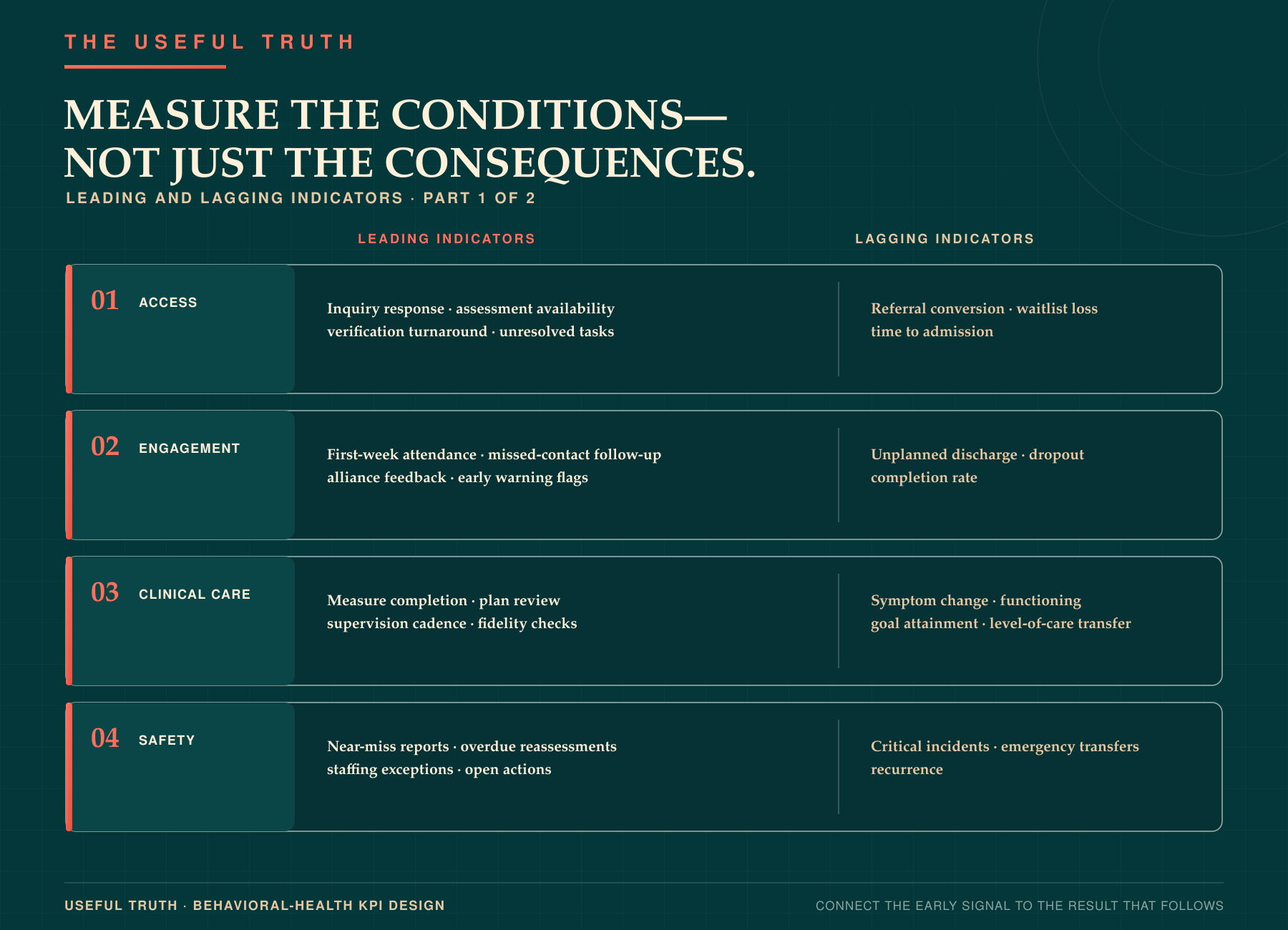
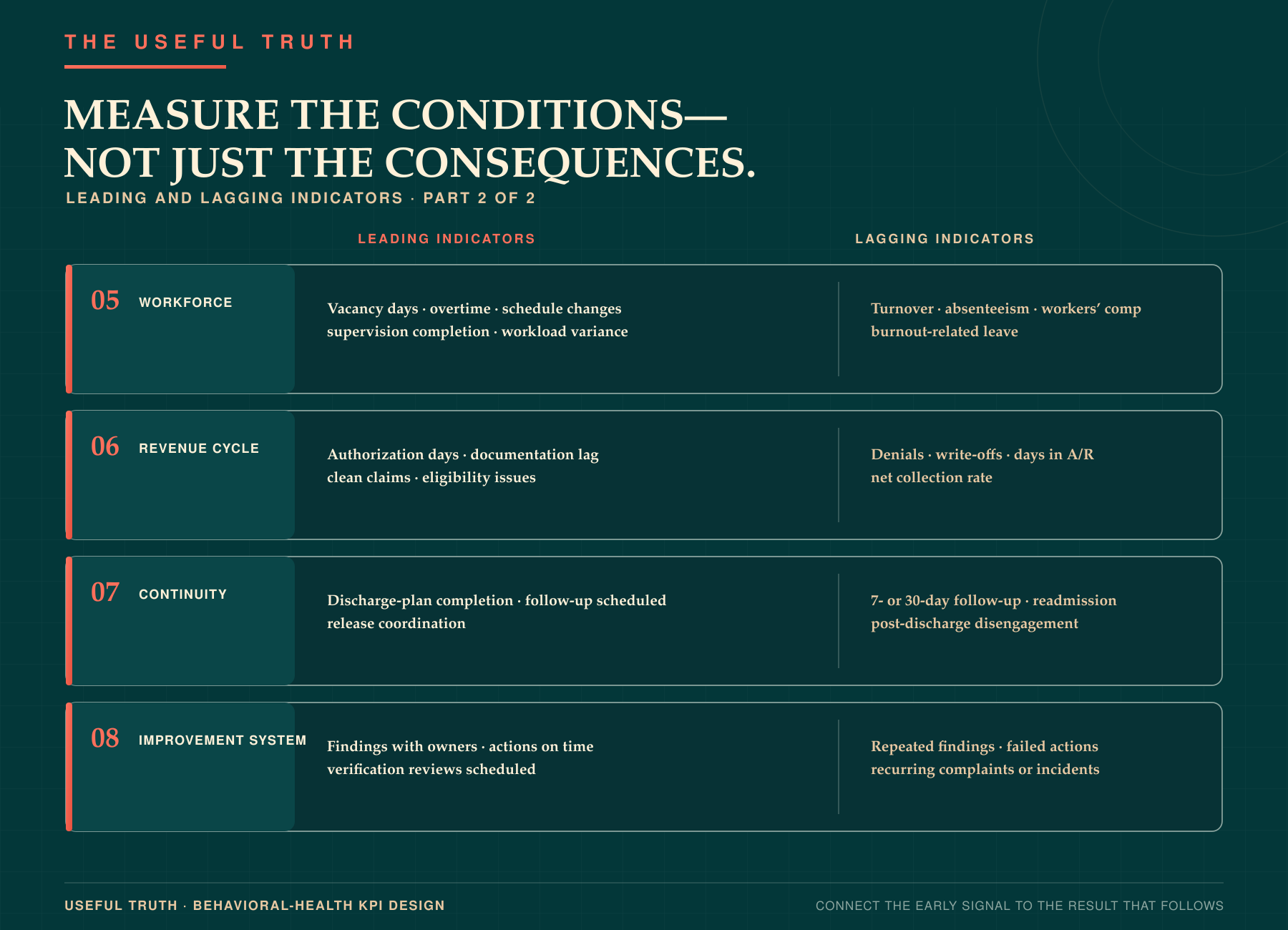
The point is not to put every available number on one dashboard until it resembles the cockpit of a small aircraft.
The point is to select measures that reveal whether the organization’s most important systems are working—and to make ownership and response visible.
CMS’s National Quality Strategy reflects this broader approach. It combines regulatory oversight with quality measurement, public reporting, improvement assistance, person-reported outcomes, safety, workforce resiliency, and data-driven care. It specifically identifies behavioral health as a high-priority area and emphasizes that measures should be used to identify opportunities, evaluate progress, improve outcomes, and reduce reporting burden. (CMS, 2024)
That last part matters too.
Good measurement should reduce confusion.
If your quality system creates enormous reporting work without improving a single decision, you have built a very expensive method for exhausting the people you need to retain.
Why Corrective-Action Plans So Often Correct Nothing
Corrective-action plans commonly fail for predictable reasons:
the finding is vague;
the investigation stops at human error;
“retraining” is selected before the cause is understood;
the action has no named owner;
the deadline is aspirational;
completion is confused with effectiveness;
no one checks whether the change lasted;
the same problem appears under a new name six months later.
“Staff reminded” is not a root-cause analysis.
“Leadership will monitor” is not an implementation plan.
“Resolved” is not evidence.
A credible corrective-action record should answer the following:
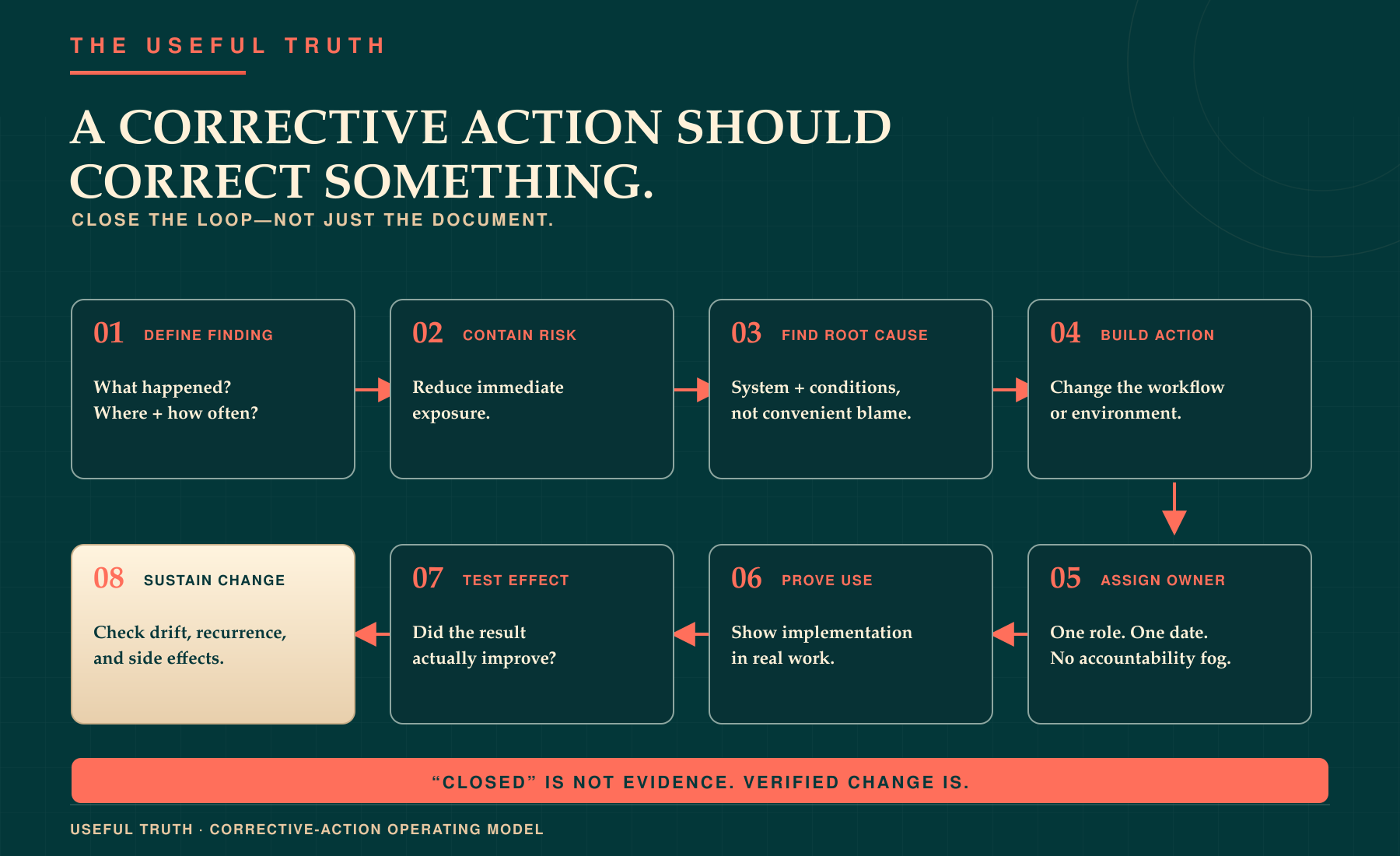
The action is not complete when the new form is uploaded.
It is complete when the intended risk is reduced and the organization has evidence that the improvement held.
That is a much higher standard.
It is also how improvement becomes real.
Seven Signs Your Organization Is Compliant but Not Improving
1. The same finding keeps returning.
The wording changes. The committee changes. The underlying problem does not.
Repeated findings are not evidence that employees need another reminder. They are evidence that the previous response did not address the system that produced the problem.
2. Quality work becomes urgent only before a survey.
If policies, personnel files, environmental rounds, and chart audits suddenly become fascinating six weeks before an inspection, quality has not been integrated into operations. It has been scheduled as an event.
3. Leaders review completion without reviewing impact.
The training occurred. The policy was revised. The meeting was held. The action item was checked.
Wonderful.
What changed?
4. Every root cause is an employee.
People make mistakes. People also work inside systems designed by leadership.
If every incident concludes that someone failed to follow policy, but nobody asks whether workload, staffing, technology, handoffs, supervision, conflicting expectations, or policy design contributed, the analysis is incomplete.
5. Bad news takes longer to travel upward than good news.
Strong organizations make escalation easy. Weak organizations create subtle penalties for inconvenient information and then wonder why problems appear “suddenly.”
6. The quality department owns everything.
Quality professionals can coordinate, monitor, advise, and verify. They cannot personally operate every department’s workflows. If operational leaders do not own the quality of their systems, the quality department becomes an administrative cleanup crew with a clipboard.
7. Passing the audit ends the conversation.
The strongest response to a successful survey is not, “We are done.”
It is, “Good. Now what did the survey not show us?”
From Survey-Ready to Reality-Ready: A 30-Day Starting Point
You do not need to rebuild the entire organization in one quarter.
You do need to stop pretending that everything has equal urgency.
Start with three high-risk workflows. Choose processes that affect safety, continuity, revenue, workforce stability, or access to care. Examples might include:
incident response;
intake-to-admission conversion;
medication reconciliation;
suicide-risk reassessment;
authorization and documentation handoffs;
unplanned discharge;
staffing and on-call escalation;
follow-up after discharge.
Then use the next 30 days deliberately.
Days 1–7: Compare the policy to the work
Identify the current policy, procedure, training material, form, and system configuration.
Interview the people who actually perform the work.
Observe the workflow or trace recent cases.
Document where practice differs from policy—and why.
Days 8–14: Find the failure pattern
Review incidents, complaints, delays, denials, rework, near misses, and employee feedback.
Separate isolated mistakes from recurring system conditions.
Identify the points where ownership becomes unclear or information disappears.
Days 15–21: Build the response
Define the desired future-state workflow.
Assign decision rights and accountability.
Remove unnecessary steps.
Configure the form, EMR, tracker, template, or alert required to support the work.
Define one leading and one lagging measure.
Days 22–30: Test whether it works
Pilot the workflow with the people who will use it.
Validate competency through observation, not attendance alone.
Review exceptions and unintended consequences.
Set a 30-, 60-, or 90-day effectiveness check.
Report what changed, what did not, and what happens next.
That is continuous quality improvement in practical terms.
Not perfection.
Not an accusation.
An honest comparison between the system you intended to build and the one currently operating—followed by disciplined action to close the gap.
There Is Always Room for Improvement. That Is Not an Insult.
Some leaders hear “there is room for improvement” as criticism of their competence.
It is not.
Every organization has room for improvement because every organization operates in changing conditions. Staff turn over. Regulations evolve. Programs grow. Payers change requirements. Technology is replaced. Client acuity shifts. Workarounds accumulate. One person becomes the unofficial owner of six processes, and then has the audacity to take a vacation.
Systems drift.
The leadership failure is not that drift occurs.
The failure is refusing to examine it.
Good organizations are not organizations without problems. They are organizations that can identify problems without collapsing into blame, denial, or theater.
They can say:
“We thought this was working. The evidence says it is not.”
“The policy is technically correct and operationally unusable.”
“We do not yet understand the cause.”
“The employee who raised this concern may be telling us something important.”
“This metric makes us look good but does not tell us whether clients are getting better.”
“We passed the audit, and we still have work to do.”
That last sentence is not weakness.
It may be one of the strongest things a behavioral-health leader can say.
Because improvement does not begin with having all the answers.
It begins with being honest enough to ask a better question.
Where Useful Truth Fits
Useful Truth helps behavioral-health organizations examine what exists between the standard and the lived experience.
We do not approach an organization looking for reasons to declare it broken. We look for the hidden friction preventing capable people from doing the work the organization already says matters.
That may include:
comparing policies with real workflows;
tracing intake, clinical, operational, and revenue-cycle handoffs;
identifying repeated findings and unresolved risk;
evaluating staffing, workload, supervision, and accountability;
defining meaningful KPIs and decision thresholds;
building dashboards leaders can actually use;
redesigning corrective-action and follow-through systems;
connecting measurement-based care to program-level outcomes;
converting recommendations into tools, owners, deadlines, and implementation plans.
We are direct because ambiguity is expensive.
We are evidence-driven because opinions do not close operating gaps.
And we produce because a beautiful deck that nobody opens again is not transformation. It is office décor with page numbers.
Our goal is not to help an organization look ready for one day.
It is to help the organization work better on all the days that follow.
The Useful Truth
Passing an audit is an achievement.
Treating it as proof that the organization has nothing left to improve is a liability.
Compliance tells you whether required structures are present.
Operational evidence tells you whether people can use those structures reliably.
Outcomes tell you whether the work is helping.
Culture determines whether anyone is willing to tell you when it is not.
The goal is not to be less compliant.
The goal is to stop confusing compliance with performance.
There is always room for improvement.
You just have to be humble enough to admit it—and disciplined enough to do something with what you find.
If your organization is survey-ready but the day-to-day work still feels harder than it should, Useful Truth can help you identify the gap, build the operating tools, and verify that the change actually worked.
Start a conversation with Useful Truth →
Frequently Asked Questions
Does behavioral-health accreditation guarantee high-quality care?
Accreditation demonstrates that an organization met the applicable standards reviewed through the accreditor’s process. It is an important indicator, but it does not guarantee that every workflow is consistently followed, every employee is supported, or every client will achieve a positive outcome. Quality also depends on leadership, workforce capacity, implementation, measurement, and ongoing improvement.
What is continuous quality improvement in behavioral health?
Continuous quality improvement is a structured process for identifying performance gaps, understanding causes, implementing targeted changes, measuring whether those changes worked, and sustaining or revising the response. It connects compliance requirements to real workflows, client outcomes, safety, access, workforce performance, and operational reliability.
What should a behavioral-health quality dashboard include?
The dashboard should reflect the organization’s services, risks, populations, payer requirements, and priorities. Common domains include access, engagement, clinical outcomes, safety, continuity, client experience, workforce stability, revenue-cycle performance, and corrective-action completion. Every KPI should have a definition, owner, target, review cadence, and response plan.
Why do corrective-action plans fail?
Corrective actions often fail because the finding is vague, the root cause is incomplete, retraining is used as the default solution, accountability is unclear, or completion is not followed by an effectiveness review. A strong corrective-action process verifies both implementation and sustained risk reduction.
How often should a behavioral-health organization conduct internal audits?
There is no responsible universal schedule for every audit. Frequency should reflect applicable law, accreditation, payer obligations, policy requirements, service type, prior findings, incident trends, organizational change, and risk. High-risk or unstable workflows should be reviewed more frequently than mature, consistently performing systems.
What is the difference between compliance and quality improvement?
Compliance demonstrates adherence to a defined requirement. Quality improvement evaluates whether a system is producing the intended result and uses evidence to improve performance. An organization needs both: compliance establishes essential expectations, while quality improvement helps ensure those expectations translate into safe, effective, and reliable care.