
Good Programs Can Prove It
What ethical behavioral-health organizations do differently—and why outcomes may be their strongest marketing strategy
The last article asked a fairly uncomfortable question: What happens when a behavioral-health organization’s mission statement and operating model are telling two entirely different stories?
This one asks the better question.
What are the good organizations doing?
Not the organizations with the most expensive website. Not the program with the prettiest campus, the largest referral dinner budget, or the most creative use of the phrase individualized care. I mean the organizations that are actually safe, ethical, effective, operationally sound, and worthy of the trust placed in them.
What are they doing differently?
The answer is not that they have no problems. Every behavioral-health organization has problems. The work is complex. Clients arrive with different histories, needs, risks, resources, diagnoses, family systems, and definitions of recovery. Insurance is a delight, assuming your preferred form of delight is administrative combat. Employees are human. Technology fails. Demand changes. A program can make thoughtful decisions and still encounter difficult outcomes.
Good organizations are not perfect organizations.
They are truth-responsive organizations.
They know what they are designed to do. They know where their limitations are. They measure whether the care is working. They pay attention when employees, clients, families, referral partners, incidents, finances, or outcomes tell them something is wrong. Then they change the operation instead of changing the subject.
And, increasingly, the strongest ones can demonstrate their value with more than a mission statement and five carefully selected testimonials.
They have evidence.
Nothing says evidence-based care quite like evidence. Radical concept, I know.
A good program knows exactly what it is promising
Behavioral-health organizations frequently describe themselves with broad, emotionally compelling language: healing, transformation, hope, excellence, whole-person care, lasting recovery.
Those words are not inherently meaningless. They become meaningful when the organization defines what they require operationally.
If a program promises individualized care, it should be able to show how assessment findings change treatment plans, schedules, interventions, and discharge planning.
If it promises evidence-based treatment, it should be able to identify the modalities being delivered, the training and supervision required, how fidelity is supported, and how the organization knows whether clients are responding.
If it promises safety, it should be able to show how staffing reflects acuity, how competency is validated, how incidents are reviewed, and how corrective actions are verified.
If it promises lasting change, it should be able to explain what change it measures, when it measures it, whose outcomes are included, and what happens when the results are not impressive.
Good organizations translate values into requirements.
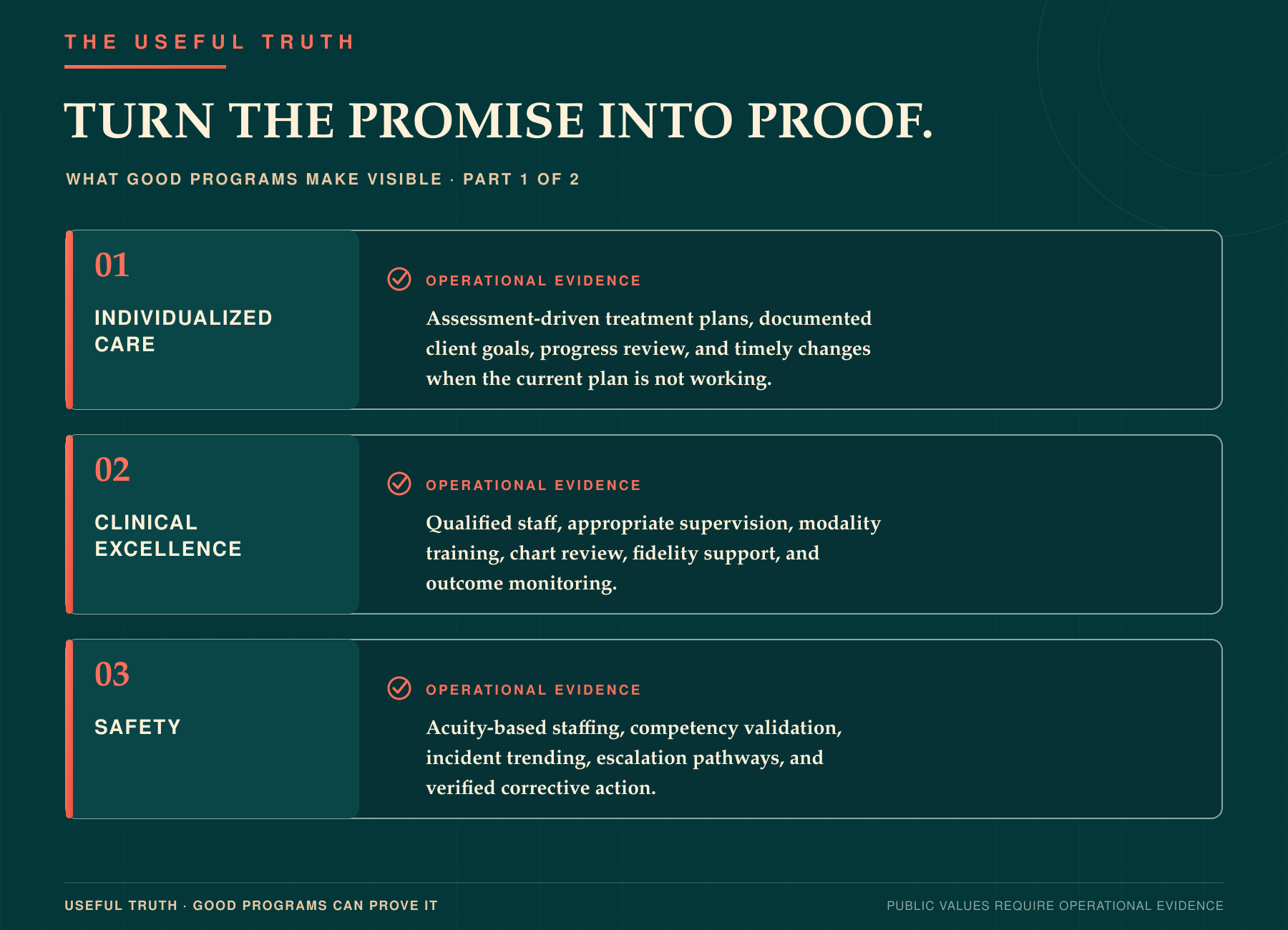
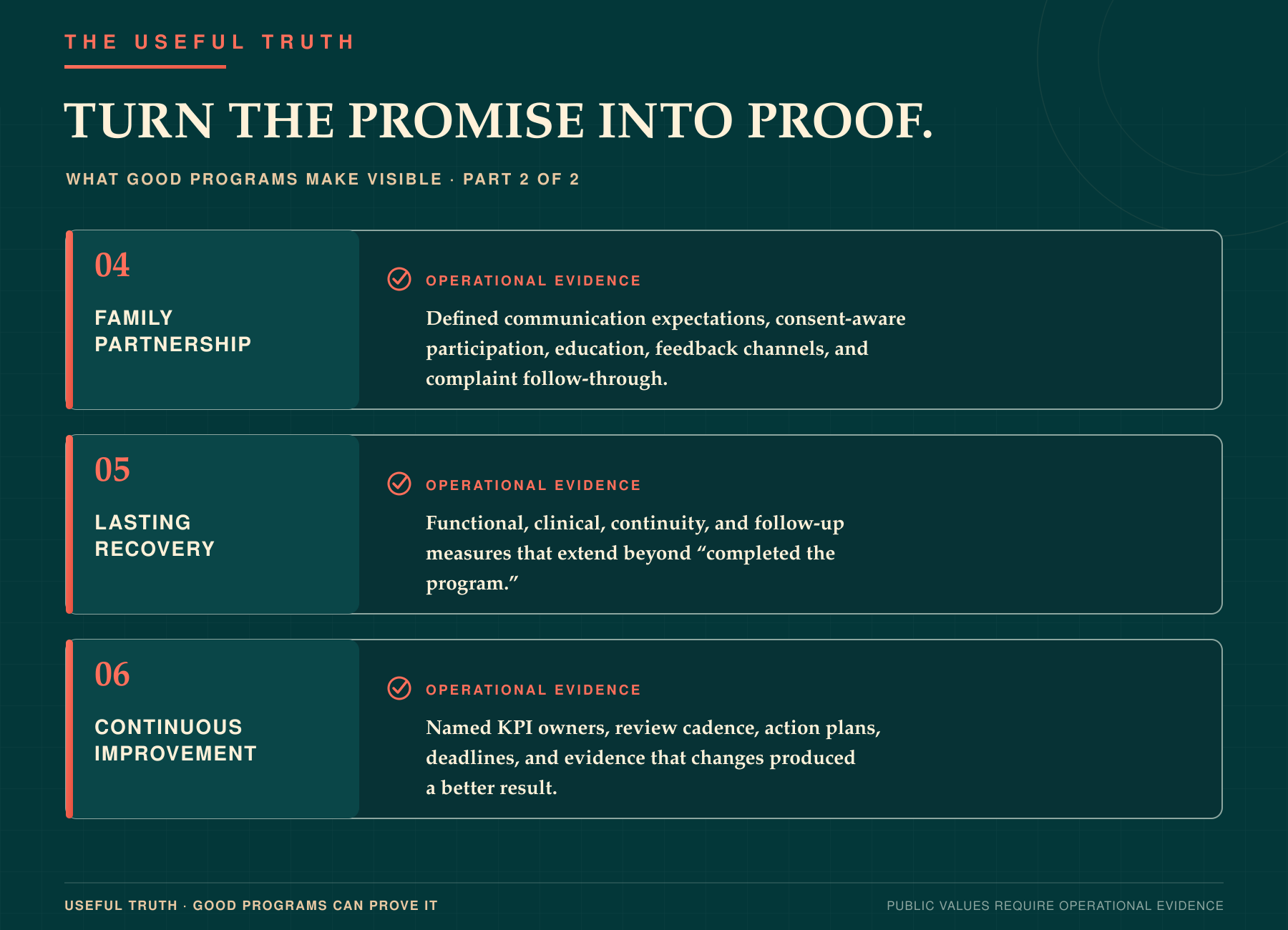
This is the first thing strong programs do differently: they operationalize the promise.
What good behavioral-health organizations consistently do
The details vary by service, population, level of care, jurisdiction, payer, accreditation, and clinical model. There is no single operating template that makes every program ethical or effective.
But well-run organizations tend to share several habits.
1. They define their scope—and they can say no
Good programs are clear about who they can safely and effectively serve.
They establish admission and exclusion criteria that reflect actual staffing, licensing, supervision, medical capacity, environment, and programming. They do not quietly expand their clinical claims every time the census is low.
They understand that declining an inappropriate admission may cost revenue today and protect a client, employee, referral relationship, and organizational reputation tomorrow.
This is not a lack of compassion. It is the discipline required to prevent desperation from becoming a business model.
2. They staff for the work—not merely the schedule
A schedule tells you who is supposed to be present. It does not tell you whether the team can safely meet the needs of the clients in front of them.
Good programs look at census, acuity, observation requirements, medical needs, programming, transportation, documentation, supervision, admissions, discharges, employee experience, and the predictable chaos that apparently never received a calendar invitation.
They monitor vacancies, overtime, agency use, sick calls, turnover, caseloads, group coverage, supervision completion, and time to competency. They understand that employee stability is not separate from client care. It is one of the conditions that makes consistent care possible.
3. They make it safe to tell the truth
Strong organizations do not treat every uncomfortable observation as a cultural threat.
Employees can raise a concern. Clients can report a disappointing experience. Families can ask hard questions. Leaders can say that an initiative is not working. Data can contradict the original plan without someone being required to ceremonially sacrifice the messenger.
Good organizations distinguish between disrespect and disagreement. They investigate patterns instead of automatically defending the person with the highest title. They use accountability fairly, specifically, and in every direction.
Psychological safety does not mean nobody receives hard feedback. It means feedback can be given, examined, and acted on without fear determining the outcome.
4. They measure care while there is still time to improve it
This is where outcome measurement becomes more than a research project.
The Joint Commission describes measurement-based care as monitoring outcomes over the course of service with a standardized instrument. Its current guidance says accredited behavioral-health organizations should administer measures at multiple intervals, use the feedback to inform goals and treatment decisions, and aggregate the information for organizational performance improvement. (The Joint Commission, Measurement-Based Care)
In other words, the purpose is not to make a client complete a questionnaire at admission so the form can spend eternity becoming one with the electronic medical record.
The purpose is to learn:
Is the client improving?
Is the improvement meaningful?
Is progress occurring where the client actually wants change?
Is the client deteriorating?
Does the treatment plan need to change?
Is one program, location, clinician, or intervention producing a different pattern?
Are certain populations engaging, improving, or completing at different rates?
A major review in JAMA Psychiatry defined measurement-based care as the systematic evaluation of symptoms before or during an encounter to inform treatment. The authors noted that it can speed improvement and detect deterioration that might otherwise be missed, while also documenting substantial implementation barriers at the client, clinician, organizational, and system levels. (Lewis et al., 2019)
Measurement alone is not the intervention. The response to the measurement is what matters.
5. They connect clinical, operational, financial, and workforce data
Good organizations do not review clinical outcomes in one meeting, staffing in another, denials three weeks later, and incidents only after something becomes legally exciting.
They examine the relationships.
If outcomes worsen, did acuity change? Did turnover increase? Was a supervisor vacant? Did group attendance decline? Were authorizations shortened? Were clients missing follow-up appointments? Did the program expand without adding infrastructure? Did documentation delays interfere with treatment coordination? Did clinicians lose protected time because another role remained unfilled?
Good organizations do not use data merely to grade employees. They use it to understand the system producing the result.
6. They close the loop
Many organizations can identify a problem. Far fewer can show what happened next.
A good program assigns an owner, deadline, expected result, reporting cadence, and verification method. It checks whether the corrective action was completed and whether completing it actually improved anything.
“Discussed in leadership” is not a corrective action.
Neither is “continue to monitor,” the administrative equivalent of putting a houseplant next to the problem and hoping they grow together.
7. They communicate results honestly
Strong programs do not wait for flawless data before becoming transparent. They explain what was measured, who was included, what improved, what did not, what the limitations were, and what they are changing.
They understand that credibility does not come from claiming perfection.
It comes from demonstrating seriousness.
Outcome measurement, outcomes management, and an outcome study are not the same thing
These terms are often blended together, which is one reason organizations become overwhelmed before they begin.
Measurement-based care: the individual level
Repeated information is collected and used with a specific client to guide treatment. A symptom, functioning, recovery, quality-of-life, alliance, or other relevant measure is administered at meaningful intervals. The clinician and client review the result and use it to support decisions.
Outcomes management: the program level
Individual data are aggregated to identify patterns across programs, services, locations, clinicians, populations, or periods. Leadership uses the information for quality improvement, resource decisions, training, program design, and accountability.
Outcome study: the evaluative level
A defined question is examined using a documented method. The organization establishes a population, time period, measures, inclusion rules, analysis plan, and limitations. Depending on the purpose and design, this may remain an internal quality-improvement evaluation or may require research oversight, privacy review, an institutional review board, or an external research partner.
You do not need to begin with a peer-reviewed, multisite, randomized clinical trial conducted by 14 people whose names collectively occupy half the first page.
You do need to begin with a credible question and a defensible process.
Outcomes may be the best marketing strategy behavioral health keeps neglecting
Behavioral-health marketing has a trust problem.
Families and clients are asked to make high-stakes decisions using information largely supplied by the organization selling the service. Websites can describe philosophy, amenities, staff credentials, therapies, and testimonials. They rarely tell a prospective client how the organization knows its care is effective.
That is a missed opportunity.
Outcome data can help an organization communicate:
who it serves;
what changes during care;
how quickly change tends to occur;
whether clients improve in symptoms, functioning, engagement, or quality of life;
what percentage complete the recommended episode of care;
how continuity is supported after discharge;
which clients may need a different or more intensive service;
and what the organization has changed based on what it learned.
That information can strengthen conversations with clients, families, referral partners, clinicians, payers, boards, investors, and prospective employees.
It can support differentiation without resorting to louder adjectives.
It can help a referral source say, “This program serves this population, measures these domains, and can show this pattern of change.”
It can help a family understand what the program means when it says better.
It can help a payer evaluate whether a service is producing value rather than simply producing units.
And it can help an organization recruit employees who want to know that their work is making a meaningful difference.
That is marketing—but it is marketing rooted in operational truth.
The distinction matters. The Federal Trade Commission’s general health-claims guidance emphasizes that advertising must be truthful, not misleading, and adequately substantiated. It also warns marketers to consider the overall impression created by words, graphs, and images—not simply whether each isolated sentence is technically accurate. (Federal Trade Commission, Health Products Compliance Guidance)
An outcome report should not imply that every client will improve, that treatment caused every observed change, or that a highly selected group represents everyone admitted.
The ethical marketing message is not:
Come here and you will get better.
It is:
Here is who we serve, what we measure, what we observed, what the limitations are, and how we use the findings to improve care.
Honestly, that is stronger.
Anyone can promise transformation. A credible organization can show its work.
Then why are so few organizations doing this well?
Because an outcome study is not merely an analyst project. It is the visible product of an operating system.
To produce credible outcomes, the organization needs:
consistent assessment;
defined measures;
reliable administration timepoints;
client and staff understanding;
usable technology;
clean documentation;
stable data definitions;
follow-up processes;
privacy safeguards;
analysis capacity;
clinical interpretation;
and leadership willing to see the result.
Most organizations do not fail because nobody has heard of outcomes.
They fail because nobody owns the entire chain.
The clinician is expected to administer the measure. The front desk is expected to send it. The EMR is expected to score it. The quality manager is expected to export it. The clinical director is expected to interpret it. Marketing is expected to turn it into a graphic. Leadership is expected to review it.
Everyone owns a piece, which is often a beautiful way of ensuring nobody owns the outcome.
Then reality arrives:
the admission measure is completed, but discharge is missing;
clients who leave early disappear from the denominator;
follow-up surveys go unanswered;
clinicians use different measures or intervals;
the EMR stores results in a PDF that cannot be aggregated;
program names change;
staff are not trained to discuss scores;
the dashboard requires four manual spreadsheets and a prayer;
and the clinical director already has 10,000 other things on their plate.
So outcome measurement becomes “something we want to do next quarter.” It moves onto a strategic plan, then a meeting agenda, then the special administrative farm where unfinished initiatives go to run freely.
There is also a more uncomfortable barrier.
Some leaders are afraid of what the data may show.
That fear is understandable. It is not a reason to remain blind.
If the results are weak, the organization needs to know before the website continues making a promise the operation cannot support. If one population is not improving, the service may need to change. If clients who leave early have worse outcomes, excluding them does not improve the program. It only improves the slide.
Good organizations would rather discover a difficult truth internally than have a client, regulator, payer, employee, or attorney discover it for them.
What a credible behavioral-health outcomes system should include
The exact measures must match the population, service, diagnoses, treatment model, payer requirements, and purpose. A residential substance-use program should not use the same outcome framework as an outpatient TMS service simply because both organizations found the same free questionnaire online.
The Joint Commission advises organizations to choose standardized tools with established reliability and validity, sensitivity to meaningful change, capacity for repeated administration, and established norms. It also recognizes that outcomes may need to reflect the perspective of a client, parent, guardian, or clinician depending on the population. (The Joint Commission)
A practical framework usually includes more than symptom reduction:
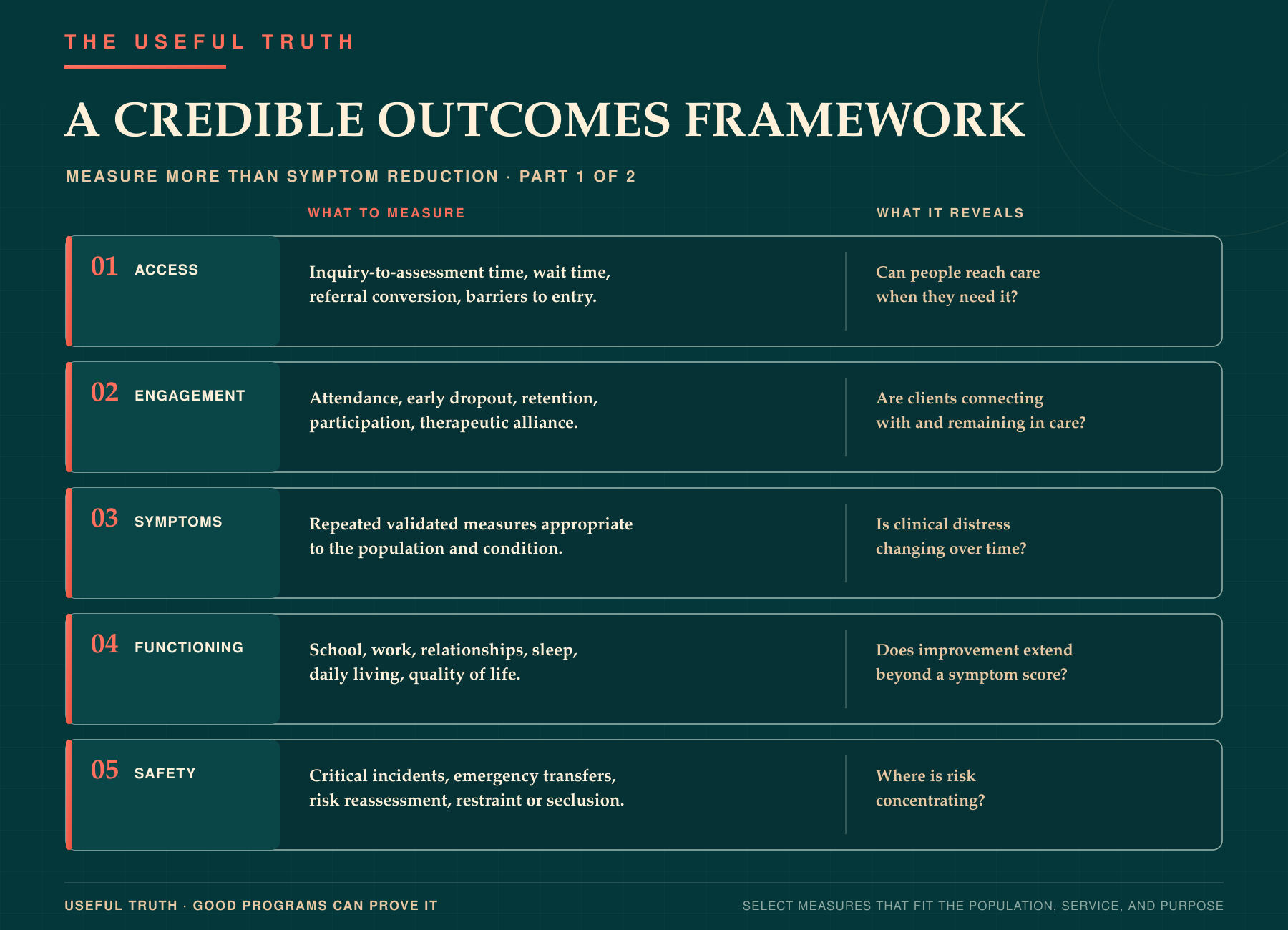
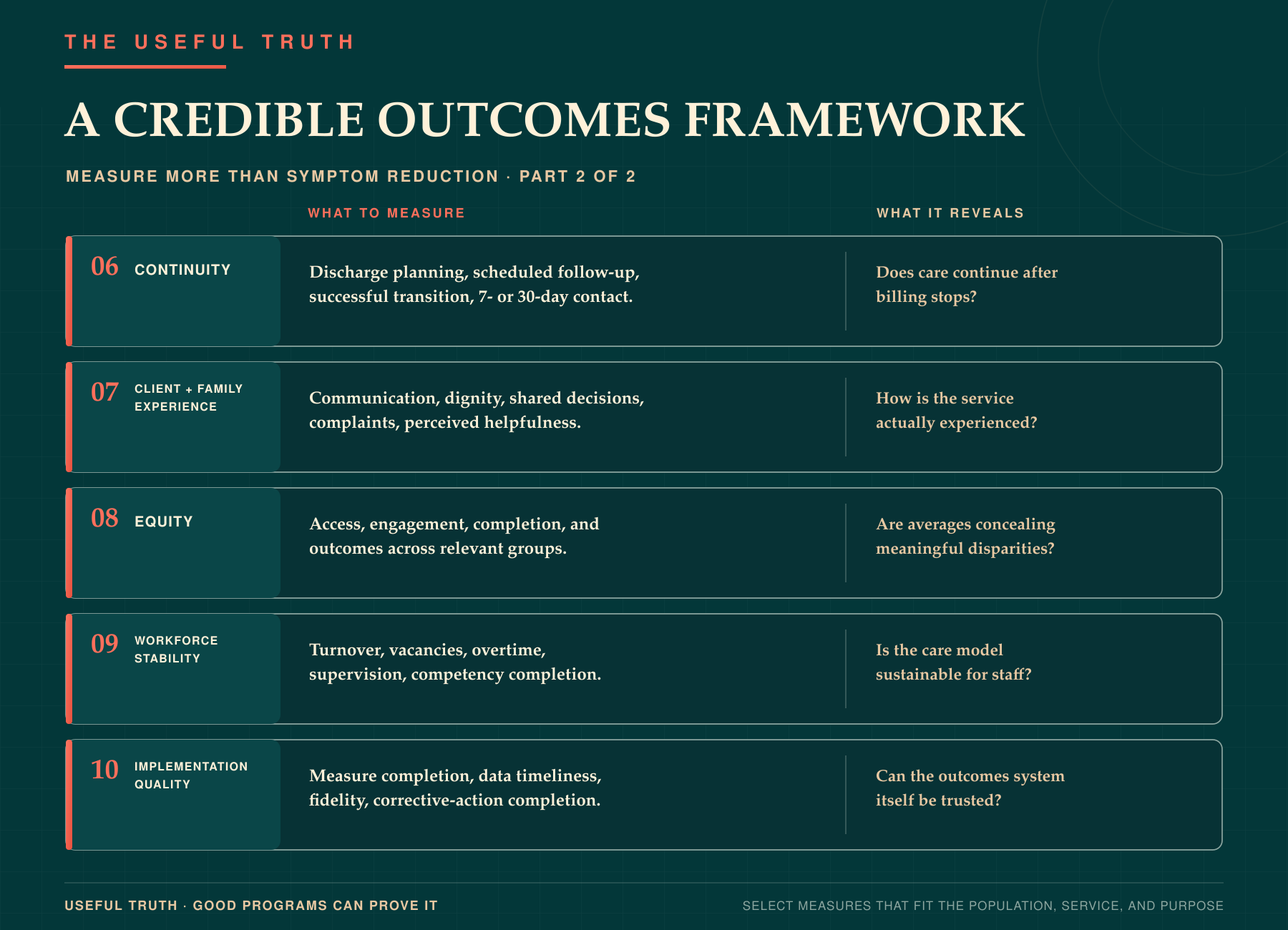
The CMS Behavioral Health Strategy similarly emphasizes coverage and access, quality of care, equity and engagement, and data and analytics. CMS has also moved toward standardized behavioral-health quality reporting and person-centered measures across programs. (CMS Behavioral Health Strategy)
The message from accreditors, payers, researchers, and quality organizations is not subtle: quality must become visible.
The minimum standard for publishing outcomes without becoming part of the problem
Outcome data can build trust. Bad outcome reporting can destroy it.
Before publishing a result, an organization should be able to answer:
Who was included?
Define the population, programs, locations, dates, diagnoses or presenting needs, age ranges, and relevant admission criteria.
What was the denominator?
Report how many people were eligible, how many completed each measure, and how missing data were handled. “Ninety percent improved” means very little if the analysis includes nine enthusiastic graduates from a cohort of 70 admissions.
When was change measured?
Admission and discharge may be appropriate for one service. A weekly measure may be necessary for another. Follow-up after discharge may matter most for claims about sustained improvement.
What exactly counted as improvement?
Distinguish average score change, treatment response, remission, clinically significant change, functioning, goal attainment, and client-reported benefit. They are not interchangeable.
Was the measure appropriate?
Use tools that are valid for the population and purpose. A convenient form is not automatically a meaningful instrument.
What else may explain the result?
Without a comparison group or stronger research design, improvement observed during care does not prove the program caused all of it. Natural recovery, medication changes, outside care, regression to the mean, selection, and attrition may contribute.
What did not improve?
Report neutral and negative findings. Include adverse events, deterioration, early exits, complaints, or other relevant counterevidence.
What are the limitations?
State them where a reasonable reader will actually see them—not in six-point cream text over a beach photograph.
What changed because of the findings?
The most powerful outcome report does not merely announce success. It demonstrates learning.
Research on progress feedback supports the value of this learning loop. A 2022 meta-analysis using data from 4,549 clients and 131 therapists across six clinical trials found that feedback was associated with better outcomes and reduced variability between therapists. The authors estimated that feedback utilization reduced the magnitude of therapist effects by approximately 18.2%. (Delgadillo et al., 2022)
That is the point: measurement is not only for proving that the program is good.
It is one of the ways a program gets better.
A realistic 90-day path to an outcomes system
Organizations often avoid outcomes work because they imagine an enormous research initiative layered on top of an already overloaded team.
That is one option. It is not the only option.
A responsible first phase can be built in 90 days.
Days 1–30: Define the truth
Clarify the population, service model, public claims, and decisions the data must support.
Inventory existing assessments, forms, EMR fields, payer measures, spreadsheets, and reports.
Establish baseline data quality and completion rates.
Select a small, defensible set of clinical, functional, engagement, safety, continuity, experience, workforce, and operational measures.
Define each metric, denominator, owner, timepoint, and escalation threshold.
Days 31–60: Build the workflow
Configure measures and scoring in the EMR or a connected system.
Define who administers, reviews, discusses, documents, and follows up on each measure.
Build exception lists for missing or concerning results.
Train staff on why the measures matter and how to use them clinically.
Create quality checks, privacy controls, and a usable leadership dashboard.
Pilot the process with one program or population before declaring victory organization-wide.
Days 61–90: Use and report the evidence
Review the first complete cohort and identify missingness, bias, workflow failure, and early patterns.
Connect outcomes to staffing, attendance, length of stay, discharge type, payer, program, and other relevant operating variables.
Assign corrective actions where the results identify a problem.
Build an internal outcomes report with clear definitions and limitations.
Develop responsible external language for the website, referral materials, payer conversations, and board reporting.
Establish a quarterly improvement and publication cadence.
The first 90 days do not create the final answer.
They create the machinery required to keep answering the question.
How Useful Truth helps organizations become the kind of program that can prove its value
Useful Truth is not an outcomes-report copywriting service.
We help build the operation that makes a credible outcomes report possible.
That may include:
an operational and clinical measurement diagnostic;
a program-specific outcomes strategy;
KPI definitions and a governed data dictionary;
admission, reassessment, discharge, and follow-up workflows;
EMR forms, templates, scoring, alerts, and reporting requirements;
denominator and cohort rules that prevent accidental statistical fiction;
dashboards for clinicians, program leaders, executives, and boards;
measure-completion and data-quality audits;
staff training and clinical feedback workflows;
accountability structures and review cadence;
outcome-report methodology and transparent limitations;
website, referral, and payer language grounded in what the evidence actually supports;
and coordination with research, privacy, legal, or institutional-review partners when a formal study requires it.
We also look beyond the outcome score.
If depression scores are improving but early dropout is rising, that matters.
If program completion is high because clients who need a different level of care are being retained too long, that matters.
If clients report improvement while staff turnover makes the model impossible to sustain, that matters.
If outcomes appear strong but half of the eligible population is missing from the follow-up data, that definitely matters.
Useful Truth connects the clinical result to the operating conditions that produced it.
Because a dashboard without ownership is decoration. A study without honest denominators is marketing theater. And data collected without a decision process is just another task added to an exhausted employee’s plate.
We build the workflow, ownership, tools, and reporting discipline that turn information into action—and action into evidence.
Good organizations are willing to be measured
The strongest behavioral-health organizations are not the ones that insist they are excellent.
They are the ones willing to define excellence, measure it, investigate where it is absent, and publish what they can support.
They understand that outcomes are not a marketing threat.
Outcomes are the opportunity to replace vague promises with credible evidence.
They help families make more informed decisions. They help referral partners understand fit. They help payers evaluate value. They help employees see the impact of their work. They help leaders invest in what works and stop protecting what does not.
Most importantly, they help the organization identify a client who is not improving while there is still time to do something about it.
That is what good programs do.
They do not simply say they care.
They create the systems required to know whether care is working.
And when the truth is not flattering, they use it.
That is not a failure of the mission. That is the mission operating correctly.
Ready to build an outcomes system you can actually use?
Useful Truth helps behavioral-health organizations turn clinical, operational, financial, workforce, and client-experience data into accountable systems and credible evidence.
Start with the Useful Truth Diagnostic. We will identify what you already measure, what is missing, where the workflow breaks, and what must be built before your organization can responsibly claim—and continuously improve—its results.
Outcome evaluation, quality improvement, and human-subjects research carry different legal, privacy, ethical, and oversight requirements. Organizations should obtain appropriate clinical, compliance, legal, privacy, and institutional-review guidance for their intended use. This article is educational and does not constitute legal, regulatory, or research-compliance advice.
