
Your Mission Statement Is Not Your Operating Model
When behavioral-health organizations say “people first” but budget as though people are disposable
Behavioral-health organizations love a mission statement.
They are usually displayed in large type over a tasteful photograph of sunlight coming through trees. They promise dignity, healing, compassion, evidence-based care, transformation, community, hope, and—if the copywriter had room—probably world peace.
Then budget season arrives.
Suddenly, “people first” means keeping a critical position vacant for another quarter. “Clinical excellence” means a newly hired employee receives three shadow shifts and a password. “Individualized care” means the census target remains nonnegotiable even when staffing, supervision, and programming are stretched thin. “We value our team” means there is pizza in the break room, but apparently not enough money for a meaningful wage adjustment.
The mission stays on the website.
The operation tells the truth.
This is a difficult subject because behavioral health must be financially sustainable. Payroll does not accept compassion as legal tender. Facilities require capital. Insurance payments are slow, denials are real, labor is expensive, and organizations that consistently lose money eventually stop serving anyone.
Profit is not unethical.
But profit is not a moral exemption either.
The ethical question is not whether a behavioral-health organization earns money. The question is how it earns that money, what it protects when margins tighten, who absorbs the consequences of its financial decisions, and whether its public mission survives contact with its operating model.
Because in an industry serving people who may be frightened, impaired, suicidal, withdrawing, traumatized, desperate, or trying to save someone they love, a polished mission statement is not enough.
Frankly, it is the easiest part.
The demand is real—and so is the opportunity to exploit it
In 2024, approximately 61.5 million U.S. adults had any mental illness, according to the Substance Abuse and Mental Health Services Administration. Only 52.1% received mental-health treatment during the year. Among the 14.6 million adults with serious mental illness, 70.8% received treatment. (SAMHSA, 2024 National Survey on Drug Use and Health)
The Centers for Disease Control and Prevention separately reported that in 2024, 19.3% of adults took medication for their mental health and only 14.0% received counseling or therapy from a mental-health professional. Adults in nonmetropolitan areas were the least likely to receive counseling or therapy. (CDC/NCHS, Mental Health Treatment Among Adults: United States, 2024)
Demand is not disappearing. The Health Resources and Services Administration projects major behavioral-health workforce shortages by 2038, including shortages of approximately 99,780 mental-health counselors, 99,840 psychologists, 43,810 psychiatrists, 33,840 marriage and family therapists, and 77,050 master’s-level addiction counselors. HRSA is explicit that those projections reflect current use—not the full unmet need. (HRSA Health Workforce Projections)
That combination creates a dangerous market:
tremendous human need;
limited capacity;
imperfect public information;
families making decisions under pressure;
clients whose ability to advocate for themselves may be compromised;
insurance systems that obscure the actual price and value of care;
and organizations that can continue receiving referrals even when the internal operation is deteriorating.
In most industries, a dissatisfied customer can leave, compare alternatives, post a review, or delay the purchase.
A parent searching for a residential placement during a crisis may have days—or hours. A person in acute psychiatric distress may go wherever a bed is available. Someone trying to enter substance-use treatment may not survive a three-week exercise in comparison shopping.
That is not an ordinary consumer relationship. It is an enormous imbalance of information and power.
And whenever vulnerability, urgency, and money occupy the same room, ethics cannot be left to branding.
The problem is not profit. It is extraction.
An ethical organization can be profitable.
It can grow, build reserves, compensate executives competitively, acquire programs, improve technology, and generate a return for owners or investors. Financial strength can improve care when it funds competent staff, stable systems, safer facilities, better training, thoughtful expansion, and access to services.
But there is a difference between earning a margin by delivering effective care and extracting a margin by allowing employees and clients to absorb preventable operational harm.
Extraction can look like:
maintaining census while essential positions remain vacant;
suppressing frontline wages while increasing workload and acuity;
treating overtime as a staffing model;
admitting clients whose needs exceed the organization’s actual capacity;
expanding programs before the existing ones are stable;
cutting supervision, training, quality review, or administrative support because those functions do not directly produce billable units;
allowing outdated policies and improvised workflows to remain in place because fixing them requires time and money;
using underqualified employees to perform work that requires more experience or oversight;
failing to examine turnover because replacing people feels easier than confronting why they leave;
and rewarding leaders for revenue without equally measuring safety, continuity, quality, employee stability, and client outcomes.
The organization may remain profitable. It may even grow.
That does not prove the operating model is ethical. It may only prove that the cost has been successfully transferred to someone with less power.
Usually that means the direct-care employee, the overextended clinician, the middle manager who has become a human patch for six broken systems, or the client who believed the mission statement was a description rather than a decorative aspiration.
Frontline labor is where the mission either lives or dies
The people spending the most time with clients are often among the least-compensated employees in the organization.
The U.S. Bureau of Labor Statistics reports that in May 2024, median annual wages in residential mental-health and substance-use facilities were $37,850 for psychiatric aides and $38,120 for psychiatric technicians—roughly $18 per hour for full-time work. BLS also reports that these workers may monitor behavior, assist with daily living, support therapeutic activities, participate in intake and discharge, respond to violence, and physically restrain patients when required. Psychiatric technicians and aides have some of the highest injury and illness rates of any occupation and frequently work nights, weekends, and holidays. (U.S. Bureau of Labor Statistics)
So yes, let us discuss the mission.
Let us discuss it with the employee earning approximately $18 per hour while managing client dysregulation, documenting incidents, covering a short-staffed shift, protecting physical safety, enforcing boundaries, and being told that the work is not about the money.
It is fascinating how often “this work is a calling” is directed at the person receiving the smallest paycheck.
Purpose matters. So does rent.
An organization cannot claim to value relational care while repeatedly destabilizing the relationships through which care is delivered. Every vacancy changes workload. Every preventable departure disrupts continuity. Every inexperienced replacement requires training from a team that is already depleted. Every burned-out employee who stays but disengages creates a form of turnover that never appears in the termination report.
Recent research makes the organizational connection difficult to ignore. A 2026 systematic review and meta-analysis covering 29 studies and 36,507 psychiatric nurses found a pooled turnover-intention prevalence of 34.1%, while emphasizing substantial variation across studies. Leadership, organizational support, burnout, and stress were among the recurring associated factors. (Zarei et al., 2026)
Another 2026 study found that roughly four in ten inpatient psychiatric nurses reported high burnout, job dissatisfaction, and intent to leave. More favorable work environments were associated with fewer negative job outcomes. (Dixon et al., 2026)
Turnover is not merely an HR inconvenience. It is operational data.
When the same roles repeatedly become vacant, when employees leave the same supervisor, when new hires exit before reaching competency, or when overtime becomes permanent, the workforce is telling leadership something.
The question is whether leadership wants the truth—or just another recruitment campaign.
Ownership is not the diagnosis—but incentives matter
It would be easy, and intellectually lazy, to argue that every for-profit or investor-owned organization provides poor care. The evidence does not support that claim.
A 2025 study in JAMA Psychiatry examined 617 Medicare-participating freestanding psychiatric hospitals, including 87 that were private-equity owned in 2021. Private-equity ownership was associated with lower adjusted staffing ratios for registered nurses and medical social workers. At the same time, the private-equity-owned facilities performed better on several existing quality measures, including reported restraint hours, follow-up visits, and readmissions. The researchers did not find evidence of lower quality overall, but they emphasized that available quality measures are limited and called for greater measurement of patient experience. (Shields, Yang, and Busch, 2025)
That nuance matters.
Private equity is not automatically evil. Nonprofit status is not a halo. Founder-led does not mean ethical. Clinician-owned does not mean well operated. A beautiful origin story does not guarantee that an organization still behaves according to the values that created it.
The ownership model is not the entire answer.
But incentives shape decisions. Short-term return expectations, acquisition debt, rapid expansion, occupancy targets, executive bonuses, and future sale value can create pressure. Whether that pressure harms care depends on governance: what is measured, what is protected, who can say no, and what happens when financial goals collide with clinical reality.
The responsible conclusion is not “profit causes poor care.”
It is this:
The more financial pressure an organization carries, the stronger its operational safeguards, transparency, and accountability must become.
If revenue has a daily dashboard but safety is discussed quarterly, the organization has already revealed its priorities.
Mission drift rarely announces itself
Most organizations do not wake up one morning and vote to become unethical.
Mission drift is quieter.
A position remains vacant because the team can “manage for now.” A supervisor inherits five additional responsibilities. Training is shortened. A policy review is postponed. A high-risk admission is accepted because the census is down. A complaint is framed as a personality conflict. A strong employee leaves, and leadership explains the departure as a lack of fit. Another workaround is created. Another exception becomes normal.
Each decision can be defended in isolation.
Together, they become the operating model.
Eventually the organization still speaks fluently about its values, but the people doing the work experience something else entirely.
This is where complacency becomes dangerous. Organizations can continue to survive—and sometimes make substantial money—while relying on the extraordinary effort of employees who are compensating for weak infrastructure.
Leaders see the service delivered and assume the system works.
The system does not work. The people are working around it.
There is a difference.
Your values need receipts
A mission statement is a claim. An operating system is evidence.
Here is what common behavioral-health values should look like when translated into practice:
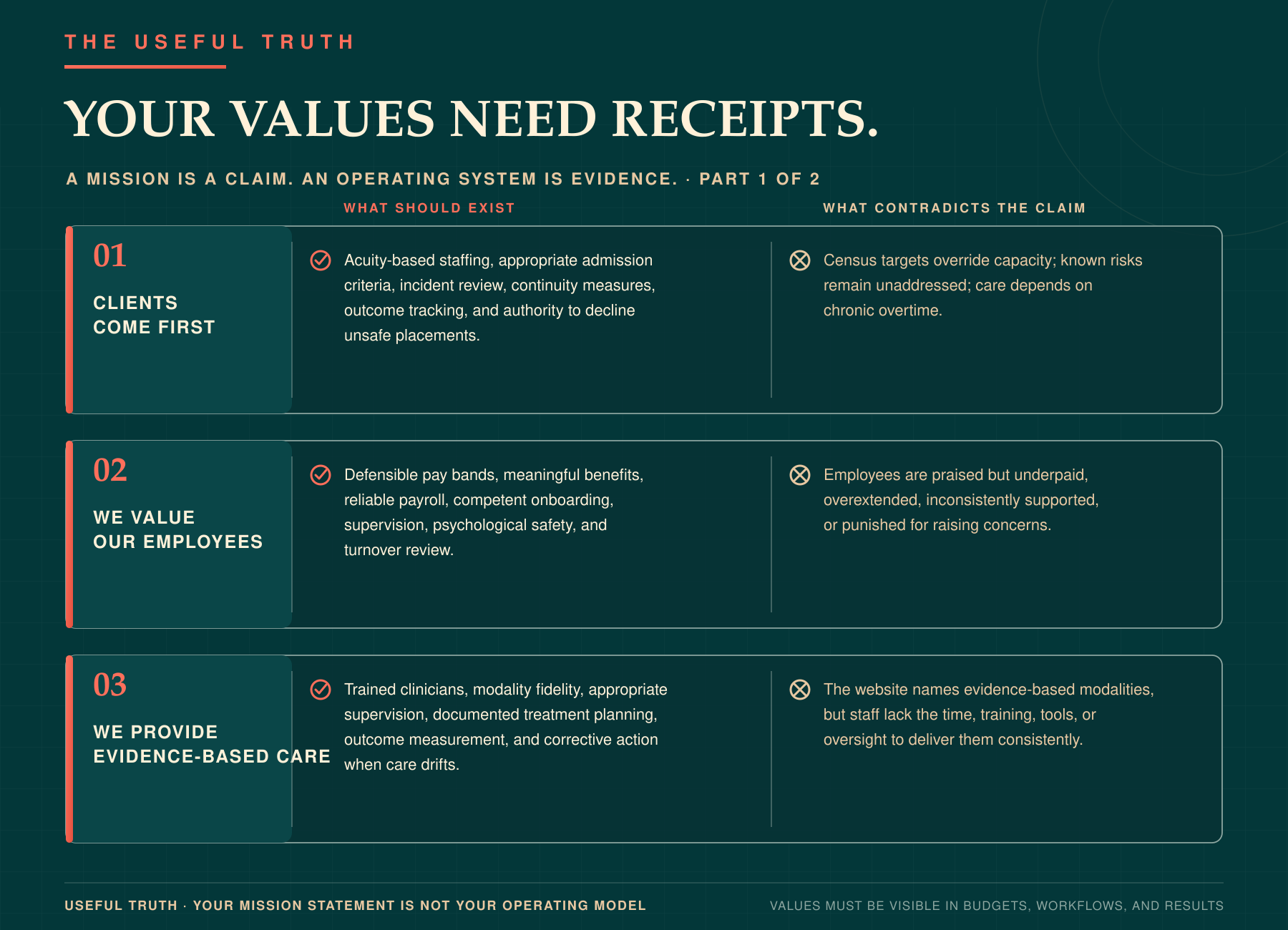
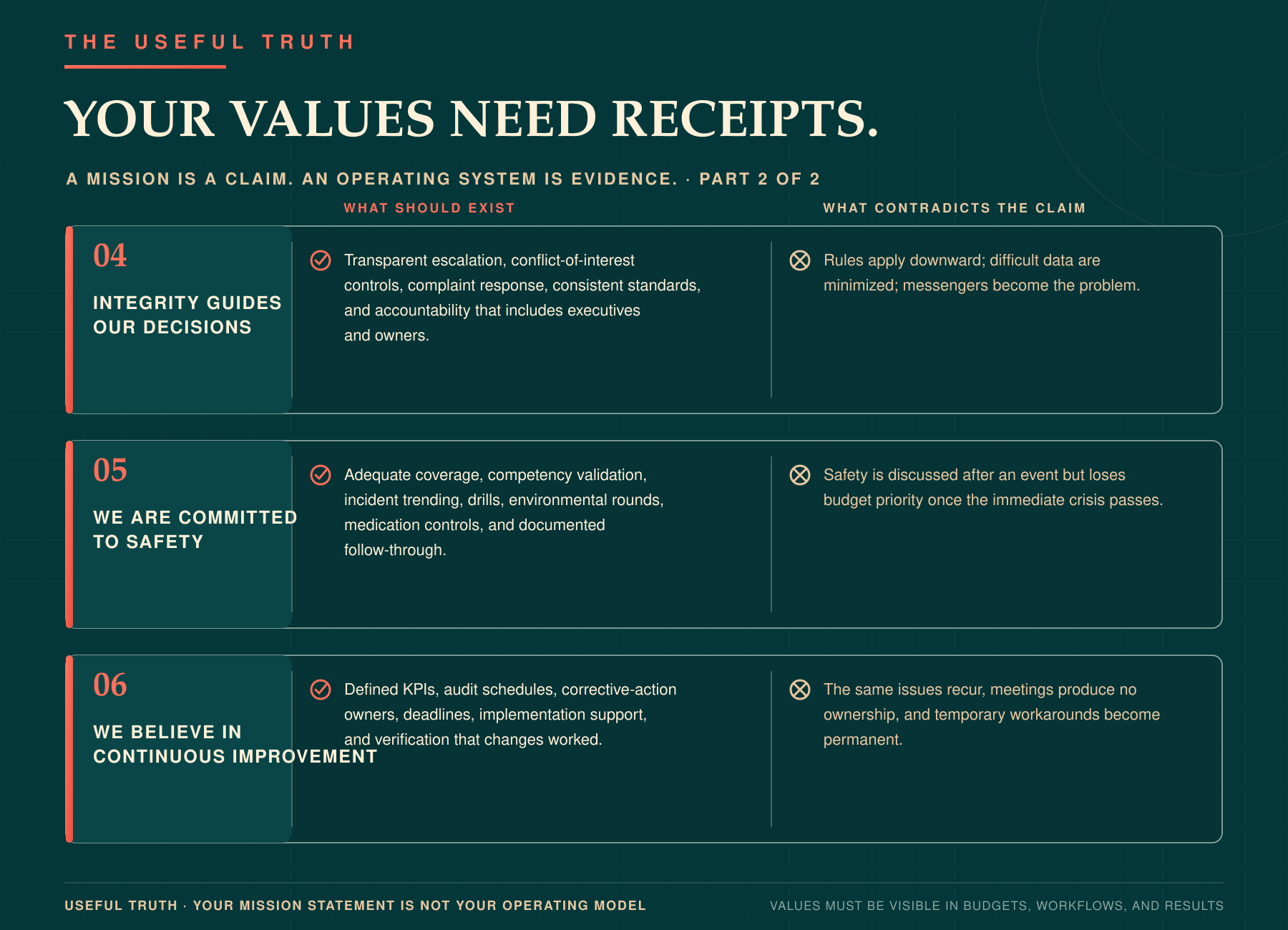
This is not administrative perfectionism.
Weak visibility can hide harm.
In 2024, the HHS Office of Inspector General found that many states lacked complete information needed to monitor maltreatment in residential facilities for children in foster care. Nearly one-third could not identify patterns of maltreatment in residential facilities within their state, and states reported limited visibility across multistate chains and out-of-state placements. (HHS Office of Inspector General)
The U.S. Government Accountability Office has also documented longstanding challenges protecting youth in residential facilities, including oversight gaps, restraint-related harm, inappropriate medication practices, and limited information sharing. (U.S. Government Accountability Office)
Those reports address specific populations and oversight systems; they should not be used to imply that every residential program is unsafe. They demonstrate something more foundational:
When the system does not collect, connect, and act on information, a reassuring public story can survive much longer than the truth.
The questions leadership should be willing to answer
If an organization claims to be mission-driven, its board, owners, and executives should be able to answer questions such as:
Workforce
What is voluntary turnover by role, supervisor, shift, program, and tenure?
Which roles are chronically vacant, and who absorbs that work?
How do frontline wages compare with market rates, job risk, acuity, and responsibility?
How much is being spent on overtime, contractors, temporary labor, and repeated recruitment?
What percentage of employees complete onboarding, competency validation, and required supervision on time?
What do exit data actually show—and what has leadership changed in response?
Client care and safety
How does staffing change with census and acuity?
Which admissions have been declined because the organization could not safely meet the client’s needs?
Are incidents trended by type, location, shift, employee tenure, and contributing system factor?
How quickly are complaints investigated, resolved, communicated, and converted into corrective action?
What continuity, engagement, discharge, readmission, and outcome measures are reviewed?
Can leadership demonstrate that corrective actions were implemented and effective—not merely assigned?
Money
Where does the organization reinvest in compensation, training, supervision, technology, facilities, and quality infrastructure?
Which savings represent genuine efficiency, and which simply transfer more work or risk to employees?
Are leaders financially rewarded only for revenue and census, or also for retention, safety, quality, and outcomes?
When growth and care capacity conflict, who has the authority to slow growth?
What financial information reaches clinical and operational leaders early enough to support responsible decisions?
Governance
Can employees raise concerns without retaliation or career damage?
Does accountability apply upward as consistently as it applies downward?
Who owns each critical risk, and what happens when deadlines are missed?
Does the board see employee stability, safety, and client outcomes alongside financial performance?
What decision has the organization made recently that protected the mission at a financial cost?
That last question matters.
Values are not demonstrated when they are convenient. They are demonstrated by what an organization is willing to protect, fund, delay, decline, or sacrifice when the easier decision would make more money.
I have seen the gap from inside
I have worked inside behavioral-health organizations filled with talented, caring people who genuinely wanted clients to get better.
I have also watched the operating model quietly contradict the brochure.
I have been brought into organizations when systems were already strained or failing. I have built and repaired admissions processes, staffing models, programs, policies, electronic-record workflows, revenue-cycle tracking, utilization analysis, executive reporting, compensation structures, accountability maps, clinical tools, and KPIs.
I have watched leaders welcome clarity when it identified an employee problem, improved revenue, increased capacity, or supported growth.
Clarity becomes less adorable when the dashboard assigns the next action to ownership.
Across my experience, one pattern has been difficult to ignore: organizations often say they want accountability when what they actually want is compliance from everyone below the person making the decision.
Real accountability is less convenient. It asks whether the employee had adequate training. Whether the supervisor provided timely feedback. Whether workload was possible. Whether the policy matched the actual workflow. Whether leadership funded the promised change. Whether ownership followed through. Whether the organization created the conditions that produced the result it is now blaming on an individual.
This is not an argument that every hard outcome is leadership’s fault. Employees make mistakes. Clinicians can perform poorly. Managers can avoid responsibility. Accountability should be fair, specific, and applied at every level.
But I have learned that data can clarify a choice; it cannot make someone in power want to be accountable.
That is part of why Useful Truth exists.
I am not interested in helping organizations write better values. I am interested in helping them determine whether those values are operationally true.
Ethical growth is possible
This article is confrontational because the stakes deserve more than polite ambiguity.
It is not an argument against growth, strong margins, executive compensation, investment, or operational efficiency. Behavioral health needs organizations that are financially stable enough to retain talent, improve access, invest in infrastructure, and continue serving people over time.
Ethical growth looks like:
expanding only when leadership, staffing, systems, and safety can support the volume;
paying people according to the real scope, difficulty, risk, and value of their work;
measuring the experience and stability of the workforce—not merely labor cost;
giving clinical and operational leaders the authority to challenge unsafe financial decisions;
treating complaints, incidents, turnover, denials, and failed handoffs as system data;
making outcomes visible even when the results are uncomfortable;
examining whether efficiencies improve the work or merely remove resources from it;
and ensuring that financial success strengthens the mission rather than gradually replacing it.
An ethical organization does not need to be perfect.
It does need to be honest.
It should be able to identify the gap between what it promises and what it delivers, discuss that gap without punishing the person who named it, assign ownership, fund the work, and verify that the change occurred.
Otherwise, the mission is not guiding the business.
It is marketing the business.
The useful truth
Your mission is not what appears beneath the logo.
It is what appears in the staffing plan.
It is in the pay structure, supervision schedule, admission decision, incident review, caseload, training budget, executive dashboard, and response to the employee who says, “This is not safe.”
It is what remains when the census is down, the margin is tight, the owner is frustrated, and doing the right thing costs money.
That is the moment the organization finds out whether it has values—or merely vocabulary.
And if your company says it puts people first, wonderful.
Show the receipts.
How Useful Truth can help
Useful Truth helps behavioral-health leaders examine the operation beneath the mission. We evaluate leadership and accountability, workforce stability, admissions, client continuity, provider capacity, revenue cycle, policies, technology, workflows, KPIs, risk, and readiness for growth.
The goal is not to produce another attractive strategy deck.
The goal is to determine what is actually happening, identify what matters most, and build the tools, ownership, and operating structure required to change it.
If your mission is real, the operation should be able to prove it.
