
How Do You Know Whether a Behavioral-Health Program Is Actually Good?
The website can tell you what an organization wants you to see. The operation tells you what care will feel like.
The photos are beautiful.
The clinicians look kind. The website says the program is trauma-informed, evidence-based, individualized, compassionate, innovative, and committed to treating the whole person. There may be mountains. There is almost certainly a photo of someone looking thoughtfully out a window.
None of that tells you what happens at 2:00 a.m.
It does not tell you whether the overnight team is adequately staffed, whether employees feel safe reporting a concern, whether the therapist advertised on the website still works there, or whether “weekly individual therapy” means a clinically appropriate session with a consistent provider—or a frequently rescheduled conversation squeezed between three crises.
It does not tell you whether the program measures outcomes, how it defines success, what happens when treatment is not working, or whether leadership responds to serious feedback with curiosity, defensiveness, retaliation, or a strongly worded reminder that everyone is “one big family.”
And it does not tell a prospective employee whether the organization’s public commitment to mental health extends to the mental health of the people working there.
This is the difficult truth: quality in behavioral health is hard to evaluate from the outside.
Clients and families are often making decisions while scared, exhausted, or in crisis. Employees may be evaluating an organization through a polished interview process in which everyone is on their best behavior. Referral partners see presentations, outcome claims, lunches, and responsive admissions teams—but may not see the staffing instability, unresolved incidents, documentation failures, or operational pressure behind the experience.
Most behavioral-health organizations are not trying to deceive people. Many are doing deeply meaningful work in an extraordinarily difficult environment. But a license is not the same as excellence. Accreditation is not a guarantee that every shift is safe. A five-star review is not an audit. And a compelling mission statement cannot compensate for an operating model that burns through employees, hides mistakes, and confuses census with clinical appropriateness.
So how do you know whether a program is actually good?
You do not look for perfection. You look for evidence, coherence, candor, and the organization’s behavior when the questions become inconvenient.
Quality is not a vibe
There is no single database that can tell a parent, client, employee, or referral partner, “Yes, this organization is good.” Different programs operate under different licenses, payer requirements, accreditation standards, scopes of service, and state rules. Public information may be incomplete. A clean inspection history can be meaningful, but it cannot show every problem. A negative review may reveal a pattern—or reflect one painful experience without broader context.
The answer requires triangulation.
Think of program quality in five layers:
Permission to operate: Is the organization properly licensed, certified, accredited where claimed, and staffed by appropriately credentialed professionals?
Capacity to deliver: Does it have enough qualified, supported people to provide the services it sells—on every shift, not only during the tour?
Clinical integrity: Is care individualized, appropriate to the person’s needs, evidence-informed, measurable, and adjusted when it is not working?
Culture under pressure: What happens after an error, complaint, difficult piece of feedback, staff injury, safety event, or disagreement?
Continuity and accountability: Does the program coordinate with families and outside providers, plan for discharge, measure outcomes honestly, and take responsibility beyond admission?
One strong layer cannot erase a dangerous weakness in another. A facility can have respected clinicians and still schedule them impossibly. It can hold accreditation and still have high turnover. It can collect impressive satisfaction scores while excluding people who left early or were discharged unexpectedly. It can describe itself as trauma-informed while using communication, restriction, or confrontation in ways that recreate fear and powerlessness.
Quality is not the presence of good language.
It is the alignment of what the organization says, what it has built, what its employees can consistently deliver, and what clients actually experience.
Why this matters more than ever
There are excellent behavioral-health organizations. There are also serious and documented gaps in oversight, staffing, transparency, and care—especially in settings where clients are separated from their usual support systems.
In 2024, the U.S. Senate Committee on Finance published Warehouses of Neglect, based on an investigation of four large operators of youth residential treatment facilities. The Committee reviewed more than 25,000 pages of company records, conducted stakeholder interviews, and visited facilities. Its findings included inadequate treatment, understaffing, poorly trained employees, inappropriate restraint and seclusion, insufficient family connection, and weak discharge planning. The report concerns the companies and facilities investigated; it should not be used to label every residential program. It does, however, show why polished claims cannot replace operational due diligence. Read the Senate report.
That same year, the HHS Office of Inspector General reported that nearly one-third of states could not identify patterns of maltreatment in residential facilities serving children in foster care. States also described limited visibility across multistate chains and difficulty monitoring children placed out of state. In other words, “someone would know if there were a pattern” is not always a safe assumption. Read the HHS-OIG findings.
The marketing path itself deserves scrutiny. In 2025, the Federal Trade Commission filed a complaint alleging that marketers used search ads displaying the names of specific substance-use treatment clinics and routed callers to unaffiliated facilities, while telemarketers allegedly presented their recommendations as objective. Those are allegations in an enforcement action, not a finding that every treatment referral is compromised. They are a very real reminder to confirm whom you are speaking with, who employs the admissions representative, and whether anyone receives compensation for the placement. Read the FTC announcement.
Online reviews also require context. The FTC’s rule on consumer reviews addresses fake reviews, undisclosed insider testimonials, review suppression, and company-controlled sites masquerading as independent review sources. Reviews can be helpful. They are not infallible. Read the FTC rule.
This is not a reason to panic or distrust every provider. It is a reason to ask better questions.
Start with the claims you can verify
The first layer is basic due diligence. It is not glamorous, but neither is discovering after admission that the facility’s legal name, license, advertised service, and actual program do not quite match.
1. Confirm the exact organization and site
Large systems may operate multiple facilities under similar brand names. Quality, licensing history, staffing, and leadership can vary by location.
Ask for:
the legal entity name;
the exact facility address;
the program’s license type and number;
the service and level of care authorized at that specific site;
the name of the accreditor, if accreditation is claimed;
the names and credentials of the professionals who will actually provide care.
Do not assume that accreditation of a parent company, one program, or one location automatically applies to every service under the brand.
2. Verify licensure and standing with the appropriate state agency
State licensing agencies differ. Depending on the setting, oversight may sit with a department of health, human services, substance-use authority, child welfare agency, professional licensing division, or another body.
Search for:
active license status;
scope and expiration date;
inspection or survey findings;
corrective-action plans;
sanctions, restrictions, suspensions, or adverse actions;
complaint or enforcement history where public.
If the information is difficult to find, ask the program to provide the relevant link or document. A responsible organization should not act offended that you want to verify the authority under which it is caring for you or your child.
3. Confirm accreditation where it is claimed
Use the accreditor’s own directory, such as the Joint Commission’s accredited-organization search or CARF’s provider search. Confirm the specific program, location, service category, and current accreditation status.
Accreditation is a meaningful signal that an external standards process exists. It is not a promise that no employee will make a mistake, no leader will behave badly, or no shift will be understaffed. Treat it as one layer of evidence—not the final verdict.
4. Verify individual professionals
Check relevant state licensing-board records for the clinicians and medical providers presented as central to care. Confirm:
active status;
license type;
disciplinary history where available;
whether the person’s credential matches the services they will provide;
whether prelicensed staff receive required supervision.
The NPI Registry can help confirm provider identifiers and taxonomy, but an NPI is an administrative identifier—not proof of current licensure, competence, or quality.
HHS-OIG also maintains the List of Excluded Individuals and Entities, which identifies people and organizations currently excluded from federally funded healthcare programs. This is one compliance check, not a complete background review.
5. Confirm who is selling—and who is providing—the care
Ask whether the admissions representative works for the facility, a parent company, a placement service, or a marketing organization. Ask whether anyone receives a fee for the referral. Ask whether the person recommending the program has reviewed multiple options and what clinical criteria drove the recommendation.
If an “independent” advisor only recommends programs owned by one network, independence may be doing some ambitious interpretive work.
Then investigate what the website cannot show
Credentials tell you whether an organization has met certain requirements. Operations tell you whether the promised care is deliverable.
The hidden variables are usually not hidden because they are mysterious. They are hidden because few people ask for them.
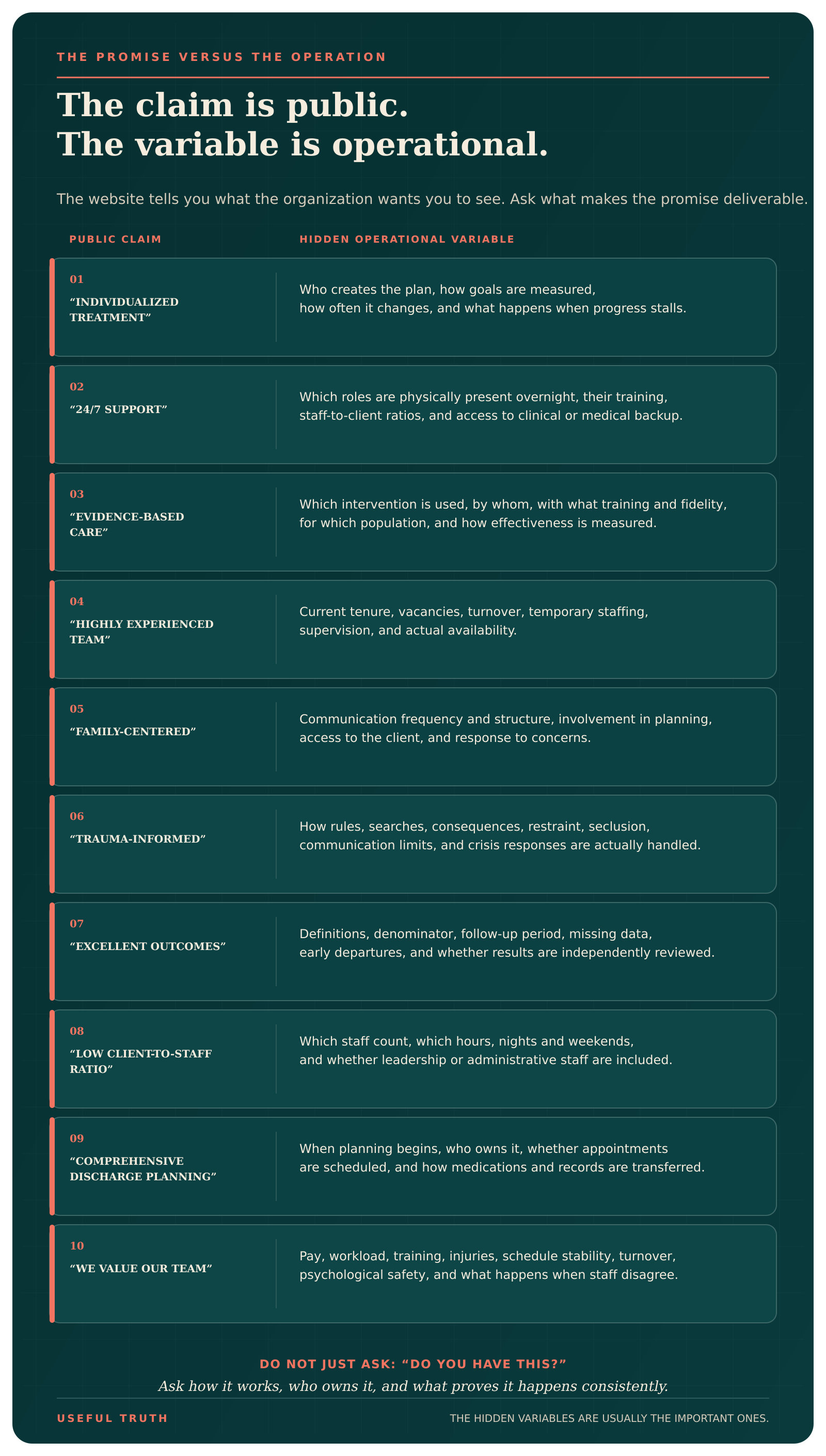
The questions every client or family should ask
You do not need to conduct a federal investigation before scheduling therapy. The depth of due diligence should match the intensity, duration, cost, restrictiveness, and risk of the service.
For routine outpatient care, provider licensure, fit, treatment approach, access, privacy, cost, and continuity may be the central issues. For inpatient, residential, withdrawal-management, or youth programs, the stakes justify substantially more scrutiny.
Clinical fit and admissions integrity
Ask:
What are your written admission and exclusion criteria?
Who determines whether this level of care is appropriate?
What conditions, risks, or medical needs are outside your capability?
When do you refer someone elsewhere rather than admit them?
What assessment occurs before admission and after arrival?
What happens if the initial diagnosis or level-of-care recommendation changes?
How do you avoid admitting someone primarily because a bed is open or insurance authorizes care?
A strong answer is specific about capability and limitations. The program can explain who makes the decision, what information is reviewed, and when it says no.
A concerning answer sounds like everyone is a perfect fit, the clinical assessment happens after financial clearance, or admissions cannot identify a condition the program would decline.
Good organizations do not need every client. They need the clients they can safely and effectively serve.
Staffing and supervision
Ask:
What positions are staffed on days, evenings, nights, and weekends?
What is the actual ratio of direct-care staff to clients by shift?
Which roles are included in that ratio?
What is the current vacancy rate?
What has frontline and clinical turnover been during the past 12 months?
How much care is provided by contractors, temporary staff, interns, or prelicensed clinicians?
How often do clinicians receive supervision?
Who is available when a client deteriorates after normal business hours?
How are new employees trained before working independently?
How do you confirm competence in suicide prevention, de-escalation, medication procedures, boundaries, trauma-informed care, and emergency response?
Do not accept “we meet state ratios” as the complete answer. Minimum compliance and operational sufficiency are related, but they are not identical.
What treatment actually consists of
Ask for a representative weekly schedule and then ask what each line means.
How many hours are clinical treatment versus recreation, school, transportation, meals, study time, or general supervision?
How often does the client receive individual therapy?
Will the same therapist provide it consistently?
Which groups are curriculum-based, and who facilitates them?
How are psychiatric, medical, substance-use, trauma, neurodevelopmental, and family needs integrated?
How are treatment goals made measurable?
How often is progress formally reviewed?
What happens when the person is not improving?
How does the program adapt care for culture, identity, disability, communication needs, or previous trauma?
“We use CBT, DBT, EMDR, IFS, motivational interviewing, equine therapy, neuroscience, mindfulness, and probably three additional acronyms” is not yet an answer.
Ask who provides each intervention, what training they have, why it fits the client, and how the program knows it is helping.
SAMHSA advises people seeking substance-use treatment to look for five quality indicators: accreditation or licensure and qualified staff, access to appropriate medications, evidence-based practices, family involvement, and ongoing supports. That framework is a strong starting point, especially when each claim is verified rather than simply located in the website footer. See SAMHSA’s quality-treatment guidance.
Safety, rights, and restrictions
Ask:
How are client rights explained, and how can I obtain them before admission?
What communication with family or outside supports is permitted?
Under what circumstances can communication be limited, by whom, and for how long?
What is the grievance and appeal process?
Can a client contact a licensing agency, advocate, attorney, or parent privately?
What are the policies for searches, room checks, contraband, consequences, elopement risk, and emergency safety interventions?
Does the program use restraint or seclusion? If so, under what conditions, who is trained, and how is each event reviewed?
What medical support is physically available, and what requires transfer to an emergency department?
How are suicide and self-harm risks assessed and monitored?
How are medications stored, administered, reconciled, and reviewed?
What happens after an injury, allegation, medication error, or serious incident?
When and how are families notified?
For a youth residential program, also ask:
How is education provided, and who verifies credits and accommodations?
How are peer-on-peer aggression, sexual safety, bullying, and room assignments managed?
How does the program maintain family and community connection?
What is the average and median length of stay?
Can discharge be delayed because an aftercare placement is unavailable?
What is the process for a child or parent to disagree with the treatment team?
The response should be calm, concrete, and respectful. Safety questions are not evidence that a parent is “not committed to the process.” They are evidence that the parent understands the assignment.
Outcomes without the marketing fog
Ask:
What outcomes do you measure?
How do you define improvement and successful completion?
What percentage of admitted clients are included in the calculation?
Are people who leave early, transfer, relapse, or cannot be reached included?
What is the sample size?
When is follow-up measured—discharge, 30 days, six months, one year?
Are outcomes based on client self-report, clinical measures, claims, utilization, school participation, employment, readmission, or another source?
Are the measures validated?
Are results specific to this location and service?
Who analyzes the data, and has anyone independent reviewed it?
What has the organization changed because of the results?
If a program reports a 95% success rate but cannot define success, identify the denominator, or explain missing follow-up data, what you have is not an outcome.
You have a number wearing business casual.
Family involvement and continuity
Ask:
Who is the family’s consistent point of contact?
How often will we receive updates, and from whom?
How are families involved in treatment planning, when clinically and legally appropriate?
What family education or therapy is included?
How are outside clinicians, schools, physicians, and referral sources coordinated?
When does discharge planning begin?
Will follow-up appointments be scheduled before discharge?
How are medications, records, safety plans, and treatment recommendations transferred?
What happens if the client leaves earlier than planned?
Does the organization track readmissions, emergency utilization, or continuity after discharge?
Discharge planning should not begin when insurance says, “Surprise, tomorrow.”
Financial clarity
Ask for the financial agreement before admission whenever possible.
What is the total expected cost?
What is billed to insurance, and what may become my responsibility?
Is the facility in network? Are all individual providers in network?
What services are included in the daily or program rate?
What may be billed separately?
Are transportation, testing, medications, labs, physician services, or ancillary therapies additional?
What is the policy for deposits, refunds, noncovered services, early discharge, and balance billing?
Who handles utilization review and authorization?
What happens if coverage ends before the clinical team recommends discharge?
Will I receive itemized statements and access to billing support?
Urgency should not be used to prevent informed financial consent.
The questions prospective employees should ask
If you are considering working for a behavioral-health organization, you are not evaluating a different company than the client is.
You are seeing the same operating system from the inside.
How an organization treats employees is not separate from quality of care. It affects continuity, attention, documentation, boundaries, supervision, escalation, and the willingness to speak up before a small problem becomes a serious one.
A systematic review of 46 studies found that poor staff wellbeing and burnout were associated with worse patient-safety outcomes in most of the included evidence, while also noting limitations in causal inference. In 21 of the 30 studies measuring burnout, researchers found a significant association with patient safety; four more found associations on some subscales. Review the study on PubMed.
A 2025 systematic review identified psychological safety as important to reliable, safe, high-quality healthcare delivery. In plain language: employees need to be able to ask questions, admit uncertainty, report errors, and challenge unsafe decisions without being punished for ruining the vibe. Review the psychological-safety study.
Evidence from other care settings reinforces the point. A study using data from 13,826 nursing homes found that higher staff turnover within the same facility was associated with more inspection citations and lower quality measures. Nursing homes are not behavioral-health programs, so the findings should not be treated as a direct estimate for residential or outpatient mental-health care. They do demonstrate why turnover is an operational quality variable—not merely an HR inconvenience. Review the turnover study.
Employee safety matters too. OSHA reported that in 2019, the rate of nonfatal workplace-violence incidents requiring time away from work was nearly five times higher in private healthcare and social-assistance establishments than in private industry overall. OSHA’s healthcare discussion expressly includes residential behavioral health and outpatient mental-health and substance-use settings. See OSHA’s workplace-violence information.
Ask:
About the role
Why is this position open?
How long did the previous person remain in the role?
How many people have held it in the past two years?
What does success look like at 30, 60, and 90 days?
What decisions can this role make independently?
What resources and staffing are already in place?
What work is currently being performed by someone outside the role because it is vacant?
About workload
What is the expected caseload, productivity target, group load, or client-contact percentage?
How is nonbillable work accounted for?
How often are employees asked to work beyond scheduled hours?
What is the on-call expectation?
How are vacations, vacancies, and call-outs covered?
How frequently do schedules change after they are posted?
What happens when acuity exceeds planned staffing?
About training and supervision
How long is orientation?
What must be completed before working independently?
Who provides clinical and operational supervision?
How often is supervision scheduled, and how often does it actually occur?
What training follows incidents, new services, or policy changes?
How does the organization assess competence instead of attendance?
About safety and culture
Tell me about a recent operational or safety problem the organization identified. What changed afterward?
How can employees report concerns confidentially?
What protects staff from retaliation?
How are injuries, threats, boundary violations, and critical incidents reviewed?
When employees disagree with leadership, what is the escalation process?
How does the organization distinguish accountability from blame?
Can I speak privately with someone currently doing this job or working on this team?
About turnover and leadership
What was voluntary turnover in this department during the past year?
What is the average tenure of frontline staff, clinicians, supervisors, and executives?
What themes have emerged from exit interviews?
What has leadership changed in response?
How are managers evaluated for retention, safety, development, and team performance?
About compensation and boundaries
What is the full compensation range?
How are raises and promotions determined?
Are supervision, documentation, meetings, training, and on-call time paid appropriately?
What benefits are offered, when do they begin, and what do they cost the employee?
What happens when responsibilities materially expand?
Are performance expectations written?
How are concerns or corrective actions communicated and documented?
Listen carefully to whether the interviewer answers the question asked.
“We are passionate,” “we move fast,” and “everyone wears a lot of hats” may all be true. They may also mean the workload has escaped containment and is currently wandering the halls unsupervised.
What good answers sound like
A good organization does not need to claim that nothing ever goes wrong.
In fact, “we have never had a serious incident, complaint, employee conflict, or treatment failure” is less reassuring than leadership seems to think.
Strong organizations usually answer with:
specificity: actual roles, frequencies, definitions, and examples;
consistency: admissions, clinical, operations, HR, and leadership describe the same system;
documentation: policies, rights, schedules, licenses, outcomes, and financial terms are available in writing;
appropriate limits: the organization clearly explains whom it cannot safely serve;
learning: leaders can describe a problem, what it revealed, and what changed;
ownership: someone is accountable for the process and the result;
measurement: the organization tracks more than census and revenue;
respect: reasonable questions are welcomed, not reframed as distrust or resistance;
candor: leaders distinguish what they know, what they are improving, and what they cannot promise.
Good organizations are not perfect. They are inspectable.
They can tolerate the truth about themselves long enough to improve it.
Red flags that deserve a pause
One red flag does not always prove that a program is unsafe or unethical. Context matters. Patterns matter more.
Proceed carefully when you encounter:
intense pressure to admit, enroll, accept a job, or pay immediately;
guarantees of recovery, cure, permanent change, or a specific outcome;
an admissions process focused on insurance benefits before clinical fit;
no clear answer about who owns or employs the admissions team;
refusal to provide license, accreditation, client-rights, grievance, or financial information;
outcomes without definitions, denominators, follow-up periods, or missing-data disclosure;
leadership that cannot state current staffing, vacancies, or turnover;
ratios that include executives, therapists who are not present, or staff assigned across multiple units;
frequent reliance on “industry standard” without naming the standard;
a large website team whose members are unavailable, contracted, or no longer employed;
restrictions on family communication that cannot be clinically or legally explained;
inability to describe after-hours medical and clinical coverage;
no clear incident-notification or grievance process;
a universal treatment model presented as appropriate for every person;
punishment, humiliation, confrontation, or isolation described as “breaking through resistance”;
staff who appear afraid to answer questions without a leader present;
high turnover explained entirely as employees “not being a fit”;
“we are a family” used to justify poor boundaries, unpaid labor, inconsistent expectations, or silence;
former clients and employees describing the same problem across time, roles, or locations;
questions treated as evidence that you are difficult, disloyal, uncommitted, or not ready.
The most revealing moment may be what happens after you ask a reasonable question the organization would prefer not to answer.
Use reviews—but do not outsource your judgment to them
Online reviews can reveal patterns in communication, billing, turnover, food, safety, respect, and continuity. Employee reviews may surface leadership instability, chronic understaffing, or unrealistic workload. Client and family reviews may show recurring problems that formal quality metrics miss.
But reviews have limitations:
satisfied and highly dissatisfied people may be more likely to post;
privacy laws restrict how providers can respond publicly;
a reviewer may misunderstand a necessary clinical boundary;
one corporate system may operate many locations with different leaders;
reviews can be manipulated, incentivized, suppressed, or posted by insiders;
recent leadership or ownership changes may make old reviews less representative;
a high rating can conceal a small number of reviews or unusual solicitation practices.
Look for repeated themes, dates, locations, and operational details. Compare multiple platforms. Separate complaints about not receiving a desired answer from concerns involving safety, rights, billing, staffing, dishonesty, or lack of care.
Then ask the organization directly:
I noticed several reviews describing delayed family communication and frequent staff changes. What has the organization learned from that feedback, and what is different now?
The answer will tell you more than the stars.
Tour the operation—not the set
If the service is facility-based, ask to see the spaces clients actually use. A beautiful lobby is nice. Clients generally do not receive treatment in the lobby.
Observe:
how staff speak to clients when they are not presenting to visitors;
whether employees know clients’ names and needs;
whether the environment feels calm, chaotic, punitive, or disengaged;
cleanliness, maintenance, privacy, food, bathrooms, bedrooms, and outdoor access;
whether schedules posted match what people describe;
whether clients appear meaningfully engaged or simply contained;
whether staff are present and attentive or absorbed in documentation and crisis management;
how medications and confidential information are protected;
how requests and transitions are handled;
whether the program can explain differences between weekday, weekend, and overnight operations.
If possible and appropriate, speak with more than one department. Admissions can describe the promise. Operations, clinicians, medical staff, direct-care employees, clients, and families can show whether the promise survives contact with reality.
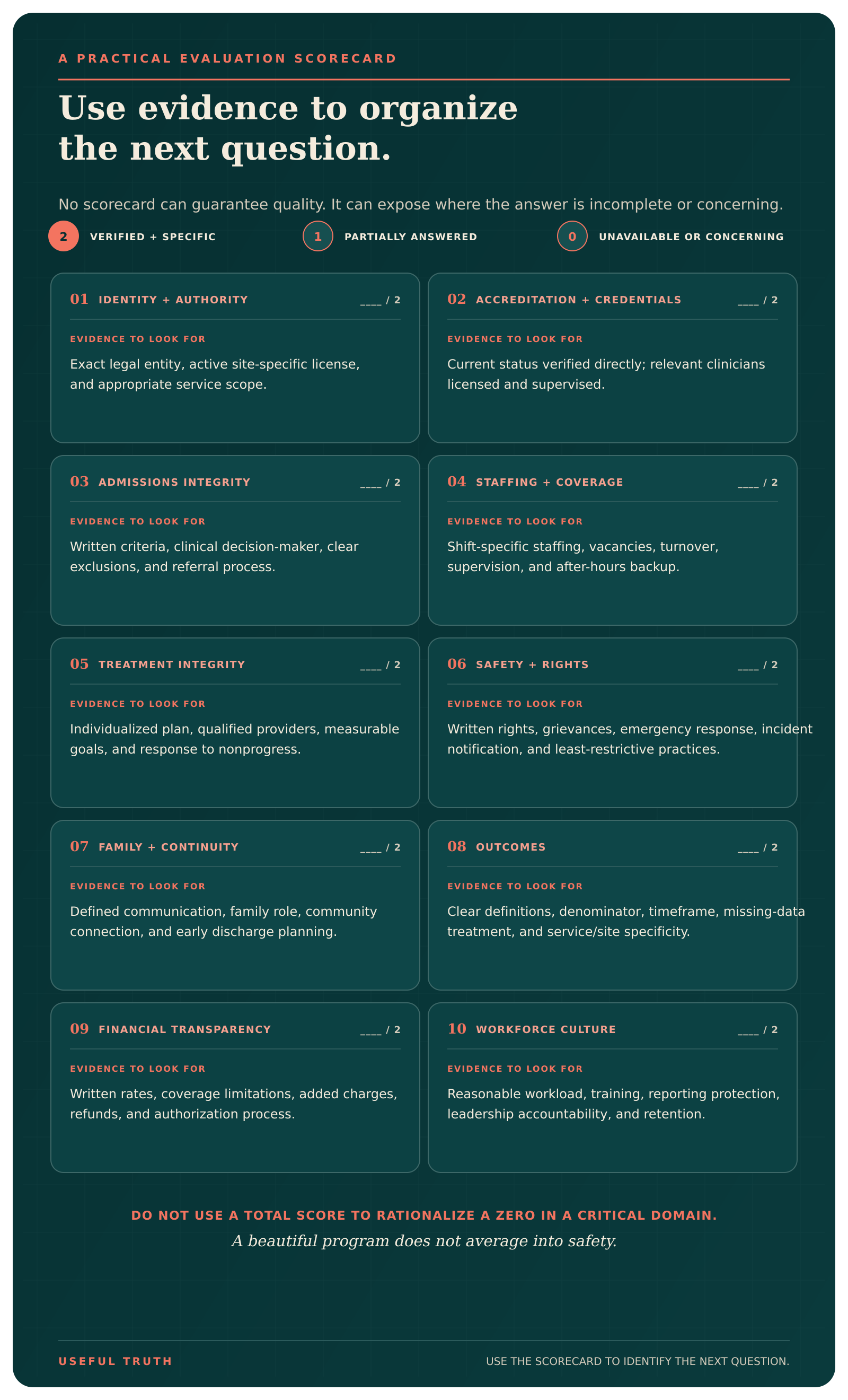
A practical evaluation scorecard
If you are making a decision during a crisis
Sometimes families do not have weeks to investigate. A person may need immediate stabilization, medical evaluation, withdrawal management, or protection from imminent harm.
In an emergency, prioritize immediate safety and clinically appropriate care. Call 911 or go to the nearest emergency department when there is imminent danger, a medical emergency, severe withdrawal risk, or another urgent condition. In the United States, call or text 988 for the Suicide & Crisis Lifeline.
When time is limited, focus on the highest-risk questions:
Is this the correct level of care for the current risk?
Is the facility licensed for this service and population?
Who is physically present now, and what medical and clinical backup is available?
How will immediate safety, medications, withdrawal, or self-harm risk be managed?
How and when will the family or designated support person be informed?
What happens if the program cannot safely meet the person’s needs?
What are the rights, financial obligations, and transfer options?
You can continue deeper due diligence once immediate safety is addressed.
The organizational truth behind quality care
Behavioral-health companies often separate “clinical quality” from “business operations” as if one is noble and the other is spreadsheets.
Clients do not experience that separation.
They experience whether the schedule was built correctly. Whether the right person was hired. Whether the therapist has time to prepare. Whether the medication list transferred. Whether the incident reached the person authorized to respond. Whether the family received consistent information. Whether a staff member felt safe enough to say, “Something is wrong.” Whether the organization learned—or simply updated a policy and waited for everyone to stop asking.
Poor employee treatment is not proof of poor clinical intent. It is an operating risk.
An exhausted, undertrained, underpaid, or frightened workforce cannot be expected to compensate indefinitely for weak systems. Some exceptional employees will try. They will stay late, cover vacancies, absorb the crisis, protect clients, and quietly hold together processes that leadership should have built.
That is not a sustainable care model.
It is organizational debt being financed by human beings.
Eventually the good employees burn out, leave, become less attentive, or stop raising concerns. Continuity breaks. Supervision thins. New employees train newer employees. Leaders receive cleaner information because people learn which truth is career-limiting. The website remains beautiful.
This is why employee experience belongs in any serious assessment of quality. Not because every unhappy employee is right about every event, but because patterns in turnover, fear, workload, retaliation, and instability affect the organization’s capacity to deliver what it promises.
What strong organizations do differently
Strong behavioral-health organizations:
admit within their capability instead of allowing census pressure to redefine clinical fit;
staff for actual acuity and workflow, not only minimum ratios or the most optimistic version of the day;
pay attention to nights, weekends, handoffs, and transitions;
define who owns decisions and what happens when something goes wrong;
train for competence and reinforce expectations through supervision;
measure safety, access, continuity, workforce stability, clinical progress, client experience, and financial performance together;
invite client, family, and employee feedback without confusing accountability with disloyalty;
investigate incidents beyond the nearest individual mistake;
distinguish a policy failure from a workflow, staffing, technology, leadership, or culture failure;
communicate limitations honestly;
change the system when the system is producing the problem.
Most importantly, they do not require outsiders to believe they are perfect.
They can show how they know they are functioning—and how they respond when they are not.
Where Useful Truth fits
Useful Truth exists because the variables that determine quality are often buried beneath the presenting problem.
A company may think it has a staffing problem when it has unclear ownership, inconsistent supervision, a broken schedule, and no useful capacity data. It may think it has a documentation problem when the EMR, workflow, training, and billing expectations contradict one another. It may think it has a few unhappy employees when fear has become the organization’s unofficial communication policy.
We help behavioral-health leaders examine the full operation:
leadership and accountability;
staffing, workload, and capacity;
client access, admissions, and continuity;
clinical and administrative workflows;
safety, incidents, policies, and compliance;
EMR and technology;
revenue cycle and financial visibility;
KPIs, reporting, and organizational learning;
employee experience and implementation capacity.
We do not evaluate whether a company looks impressive.
We identify whether the systems beneath the promise can reliably produce safe, ethical, financially sustainable care—and what needs to change when they cannot.
Because the most dangerous organizational problems are rarely the ones no one can see.
They are the ones everyone has learned to work around.
Start a conversation:www.useful-truth.com
Quick due-diligence checklist
Before choosing a high-intensity behavioral-health program, try to confirm:
Exact legal entity, location, license, and authorized service
Accreditation verified directly with the accreditor, where claimed
Key clinicians and medical professionals verified with licensing boards
Written admission and exclusion criteria
Shift-specific staffing and after-hours clinical/medical coverage
Current vacancy and turnover information
Actual weekly treatment schedule and provider qualifications
Individualized, measurable treatment-planning process
Client rights, grievance, communication, restraint/seclusion, and incident procedures
Family-involvement and notification expectations
Outcome definitions, denominators, follow-up periods, and limitations
Discharge and continuity process
Complete financial terms
Multiple sources of information—not only the website and testimonials
A leadership response to questions that demonstrates candor rather than pressure
Frequently asked questions
Does accreditation mean a behavioral-health program is good?
Accreditation is a meaningful verification that the organization or program has participated in an external standards process. It does not guarantee the quality of every interaction, employee, shift, or outcome. Confirm the specific site and service, then evaluate staffing, clinical practice, safety, culture, and outcomes separately.
Can I trust online reviews of treatment centers?
Use reviews as one source. Look for repeated, operationally specific themes across platforms and time. Consider privacy limitations on provider responses and the possibility of selection bias, manipulation, undisclosed relationships, or changes in leadership. Verify important claims through licenses, inspection records, written policies, and direct questions.
What is the biggest warning sign during an admissions call?
Pressure combined with vagueness. Be cautious when the representative pushes for immediate commitment but cannot clearly explain clinical fit, exact location, ownership, staffing, exclusions, costs, or who is making the recommendation.
Should a program disclose employee turnover?
Not every organization publishes turnover, and definitions vary. A credible program should still be able to discuss staffing stability, vacancies, supervision, coverage, and steps taken to retain qualified employees. Refusal to engage with the subject is information in itself.
How can a parent evaluate a youth residential program from another state?
Verify both the exact site and applicable licensing authority. Review public inspection and enforcement records. Confirm how the home state, receiving state, school, payer, and placing agency oversee the placement. Ask detailed questions about family contact, client rights, staffing by shift, restraints, incidents, education, discharge, and independent advocacy. Out-of-state placement can make oversight and family visibility more difficult, so communication and escalation processes matter substantially.
What outcomes should a behavioral-health program report?
Outcomes should fit the population and service and may include validated symptom measures, functioning, safety, retention, continuity, engagement after discharge, emergency utilization, readmission, substance use, housing, school, employment, or client-defined goals. The program should explain who is included, the measurement period, missing data, and limitations.
Does high staff turnover automatically mean poor care?
No. Turnover can reflect growth, labor-market conditions, restructuring, location, or other factors. Persistent or concentrated turnover—especially when combined with vacancies, weak supervision, inconsistent answers, safety concerns, or leadership instability—deserves closer examination because it can disrupt continuity and organizational learning.
What if a program refuses to answer these questions?
Ask whether the information can be provided by another leader or in writing. Some data may be restricted for privacy, legal, or security reasons, but the organization should explain the limitation and provide an appropriate alternative. Evasion, pressure, hostility, or contradictory answers should weigh into your decision.
The useful truth
You cannot determine whether a behavioral-health organization is good from one badge, one review, one tour, one outcome percentage, or one very expensive website.
You determine whether it is trustworthy by comparing the promise to the operating system beneath it.
Verify the authority. Examine the staffing. Ask how care is delivered. Look at outcomes with their definitions attached. Understand the rights, costs, and safety processes. Pay attention to how employees are treated. Then watch what leadership does when a question exposes something uncomfortable.
A good organization does not have a perfect answer to everything.
It has an honest answer, a responsible process, and evidence that it can learn.
