
You Know Something Has to Change. You Just Don’t Have Time to Find It.
Why behavioral-health leaders keep postponing the audits, policies, and system fixes they know the organization needs
There is probably a document somewhere in your organization called something like:
Policies to Update
It may live in a shared drive. It may live in someone’s notebook. It may live in the increasingly judgmental part of your brain that wakes up at 3:17 a.m. and reminds you that the admissions policy still references a workflow you stopped using two years ago.
You know it needs attention.
You also know the intake process is inconsistent, the EMR has become a maze of workarounds, three departments calculate the same KPI three different ways, and at least one critical process depends entirely on a person named Susan remembering what to do.
You have been meaning to fix all of it.
Then someone calls out. A client escalates. A payer wants records. A provider’s schedule collapses. Payroll has a question. The census moves in the wrong direction. A family needs an answer. A regulator changes something. The owner wants a report by tomorrow. Your “protected time” becomes a meeting about why nobody has protected time.
And the full operational audit gets moved to next quarter.
Again.
This is not a motivation problem. It is not evidence that you do not care. It is not because you need a prettier planner, a better morning routine, or another webinar about managing your inbox.
It is a capacity problem built into the operation itself.
The people responsible for improving the organization are usually the same people responsible for keeping it alive today. Urgent work has a calendar invitation. Important infrastructure becomes a someday problem.
That is how organizations end up with exhausted leaders, outdated policies, hidden workarounds, inconsistent performance, and a growing sense that something is wrong—even when no one has enough uninterrupted time to determine exactly what.
The answer is not to work harder. The answer is to create the capacity to see the operation clearly, identify the actual failure points, and fix them in the right order.
That is the work.
The most dangerous sentence in operations
“We know we need to look at that.”
It sounds responsible. It acknowledges the issue. It suggests future action.
It also tells you that the issue currently has no owner, no protected time, no decision date, and no clear definition of what “look at” means.
In behavioral health, the list of things leadership knows it needs to examine can become enormous:
policies and procedures that no longer match practice;
admission criteria that are interpreted differently by different people;
handoffs between outreach, admissions, clinical, medical, and billing;
schedules that do not reflect census, acuity, or service demand;
documentation processes that create delays or duplicate work;
unclear decision rights between clinical and operational leaders;
KPIs that are late, disputed, or disconnected from action;
denials, write-offs, or authorization failures treated as billing problems when they began upstream;
onboarding that exists as a checklist but not as a reliable transfer of competence;
recurring client or employee complaints that are addressed one at a time;
technology that was supposed to make work easier but now requires six tabs and a personal decoder ring;
and “temporary” workarounds that have been operating long enough to qualify for benefits.
None of these issues is invisible. Leaders usually see pieces of them every day.
What they do not have is the time, distance, and cross-functional access required to assemble those pieces into a reliable diagnosis.
Seeing symptoms is not the same as understanding the system that produces them.
Why the audit never makes it to the top of the list
A real operational audit requires a kind of work that daily operations are specifically designed to interrupt.
It requires leaders to:
collect and reconcile data;
review policies, contracts, reports, forms, and training materials;
interview people across roles and departments;
observe how work is actually completed;
map handoffs and decision points;
compare intended practice with real practice;
trace recurring problems upstream;
distinguish isolated errors from system patterns;
assess risk, capacity, cost, and client impact;
prioritize findings;
make decisions that cross departmental boundaries;
create new tools and processes;
implement the changes;
and measure whether the changes worked.
That is not a two-hour leadership retreat with sticky notes.
It is focused, evidence-based work. It requires sustained attention and the willingness to examine the whole operation—not only the department currently making the most noise.
Most internal leaders do not have that kind of capacity because their calendars are already structured around response. They are approving, clarifying, covering, deciding, correcting, reporting, de-escalating, and filling gaps.
The result is a predictable cycle:
A problem becomes visible.
Leadership discusses it.
Someone creates a temporary fix.
The temporary fix reduces the immediate pressure.
The deeper review is postponed.
The workaround becomes normal practice.
A related problem appears somewhere else.
Leadership discusses that one too.
This is how competent leaders become full-time custodians of organizational friction.
They are not failing to manage the business. They are managing the consequences of a business that has not had enough time to examine and redesign itself.
Burnout is not a personality defect
The World Health Organization describes burnout as an occupational phenomenon associated with chronic workplace stress that has not been successfully managed. Its dimensions include exhaustion, increased distance or cynicism toward work, and reduced professional efficacy. That definition matters because it places burnout where it belongs: in the relationship between a person and the conditions of the work—not in a supposed lack of toughness. (World Health Organization)
The U.S. Surgeon General’s advisory on health-worker burnout is equally direct: workplace systems contribute to burnout through factors such as excessive workloads, administrative burden, limited control over scheduling, and insufficient organizational support. (U.S. Department of Health and Human Services)
Behavioral health adds its own pressure. A 2025 federal workforce report describes large workloads and caseloads, workplace violence, low wages, and lack of organizational support among the factors affecting retention and burnout across the field. (Health Resources and Services Administration)
So when a behavioral-health leader says, “I know we need to fix this, but I cannot get to it,” the appropriate response is not another lecture about resilience.
It is an operational question:
What is consuming the capacity required to improve the system?
That question may reveal:
too many decisions concentrated in one role;
managers without the authority, training, or information to resolve issues;
no clear escalation criteria;
meetings that report problems but do not close decisions;
unreliable data that require manual reconciliation;
chronic vacancies or schedules that depend on overtime;
unclear ownership across departments;
tools that create duplicate entry;
policies that require steps the current workflow cannot support;
or a culture in which everything is urgent because priorities have never been made explicit.
The Centers for Disease Control and Prevention’s NIOSH Impact Wellbeing Guide specifically tells healthcare organizations to go beyond individual self-care and resilience and focus on operational-level, systems-based improvements. Its first action is to review the organization’s operations. (CDC/NIOSH)
In other words: the federal guidance is not “try yoga while answering emails.” It is to examine the system creating the strain.
Radical, apparently.
Work-life balance cannot depend on finishing the real work after work
Many leaders technically have a workday and then have a second, quieter workday after everyone else stops needing them.
The first is spent in meetings, escalations, approvals, interruptions, and immediate decisions.
The second is when they try to think.
That is when they review the policy, build the dashboard, analyze the trend, rewrite the job description, prepare the board report, or map the process everyone agrees needs to change.
At first, this can look like dedication. And it is dedication.
But when the organization’s improvement strategy depends on leaders regularly donating their evenings, weekends, and nervous systems, it is not a strategy. It is an unrecorded operating expense.
The cost eventually appears somewhere:
slower decisions;
reduced patience;
shallow analysis;
missed details;
avoidance of difficult conversations;
less time with employees;
less time with family;
increased turnover;
or talented leaders leaving because the role requires them to choose, indefinitely, between doing the job and having a life.
Burnout does not always look dramatic. Sometimes it looks like a high-performing executive who continues to deliver but has stopped believing there will ever be enough time to do the work correctly.
That is not sustainable leadership. It is survival with a good email signature.
What happens while the policies wait
Policies and procedures are often treated as a compliance library: documents to produce when a surveyor, payer, attorney, or auditor asks for them.
But a useful policy system should do much more. It should preserve organizational memory, clarify expectations, define decision authority, support training, and reduce dependence on individual recall.
A policy library is operating infrastructure—not a digital attic.
When policies fall behind, the consequences are not limited to an outdated revision date.
The written process and the real process separate
Staff learn the actual work through coworkers, forwarded emails, screenshots, old forms, private notes, and whatever explanation is available on the shift they happen to work.
The official policy describes one process. Training describes another. The EMR permits a third. The experienced employee knows the fourth.
Everyone can truthfully say they were following the process. They were just following different processes.
Workarounds become invisible
A workaround often begins as a reasonable response to a broken step. Someone creates a spreadsheet because the report is unreliable. Someone sends a group text because the handoff tool is unclear. Someone keeps a personal list because tasks disappear in the system.
The workaround may keep the organization functioning. It may also create privacy risk, rework, inconsistent data, single-person dependency, or missed follow-up.
Eventually, nobody remembers why it began. It is simply “how we do it.”
Your organization has learned to work around the system—until the workaround becomes the system.
Accountability becomes personal instead of structural
When ownership, criteria, and expected timing are unclear, performance conversations focus on individuals:
“Why didn’t you follow up?”
“Why wasn’t this escalated?”
“Why is this report wrong?”
Those may be fair questions. But a complete review also asks:
Who was assigned ownership?
Where was the task visible?
What triggered the handoff?
What information was available?
What competing priorities existed?
What was the escalation standard?
How was completion confirmed?
Fair accountability is not the absence of consequences. It is the presence of clear expectations, usable systems, appropriate authority, and reliable evidence before consequences are assigned.
Risk accumulates quietly
The organization may experience:
incomplete or late documentation;
inconsistent admission decisions;
missed authorizations;
avoidable denials;
training gaps;
delayed incident follow-up;
unclear medication or safety workflows;
client complaints that recur in different forms;
schedule instability;
or inconsistent reporting to leadership.
Each issue may be managed individually. The cumulative pattern remains unexamined.
Until, of course, the pattern introduces itself during a crisis, a survey, a lawsuit, a payer review, a resignation, or a truly spectacular spreadsheet failure.
A policy review is not the same as an operational audit
Organizations often begin by asking someone to update the policies.
That can be useful. But if the person updates the document without examining how the work is actually performed, the organization may end up with cleaner language describing the same broken system.
A policy review asks:
Is the document current?
Does it contain required elements?
Is the formatting consistent?
Is the approval and revision history complete?
A true operational audit asks:
What is the intended outcome?
What actually happens from beginning to end?
Where does work wait, repeat, disappear, or depend on memory?
Who owns each decision and handoff?
Do the policy, workflow, technology, staffing model, training, and performance measures agree?
What evidence shows the process is working?
What risk is created when it does not?
What should change first?
The second set of questions is harder. It is also where the useful truth usually lives.
Healthcare safety work uses the same systems logic. The Agency for Healthcare Research and Quality explains that root-cause analysis should look for underlying and latent system problems rather than stop at individual error—and warns that analysis is weak when it does not lead to sustainable, systems-level action. (AHRQ Patient Safety Network)
That principle applies well beyond a single adverse event. If the same operational problem keeps returning, “remind the staff” is not a complete corrective action.
Neither is “retrain everyone” when the workflow still makes the correct action difficult, invisible, or impossible to verify.
What a full behavioral-health operational audit should examine
The scope should reflect the organization, level of care, payer mix, regulatory environment, and current risk. But a meaningful audit usually crosses the following domains:
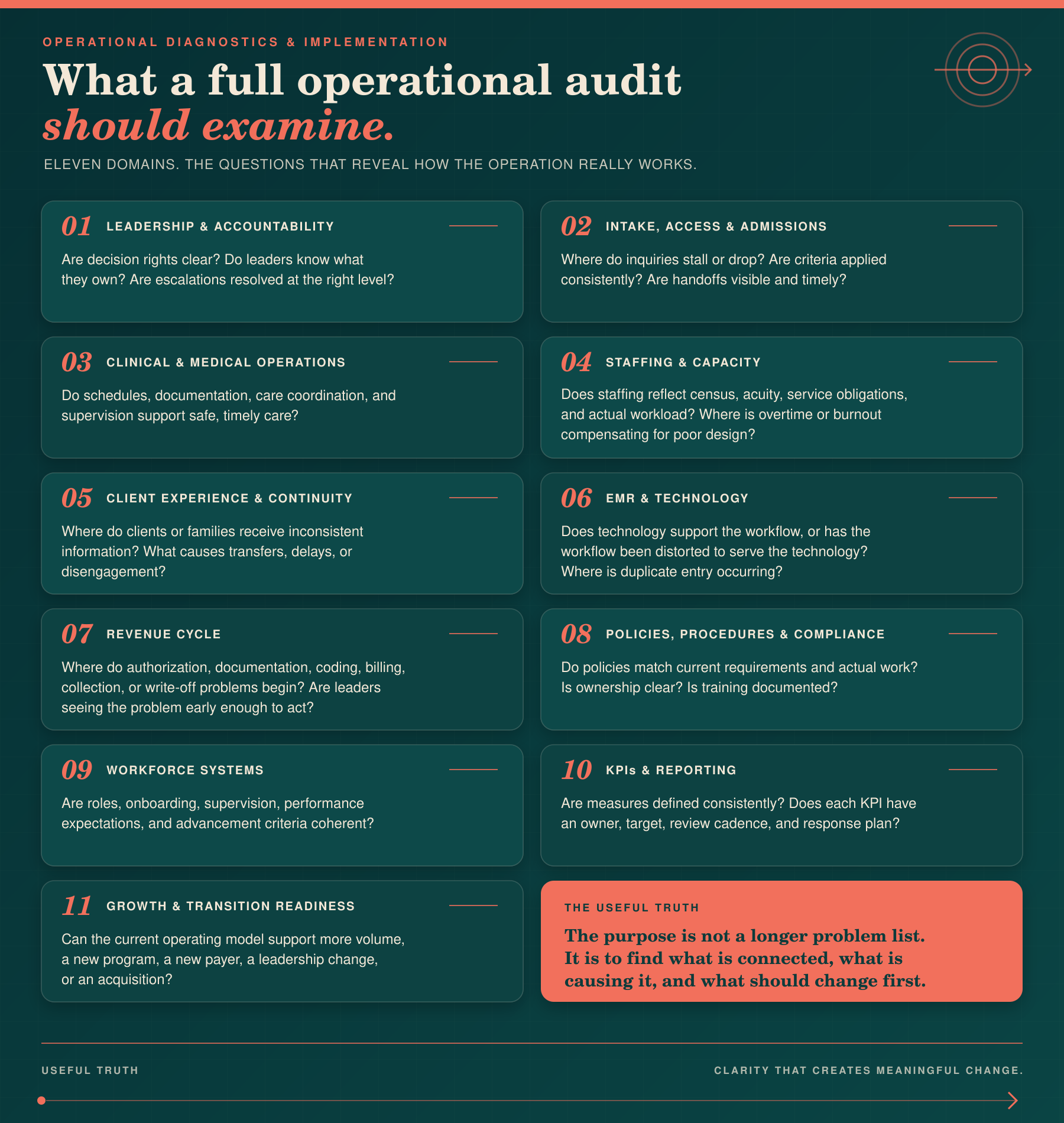
The purpose is not to produce the longest possible list of things that could be better. Most leaders already have a list. It is to determine which problems are connected, what is causing them, and what sequence of changes will produce the greatest impact.
Ten signs your organization needs an audit—not another meeting
1. The same issue appears in multiple departments
Admissions calls it a clinical delay. Clinical calls it an admissions problem. Billing calls it missing information. Leadership calls a meeting.
When a problem changes names as it moves across the organization, audit the handoff.
2. Employees ask the same question repeatedly
Repeated questions are data. They may indicate unclear policy, ineffective training, poor tool design, conflicting expectations, or missing decision authority.
Answering faster is helpful. Removing the need to ask is operational improvement.
3. A process depends on one person
If the organization loses a critical function when one employee takes PTO, you do not have a high performer problem. You have a continuity problem.
4. Leadership cannot agree on the number
If finance, operations, clinical leadership, and admissions present different versions of the same metric, the problem is not the dashboard color. Audit the definition, source, calculation, timing, and owner.
5. Policies are reviewed mainly when someone asks to see them
That is document retrieval, not governance.
6. Training is the default corrective action
Training matters when people lack knowledge or skill. It does not fix unclear roles, bad software configuration, impossible workloads, missing controls, or processes built on memory.
7. Leaders are routinely doing frontline rescue work
Occasional support is leadership. Chronic coverage is a staffing, role-design, or escalation problem wearing a very dedicated blazer.
8. “Temporary” trackers are multiplying
Every shadow spreadsheet is trying to tell you something. Listen before it develops macros.
9. Employees are afraid to raise problems
The absence of reported problems does not prove the absence of problems. It may prove that reporting them feels pointless or unsafe.
10. Everyone knows something is off, but nobody can define it
That is exactly when disciplined diagnosis is valuable. You do not need a louder opinion. You need evidence.
The Useful Truth approach: Truth, Triage, Traction
Useful Truth exists for the work organizations have learned to live with—the friction everyone feels but no one has had enough protected capacity to fully investigate and resolve.
We approach that work in three stages.
1. Truth: See the operation as it actually functions
We gather evidence across departments and levels of the organization. Depending on scope, that may include:
stakeholder interviews;
policy and procedure review;
workflow observation;
EMR and technology review;
KPI and financial analysis;
staffing and schedule analysis;
incident, complaint, denial, and turnover patterns;
role descriptions and accountability structures;
training and onboarding materials;
and the unofficial trackers that often reveal more than the official report.
We compare what leadership believes is happening, what policy says should happen, what systems allow to happen, and what employees actually do to get the work completed.
The gaps matter.
2. Triage: Name what matters most
Not every problem deserves the same urgency. We prioritize findings using practical dimensions:
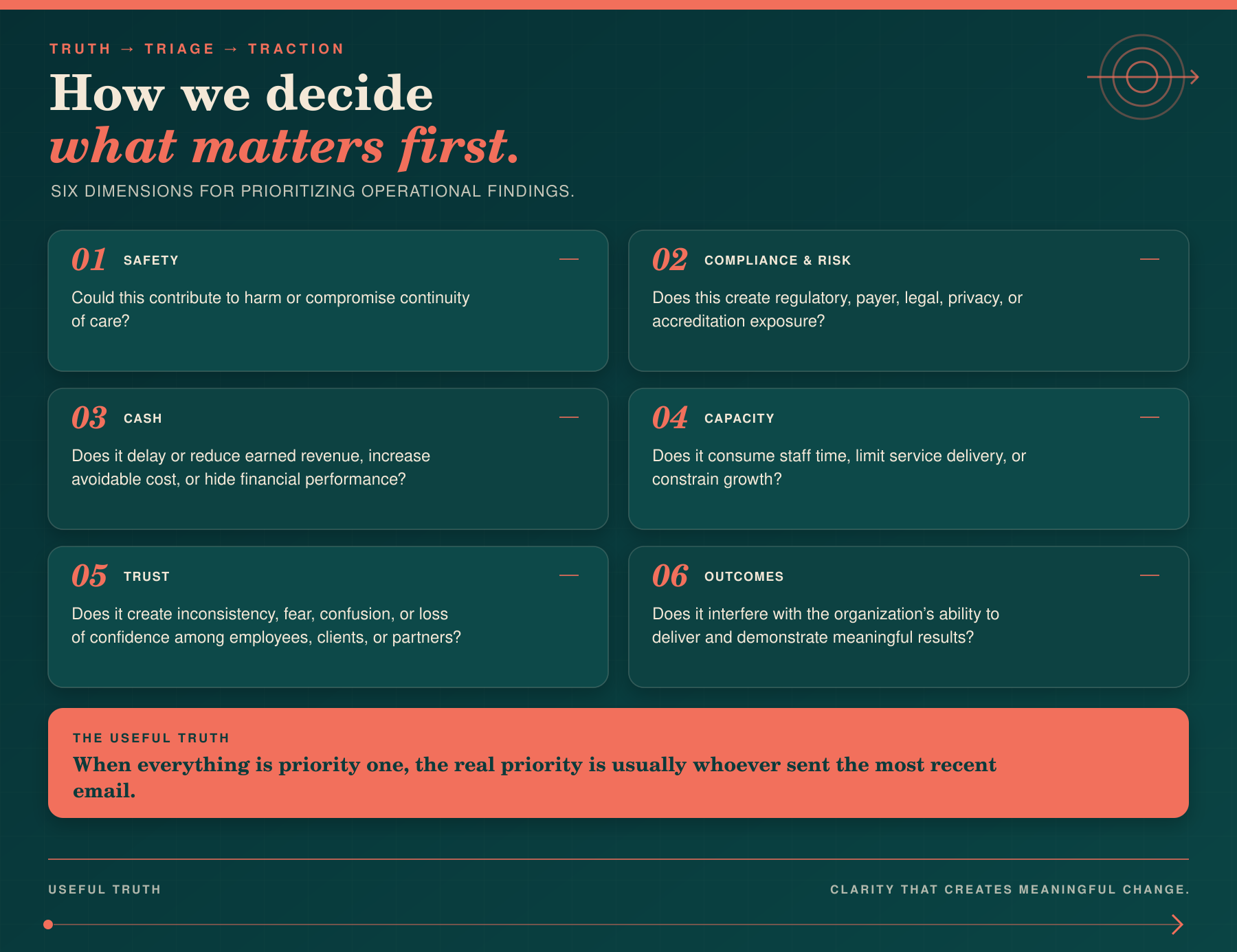
This turns “everything is important” into an ordered set of decisions.
3. Traction: Build and implement what comes next
Diagnosis without action is just a more expensive way to be aware of the problem.
The work should result in usable deliverables, which may include:
current-state and future-state workflow maps;
updated policies and procedures;
clear owners and decision rights;
role and accountability maps;
staffing, schedule, or capacity models;
executive dashboards and KPI scorecards;
intake and admissions tools;
revenue-cycle controls;
implementation plans;
meeting and reporting structures;
training materials;
and a defined method for measuring whether the change worked.
We do not believe the final product should be a beautiful deck that no one opens again.
It should reduce a burden, clarify a decision, close a risk, improve visibility, or help the organization produce.
How to update policies without creating corporate fan fiction
Policies become corporate fan fiction when they describe an elegant process that bears no emotional or logistical relationship to daily work.
To avoid that, update the policy and the operating system together.
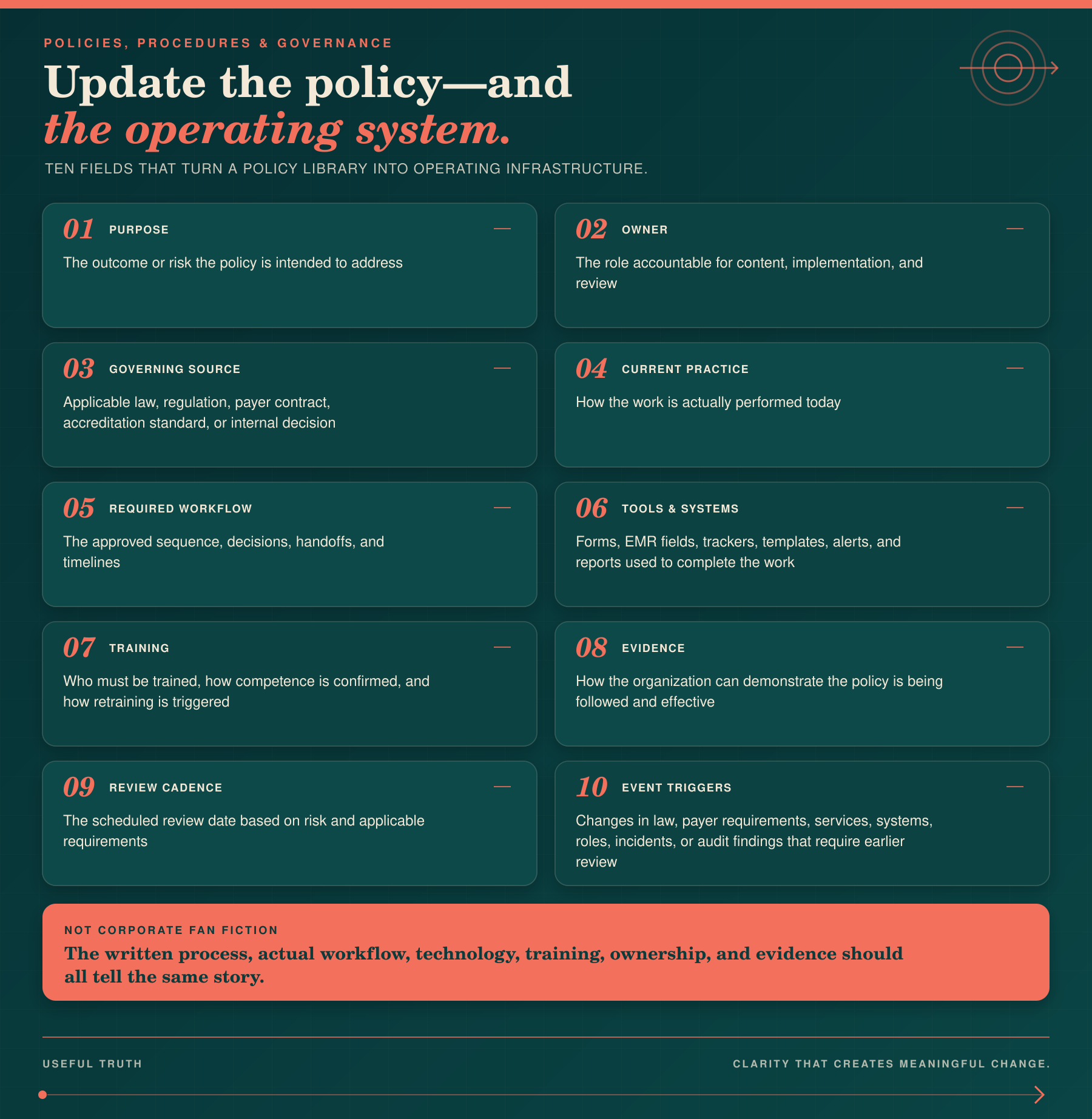
There is no responsible universal rule that every policy in every behavioral-health organization must follow the same review schedule. Requirements vary by jurisdiction, service, payer, accreditation, and subject matter.
The better approach is risk-based governance: confirm applicable requirements, assign an owner, establish a review cadence, and define the events that trigger immediate review.
High-risk, frequently used, or rapidly changing processes should not wait for someone to rediscover them during next year’s spring cleaning.
A realistic 90-day path from “we need to fix this” to forward motion
A complete transformation may take longer than 90 days. But an organization should be able to establish truth, make priorities visible, and begin implementation within a defined period.
Days 1–30: Establish the truth
Confirm scope and executive sponsor.
Gather policies, reports, contracts, tools, and organizational data.
Interview leaders and employees across the work.
Observe key workflows.
Map current-state processes and handoffs.
Identify immediate safety or compliance concerns.
Establish a baseline for selected KPIs.
Create a visible issue inventory.
Deliverable: A fact-based current-state assessment—not a collection of opinions.
Days 31–60: Name what matters
Validate findings with the people closest to the work.
Group symptoms that share a common cause.
Rank issues by safety, risk, cash, capacity, trust, and outcomes.
Define owners and decision rights.
Select quick wins and foundational changes.
Draft future-state workflows.
Build the policy-update roadmap.
Define success measures.
Deliverable: A prioritized transformation blueprint with sequencing, ownership, and measurable outcomes.
Days 61–90: Build and begin implementation
Finalize priority policies, workflows, tools, and reporting structures.
Configure or align systems where possible.
Train leaders and staff on the new process.
Start implementation working sessions.
Monitor adoption and early results.
Resolve barriers.
Establish the governance cadence for ongoing review.
Deliverable: Operating tools in use—not recommendations waiting patiently in a folder.
What leaders should measure during the work
An operational audit should improve visibility as well as performance. The exact measures will vary, but useful indicators may include:
percentage of priority policies reviewed on schedule;
number of policies that conflict with current workflow;
time from issue identification to ownership and resolution;
repeated escalations by category;
unresolved action items and average age;
after-hours work reported by leaders;
meeting hours compared with decision closure;
employee turnover by role, manager, shift, and tenure;
vacancy days, overtime, and schedule changes;
documentation completion time;
authorization delays and preventable denials;
intake response and conversion rates;
missed or delayed handoffs;
incident and complaint recurrence;
training completion and demonstrated competence;
percentage of critical tasks dependent on a single person;
dashboard timeliness and data reconciliation time;
and implementation milestones completed on schedule.
The goal is not more measurement for the spiritual enrichment of the spreadsheet.
Every KPI should clarify a decision, trigger a response, or reveal whether the change is working.
If nobody knows what action a metric should produce, it is not yet a management tool. It is a number with excellent attendance.
When an outside operational partner adds value
An outside partner is not valuable merely because they have a template and a willingness to schedule meetings.
They are valuable when internal leadership needs:
Protected capacity
The audit cannot keep losing to the emergency of the day if it is the work required to reduce future emergencies.
Cross-functional neutrality
Many problems sit between departments. An outside operator can follow the work across boundaries without defending a departmental version of the story.
Pattern recognition
Experienced operators recognize recurring failure patterns: unclear ownership, hidden queues, decision bottlenecks, measures without action, technology-workflow mismatch, and problems that appear downstream but originate much earlier.
Direct feedback
Leaders need the truth delivered clearly enough to act on it. Not cruelly. Not theatrically. Not diluted until everybody feels wonderful and nothing changes.
Directness and fairness can coexist. The standard is evidence, context, clear expectations, and a practical path forward.
Implementation ability
The organization does not need someone to identify twenty-seven problems and wish the leadership team luck.
It needs someone who can help build the workflow, policy, tool, dashboard, ownership structure, training plan, and implementation rhythm required to change the result.
Momentum without permanent dependency
The best engagement transfers ownership back to the organization. It leaves leaders with clearer systems, stronger measures, better tools, and the ability to sustain the work after the engagement ends.
That is why Useful Truth uses a dual-principal model. We investigate, interpret, prioritize, build, and implement together. The work is not thrown over a wall between strategy and operations, because that wall is usually where good recommendations go to die.
This is not about telling leaders they should have done more
Most behavioral-health leaders do not need another person pointing at their backlog.
They know the policies need attention. They know the workflow is harder than it should be. They know the team is tired. They know decisions are concentrating at the top. They know the organization cannot keep scaling by asking its most responsible people to absorb more.
The useful question is not:
Why haven’t you fixed this yet?
It is:
What would make it possible to fix this well?
That shift matters.
It replaces shame with evidence. It replaces vague concern with an operating plan. It recognizes that leaders are human beings working inside the same systems they are being asked to improve.
And it acknowledges something obvious that organizations routinely ignore: you cannot protect employee wellbeing while designing leadership roles that require constant interruption, permanent availability, and after-hours improvement work.
Work-life balance is not a personal promise a leader makes to themselves. It is partly an operational outcome.
Clear roles create it.
Reliable data support it.
Defined escalation paths protect it.
Usable technology contributes to it.
Adequate staffing makes it possible.
Managers with authority sustain it.
And disciplined review keeps the system from slowly becoming dependent on heroics again.
The audit is not extra work
It is easy to treat an operational audit as something the organization will do once the urgent work is under control.
But the urgent work may not come under control until the organization examines what keeps producing it.
The audit is not separate from performance. It is how leadership finds the conditions limiting performance.
It is not separate from retention. It is how the organization identifies the workloads, ambiguity, instability, and lack of support driving people out.
It is not separate from compliance. It is how the organization confirms that policy, practice, training, technology, and evidence agree.
It is not separate from financial health. It is how leadership finds the rework, leakage, delays, capacity constraints, and invisible labor affecting margin.
And it is not separate from work-life balance. It is how the organization stops requiring its most capable people to personally compensate for every weakness in the system.
The audit is the work that helps everything else become less unnecessarily difficult.
You do not need another reminder that something has to change.
You need enough capacity to find the truth, decide what matters, and build what comes next.
That is where forward motion begins.
Frequently asked questions
What is a behavioral-health operational audit?
A behavioral-health operational audit is a structured review of how an organization’s people, workflows, technology, policies, finances, accountability, and performance measures function together. It examines both intended processes and actual practice to identify risk, friction, capacity constraints, and root causes.
Which systems should a behavioral-health organization audit first?
Start where there is meaningful safety, compliance, financial, workforce, or client risk. Common priorities include intake and admissions, documentation, authorizations, staffing and scheduling, incident response, medication processes, client handoffs, billing, and leadership accountability. The right sequence should be based on evidence—not only on which department is currently loudest.
How often should policies and procedures be reviewed?
The required cadence depends on laws, regulations, accreditation standards, payer contracts, services, and the type of policy. Every policy should have an owner and scheduled review date, while higher-risk policies should also be reviewed when regulations, services, technology, staffing models, incidents, or audit findings change.
How long does a full operational audit take?
Scope matters. A focused executive review may take days, while a cross-functional diagnostic may take several weeks. More complex transformation work can extend over multiple months. A good engagement defines the scope, evidence requirements, stakeholders, deliverables, and implementation expectations before work begins.
How can an operational audit reduce burnout?
An audit can identify structural conditions that create chronic overload: unclear ownership, unnecessary administrative steps, duplicate work, unreliable technology, poor escalation design, staffing mismatch, and excessive decision concentration. Removing those conditions is more durable than relying only on individual coping strategies.
Why use an outside consultant if leadership already knows the business?
Internal knowledge is essential, but leaders may lack protected time, cross-functional neutrality, specialized pattern recognition, or implementation capacity. An effective outside partner combines internal expertise with structured evidence gathering and helps convert findings into operating tools and measurable change.
What is the difference between a compliance audit and an operational audit?
A compliance audit evaluates whether the organization meets defined requirements. An operational audit examines whether the entire system works effectively, including handoffs, ownership, staffing, technology, reporting, and implementation. The two overlap, but neither fully replaces the other.
Ready to stop working around it?
Useful Truth helps behavioral-health leaders examine the full operation, find the friction no one has had time to trace, and turn findings into clear priorities, working systems, and measurable progress.
We do not arrive with a generic playbook and call it transformation. We gather the evidence, name the real problem, build the deliverables, and help the organization implement what comes next.
What has your organization learned to live with?
Start there.
