
How Often Should Behavioral-Health Policies Be Reviewed?
Stop using “annually” as your entire governance strategy.
There is no responsible universal rule that every policy in every behavioral-health organization must follow the same review schedule.
Requirements vary by jurisdiction, license, service, level of care, payer, accreditation, profession, subject matter, and the specific authority governing the policy. Some rules require review on a fixed schedule. Some say “periodically.” Some require action when something changes. Some combine all three. Your organization may also choose a stricter internal standard when the risk justifies it.
That is less convenient than putting every policy into an annual calendar and calling the problem solved. It is also more accurate.
When someone says, “All policies have to be reviewed every year,” the next question is not which color to use in the tracker.
It is: According to whom?
If no one can identify the law, regulation, contract, accreditation standard, licensing rule, or governing-body decision behind the cadence, you may not have a requirement. You may have organizational folklore with a recurring Outlook invitation.
That does not mean annual review is wrong. An organization can absolutely adopt annual review as an internal control. But “we review everything annually” is not a substitute for knowing what each policy requires, what risk it governs, what should trigger an earlier review, and whether the written document matches the work people actually perform.
The useful question is not:
How often do we update policies?
It is:
What authority governs this policy, what risk does it control, and what events should force us to look at it before the calendar does?
That is policy governance.
Changing the footer from 2025 to 2026 is document cosplay.
The short answer: source first, risk second, calendar third
A defensible policy-review schedule should be built from three things:
The governing requirement. What do applicable federal, state, local, payer, accreditation, licensing, contractual, and professional sources actually require?
The operational risk. What could happen if the policy is outdated, unclear, inaccessible, or inconsistent with practice?
The change triggers. What event should require review even if the next scheduled date is months away?
The strictest applicable requirement wins. If a state rule requires annual review, your internal three-year cycle does not override it. If a payer contract requires an update within a defined period, the policy calendar needs to reflect that obligation. If an organization chooses a more frequent cadence because of incident trends, program growth, or known variation in practice, that can be a sound internal control.
The calendar should be the output of that analysis—not the starting assumption.
Why this gets complicated quickly in behavioral health
Behavioral-health organizations rarely operate under one tidy set of rules. Depending on the organization, a single workflow may be shaped by:
federal privacy and substance-use-disorder-record requirements;
state facility licensing and program rules;
local health, fire, emergency, or occupational requirements;
Medicare or Medicaid conditions;
managed-care and commercial-payer contracts;
accreditation standards;
professional-board and scope-of-practice requirements;
employment, workplace-safety, and labor rules;
the services and levels of care actually provided;
client age, acuity, population, or funding source;
the organization’s own bylaws, governing-body actions, and internal controls.
Two organizations can both call themselves behavioral-health providers and have materially different obligations. A community mental health center, a hospital-based program, a residential treatment setting, an outpatient clinic, a substance-use treatment provider, and a virtual-care organization may share some requirements while differing substantially in others.
Even within one company, the same policy may not apply identically across every site or program. A newly added service, a different payer mix, a new state, or a change in the credentials of staff performing the work can alter the governing sources and the risk.
This is why a downloaded “behavioral health policy review checklist” cannot tell you, by itself, what your organization must do. It can help you ask questions. It cannot perform legal, regulatory, contractual, and operational analysis on your behalf.
Convenient? No. Important? Very.
Three different review logics—and why one policy may need all three
Policy governance becomes clearer when leaders stop treating every review as the same event. Most review obligations fall into one or more of three categories.
1. Fixed-cadence review
The governing source states a defined frequency: annually, every two years, at another stated interval, or before a specified milestone.
This is the easiest requirement to place on a calendar. It is also the category most likely to become a checkbox exercise. The organization sees the due date, opens the document, changes nothing, records “reviewed,” and moves on.
A fixed cadence establishes the latest scheduled point for a real review. It does not prove the policy is effective, implemented, trained, or consistent with practice.
2. Periodic or risk-based review
The governing source requires periodic evaluation or ongoing assessment without assigning one universal interval to every organization or circumstance.
In this situation, the organization needs to define and justify its cadence. That decision should reflect risk, operational complexity, regulatory change, incident history, technology, staffing, and the maturity of the process.
“Periodic” should not mean “whenever someone remembers.” It should produce a documented schedule and an explanation for why that schedule is reasonable.
3. Event-triggered review
A defined event requires the organization to examine or revise the policy outside its normal cycle.
Triggers can include:
a change in law, regulation, guidance, accreditation, or payer requirements;
a new service, site, population, payer, or level of care;
a serious incident, complaint, grievance, audit finding, or corrective action;
a change in ownership, leadership, or decision authority;
an EMR implementation, vendor change, cyber event, or altered data flow;
a staffing-model, credentialing, scope, or workflow change;
evidence that employees are using workarounds;
repeated denials, documentation gaps, delayed handoffs, or safety concerns;
a policy that cannot be implemented as written.
The highest-risk policy should not wait politely for its anniversary after a serious incident.
Many policies need more than one kind of review logic. A scheduled cadence provides the baseline. Event triggers prevent the organization from remaining technically “on schedule” while the real world has moved on without it.
What the regulations actually demonstrate
Federal rules provide clear examples of why one blanket schedule is unreliable.
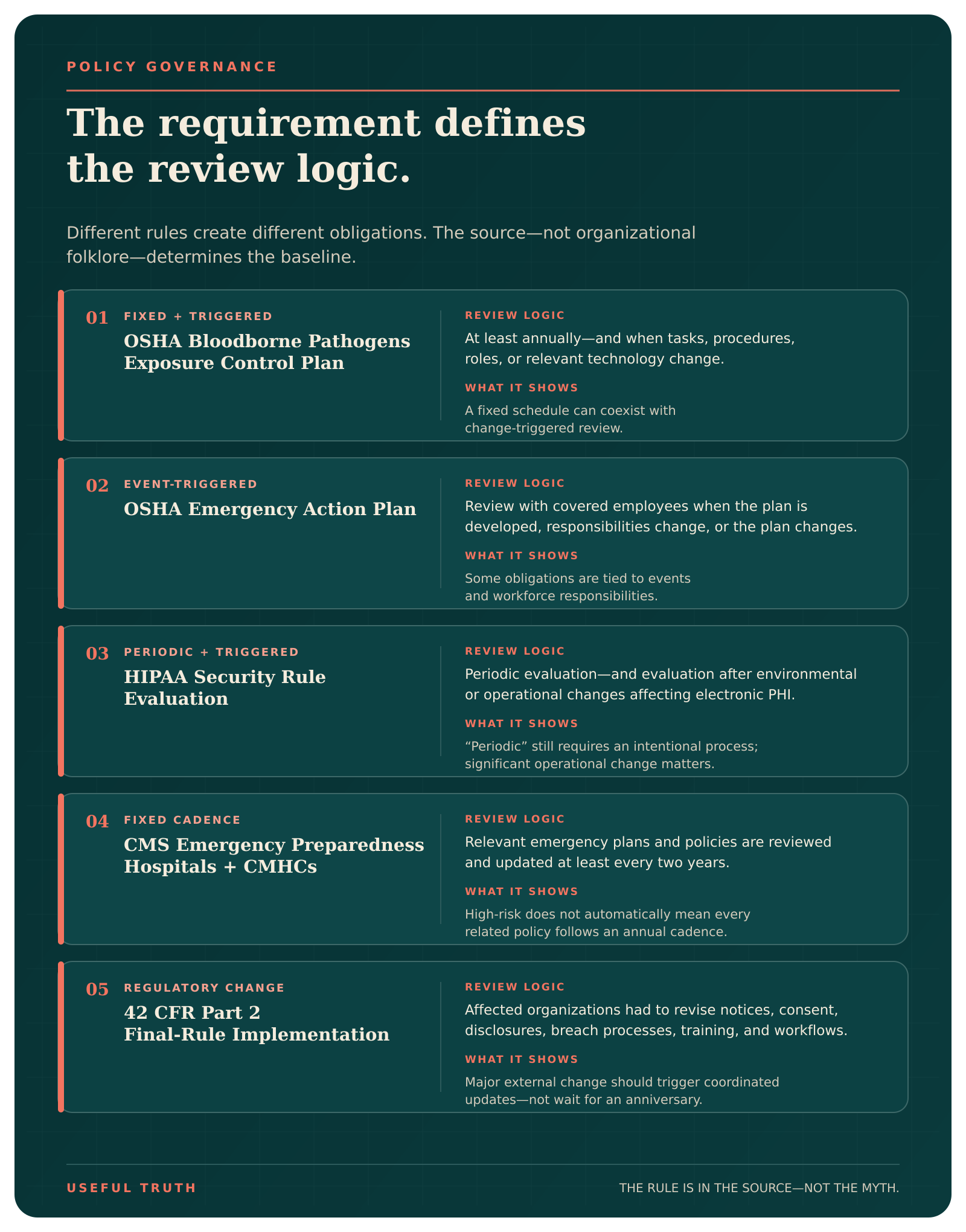
OSHA’s Bloodborne Pathogens standard requires at least annual review of the Exposure Control Plan and updates when relevant work, roles, procedures, or technology change. OSHA’s Emergency Action Plan standard, by contrast, ties review with employees to the plan’s development, changes in assigned responsibilities, and changes to the plan.
The HIPAA Security Rule requires periodic technical and nontechnical evaluation and evaluation in response to environmental or operational changes affecting the security of electronic protected health information. That is not permission to be vague. It is a requirement to establish a reasonable, documented process based on the organization’s circumstances.
The difference between programs is also visible in current CMS rules. The emergency-preparedness provisions for hospitals and community mental health centers specify two-year review-and-update cycles for relevant plans, policies, procedures, communication plans, and training programs, while setting distinct testing requirements. The details matter. The provider type matters. The exact provision matters.
And when the governing landscape changes, the review process must respond. HHS’s 42 CFR Part 2 final-rule materials describe changes affecting consent, redisclosure, breach notification, patient rights, notices, and enforcement. An organization subject to Part 2 could not responsibly wait for an unrelated policy anniversary to assess those changes.
These are examples, not an exhaustive list of your obligations. They prove the central point: the rule is in the source, not in the myth.
Why “review everything annually” can still fail
An annual standard may feel conservative. In some organizations, it is a reasonable internal decision. But without stronger governance, it can create a false sense of control.
It treats every policy as equally risky
A policy governing emergency response, medication, privacy, client rights, incident reporting, or clinical safety does not carry the same consequences as a stable administrative policy with limited operational impact.
Equal calendar space is not the same as intelligent attention.
It ignores midyear change
The policy may have been reviewed in January. In March, the organization changes its EMR. In May, a payer changes documentation expectations. In July, a serious incident reveals unclear escalation. In September, the organization adds a new service.
If the governance process says, “Great, we will look again next January,” the calendar is protecting itself—not the organization.
It creates one enormous administrative season
When every policy is due in the same month, leaders face hundreds of documents while still running the business. The predictable result is rushed review, copied approvals, delayed training, and a great deal of clicking “no changes required.”
The tracker turns green. Practice remains exactly as confusing as it was.
It rewards dates instead of evidence
A document can carry a current approval date while employees follow a different workflow, use an old form, rely on an undocumented workaround, or receive no training at all.
A policy date is not proof the policy works.
It obscures the governing source
If the organization cannot show why the policy exists, who owns it, which authority applies, and what evidence demonstrates implementation, the annual cadence is doing too much reputational work.
It wastes the scarcest resource: attention
Behavioral-health leaders do not have unlimited time. A system that demands equal effort on every policy can consume the capacity needed to repair the policies creating actual safety, compliance, workforce, financial, or continuity risk.
The answer is not fewer reviews for the sake of doing less. It is the right reviews, at the right time, for the right reason.
Build a policy source matrix before you build the calendar
Before assigning review dates, inventory the policy library and document what governs each item.
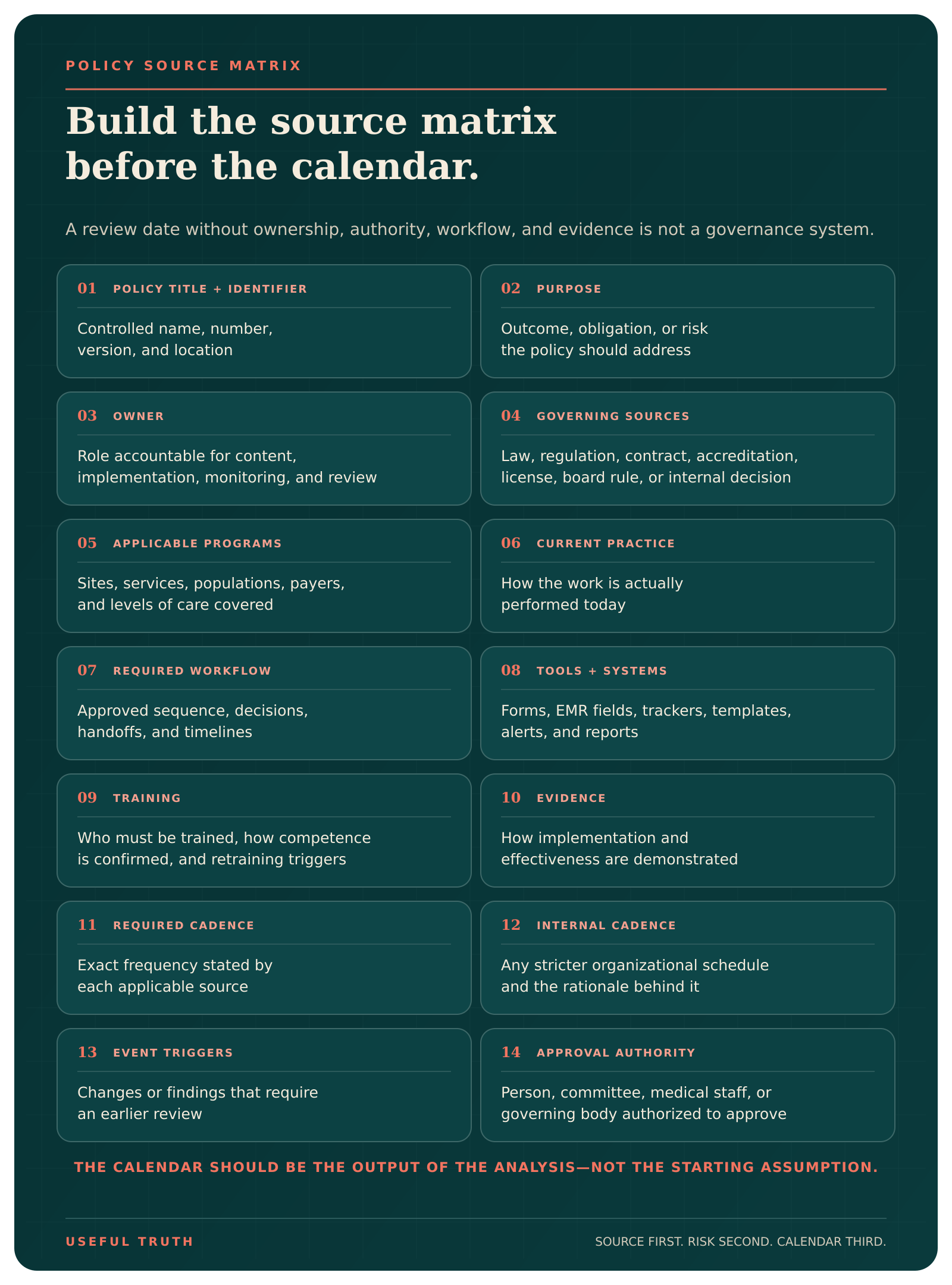
This is where many organizations discover that the real problem is not an overdue date. It is that no one knows who owns the policy, the source is missing, three programs are using different forms, or the document describes a workflow that ended two software systems ago.
That discovery is not a failure. It is useful truth.
Use risk tiers carefully—not as invented law
Once all external requirements are verified, an organization can use risk tiers to allocate review attention. The example below is an internal governance model, not a universal legal schedule.
External requirements always override the sample intervals.
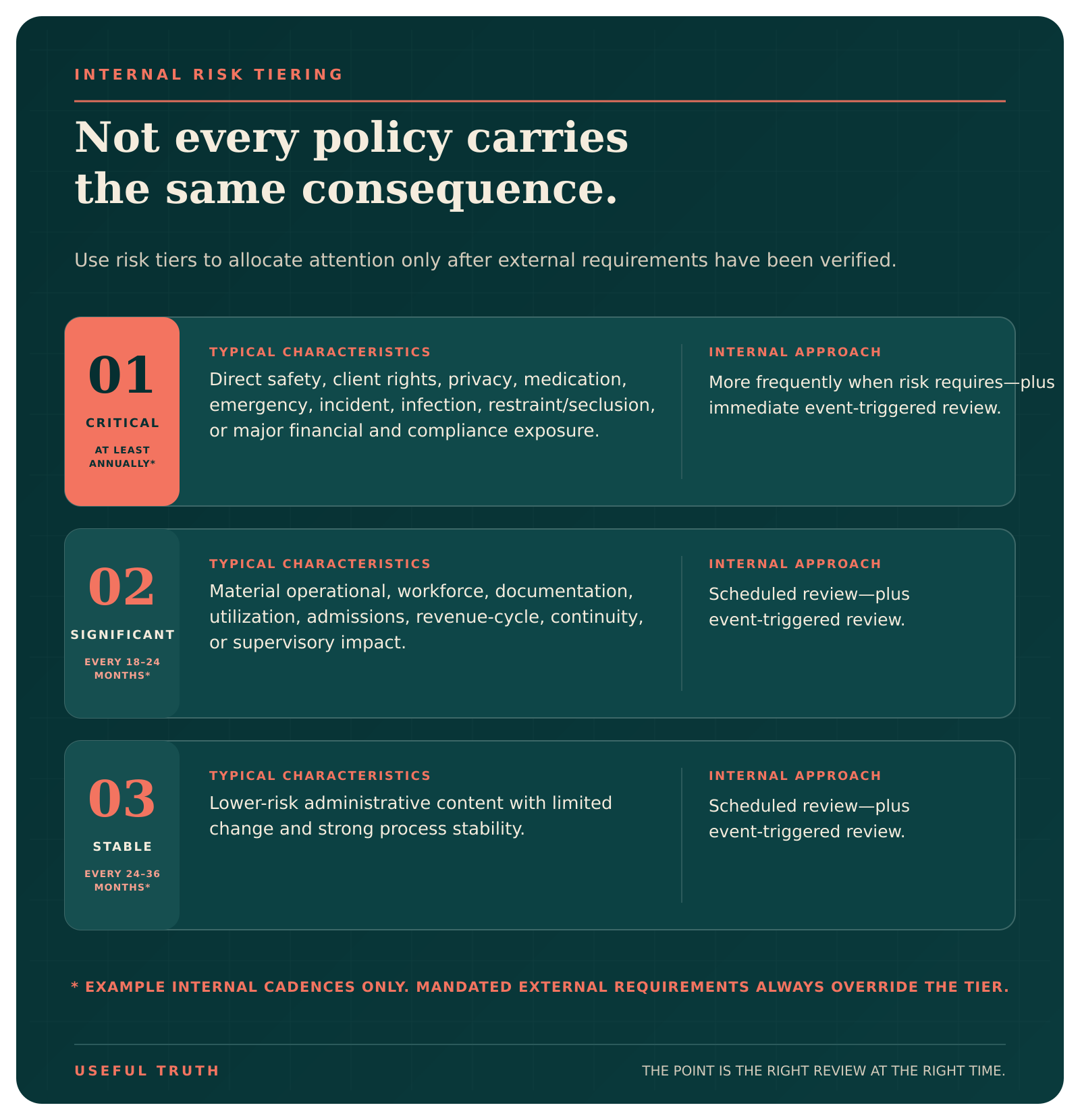
A risk score can consider:
potential for client or employee harm;
legal, regulatory, payer, privacy, or accreditation exposure;
frequency and complexity of the workflow;
number of departments, programs, or sites affected;
dependence on technology or external vendors;
turnover and training burden;
incident, complaint, denial, audit, or variance history;
pace of change in the governing requirements;
financial and capacity impact;
the time since the policy was validated against actual practice.
The point is not to create an elegant scoring model that no one uses. The point is to make the prioritization explicit, repeatable, and defensible.
Create an event-trigger register
A calendar alone cannot govern a changing organization. Each policy family should have defined review triggers and a way to route those triggers to the owner.
Common triggers include:
Regulatory and contractual change
new or amended federal, state, or local requirements;
payer manual, authorization, documentation, or billing changes;
accreditation or certification updates;
professional-board or scope-of-practice changes;
new contractual obligations or corrective-action requirements.
Organizational change
acquisition, ownership, governance, or leadership transition;
new site, service, level of care, population, or jurisdiction;
redesigned staffing model or changed decision rights;
new vendor, outsourced function, or material contract;
expansion, closure, consolidation, or relocation.
Workflow and technology change
EMR, CRM, billing, scheduling, payroll, or communication-system changes;
new forms, templates, automations, reports, or access controls;
revised handoffs, approval paths, or documentation responsibilities;
evidence that the policy and the real workflow no longer match.
Performance and risk signals
serious incidents, near misses, complaints, grievances, or privacy events;
repeat audit findings or corrective actions;
denials, write-offs, delayed authorizations, or documentation failure;
staff injuries, turnover, overtime, burnout, or vacancy patterns;
inconsistent implementation across leaders, shifts, sites, or programs;
missed KPIs, unexplained variance, or failure to achieve the intended outcome.
Human signals
employees cannot locate the policy;
different leaders give different answers;
staff say, “That is not how we actually do it”;
the policy requires a role that no longer exists;
frontline teams have developed a workaround because the approved process is unusable.
These are not side comments to collect at the next retreat. They are evidence that governance and operations have separated.
A real policy review is an operational review
Policy review should not begin and end in the document.
A meaningful process asks:
Is the governing source still current? Verify the actual authority, not a copied citation from an old template.
Does the policy apply to the organization as it operates now? Confirm services, sites, populations, payers, licenses, and roles.
Does the policy describe the real workflow? Observe the work and speak with the people performing it.
Is the required workflow safe, compliant, and executable? A policy that cannot be followed is not a control.
Do the tools support the policy? Check EMR fields, forms, templates, alerts, reports, and access permissions.
Is ownership clear? Define who makes decisions, who completes the work, who monitors it, and who resolves exceptions.
Has training occurred? Confirm that the right people received the right training and can demonstrate competence.
What evidence proves implementation? Identify the audit, KPI, report, observation, test, or record that shows the policy works.
What changed? Record substantive revisions, not just the new date.
What happens next? Assign implementation tasks, communication, retraining, monitoring, and the next scheduled or trigger-based review.
If a review produces an updated PDF but leaves the workflow, form, training, and measurement unchanged, the organization may have improved the document without improving the operation.
Who should own policy governance?
“Compliance owns all the policies” is usually an organizational warning sign.
Compliance and quality may coordinate the system, maintain the inventory, monitor requirements, and challenge weak controls. They cannot credibly own every clinical, operational, HR, privacy, revenue-cycle, technology, and safety process.
Policy governance requires distributed subject-matter ownership with centralized control.
Governing body or executive leadership
establishes the governance standard;
approves policies within its authority;
ensures adequate resources and accountability;
reviews material risk, overdue items, and implementation failures.
Compliance and quality
maintain the policy framework, inventory, version controls, and source matrix;
monitor regulatory and accreditation change;
facilitate risk assessment and audit;
escalate overdue, unsupported, or ineffective policies.
Operational and clinical owners
validate the actual workflow;
draft or revise the content;
coordinate implementation;
monitor outcomes and resolve variance.
Privacy, security, HR, finance, revenue cycle, and other specialists
evaluate requirements and downstream effects within their domains;
confirm that systems, training, controls, and reporting align.
Legal counsel, when appropriate
interprets legal requirements and risk where the organization needs legal advice;
reviews high-risk, disputed, or jurisdiction-specific questions.
A good governance process does not ask one department to become magically expert in everything. It creates a reliable route for the right expertise to reach the right decision.
Measure whether governance works
Useful policy metrics should show more than how many documents were approved.
Consider tracking:
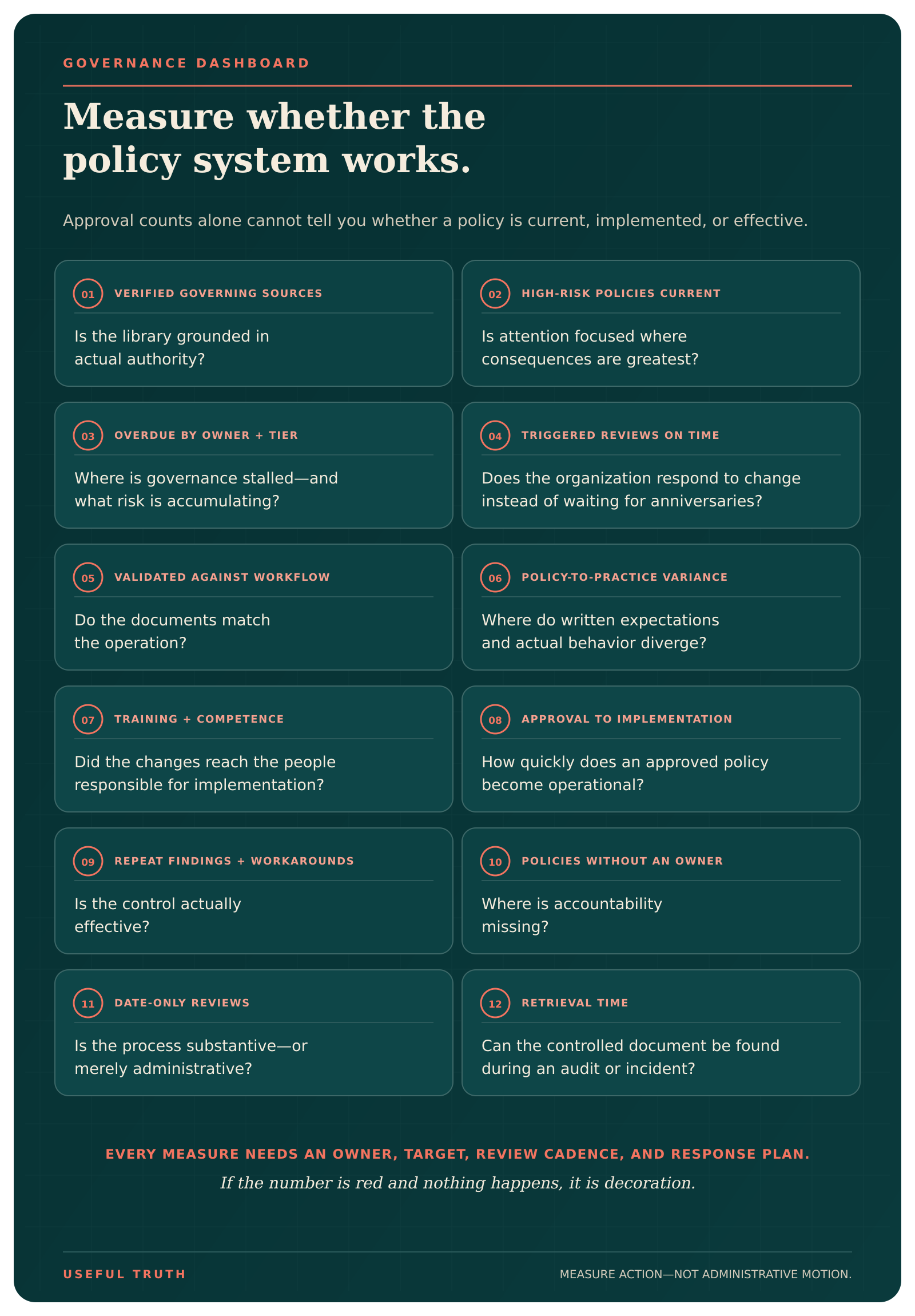
Do not turn the dashboard into another ceremonial object. Every measure should have an owner, a target, a review cadence, and a response plan.
If the number is red and nothing happens, it is decoration.
A 90-day implementation plan
You do not need to repair the entire policy library in one heroic weekend. You need a disciplined sequence.
Days 1–30: See the truth
inventory all policies, procedures, plans, protocols, forms, and related tools;
identify duplicates, expired versions, missing owners, and uncontrolled copies;
map applicable programs, sites, payers, and jurisdictions;
identify governing sources and unresolved legal or regulatory questions;
flag critical safety, privacy, rights, emergency, medication, incident, and compliance content;
gather incident, grievance, audit, denial, turnover, and workflow-variance data;
interview the people who actually perform the work.
Deliverable: a controlled inventory, preliminary source matrix, and risk map.
Days 31–60: Name what matters
assign owners and approval authorities;
confirm mandatory cadences and event triggers;
apply internal risk tiers where requirements allow;
prioritize policy-practice gaps;
separate document problems from workflow, system, role, or training problems;
create a realistic review calendar based on capacity and risk;
define escalation for overdue or high-risk items.
Deliverable: a prioritized remediation plan and governance calendar.
Days 61–90: Build what works
revise the highest-risk policies and connected procedures;
update forms, EMR workflows, tools, and accountability structures;
complete cross-functional and legal review where needed;
approve, version, publish, archive, communicate, and train;
validate implementation through observation, testing, record review, or KPI monitoring;
establish dashboards and a recurring governance meeting.
Deliverable: implemented controls—not merely revised documents.
Then keep going. Policy governance is not a cleanup project with a permanent finish line. It is operating infrastructure.
What a strong policy-governance system produces
At the end of the work, leadership should be able to answer:
Why does this policy exist?
What source governs it?
Where does it apply?
Who owns it?
Who approves it?
How often must it be reviewed?
Why did we choose any stricter internal cadence?
What events require an earlier review?
How is the work actually performed?
What tools, forms, and systems support it?
Who has been trained?
What evidence proves implementation?
What measure tells us whether it is effective?
If the answer to most of those questions is “I think compliance has a spreadsheet,” the organization does not have policy governance yet.
It has a spreadsheet with an unreasonable amount of emotional responsibility.
Where Useful Truth helps
Most leaders know parts of the policy system are outdated. They also have clients to protect, staff to support, revenue to collect, incidents to manage, vacancies to cover, and approximately 10,000 urgent things competing for the same hour.
Useful Truth helps behavioral-health organizations turn the policy library into a functioning operating system.
Depending on the need, that can include:
complete policy and procedure inventory;
governing-source and applicability matrix;
risk tiering and review-cadence design;
policy-to-practice workflow validation;
gap analysis and prioritized remediation roadmap;
ownership and approval structure;
policy, procedure, form, and tool development;
EMR and workflow alignment;
training and implementation planning;
KPI dashboards and governance reporting;
event-trigger and regulatory-change processes;
executive facilitation when teams disagree about what is actually happening.
We do not hand you a beautiful policy deck that no one opens again. We identify what governs the work, find where the document and the operation have separated, and produce the tools your team can actually use.
Because a policy library should be operating infrastructure—not a museum of decisions no one remembers making.
Frequently asked questions
Does every behavioral-health policy have to be reviewed annually?
No single universal rule establishes an annual review cadence for every policy in every behavioral-health organization. Requirements depend on the applicable law, regulation, license, payer contract, accreditation standard, service, jurisdiction, and subject. Some policies may require annual review; others may have different or periodic requirements. Organizations may also adopt a stricter annual standard internally.
Is it acceptable to review every policy annually anyway?
It can be an internal governance choice, provided it does not conflict with or fall short of an applicable requirement. But annual review should not replace event-triggered review, source verification, operational validation, training, implementation, or monitoring.
Who determines the review cadence?
First, applicable external authorities determine any mandatory cadence. Then the organization’s authorized leadership or governing body can adopt stricter internal standards based on risk. Compliance, quality, operational, clinical, privacy, security, HR, and legal expertise may all be needed.
Which policies should be reviewed first?
Begin with policies tied to client and employee safety, rights, privacy, emergency response, medication, incidents, infection control, clinical risk, regulatory exposure, and known failures. Also prioritize policies affected by recent changes, findings, complaints, denials, workarounds, or new services.
What should trigger an immediate policy review?
Material changes in law, payer requirements, accreditation, services, ownership, leadership, staffing, technology, workflow, or scope may trigger review. Serious incidents, audit findings, complaints, repeat errors, denials, safety concerns, and evidence that practice differs from policy should also prompt assessment.
How do we prove a policy was genuinely reviewed?
Maintain evidence of the governing sources checked, reviewers involved, workflow validation completed, changes considered, approval obtained, version history, implementation tasks, communication and training, and follow-up monitoring. A new date alone is weak evidence.
Do we need an attorney to set the schedule?
Not for every administrative decision. However, qualified legal counsel should address disputed, ambiguous, high-risk, or jurisdiction-specific legal questions. Operational consultants, compliance professionals, accrediting resources, payer representatives, and agency guidance can support the process but should not be treated as substitutes for legal advice.
What is the difference between policy review and an operational audit?
Policy review examines whether a controlled document remains accurate, applicable, compliant, implemented, and effective. An operational audit looks more broadly at people, workflow, technology, leadership, capacity, financial performance, and outcomes. The two should inform each other because many “policy problems” are actually ownership, workflow, system, or implementation problems.
The useful truth
The annual-review myth survives because it is simple.
Compliance, unfortunately, has declined to become simple for our convenience.
Responsible policy governance does not force every document into the same schedule and hope that consistency will substitute for judgment. It verifies the source. It follows the risk. It responds to change. It checks whether the written policy matches the work. And it produces evidence that the control is functioning.
Source first. Risk second. Calendar third.
If your organization knows the policy library needs attention but does not have the time or capacity to determine what is outdated, what is required, and what matters most, that is exactly the kind of problem Useful Truth was built to solve.
